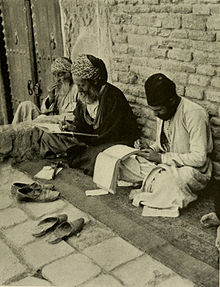
Language Blogs Round-Up

Canadian science fiction reviewer James Nicoll said, “The problem with defending the purity of the English language is that English is about as pure as a cribhouse whore. We don’t just borrow words; on occasion, English has pursued other languages down alleyways to beat them unconscious and rifle their pockets for new vocabulary.”

Among the many reasons I love writing is the way it allows me to explore the wonders of the English language. Here are some of the posts I’ve written on this blog that directly concern how language can enhance or destroy writing.


Commonly Confused Words

  • Mind Your A’s and The’s
    • Pay attention to what you mean to be saying when you use a or the to designate something. In general, a indicates one of many possibles while the is restrictive to one specific person, place, event, item, etc.
  • The Limits of Spellcheck
    • Spellcheck programs will not generally recognize incorrect word usage if those words are spelled correctly.  Eliminating word confusion is up to you.  This is a writing prompt to practice correct usage of some of the most commonly confused words.
  • Choosing the Pronoun for Your Purpose
    • Know the rules of grammar so you can use them or abuse them to suit your purposes!  Pronouns can be subject (I/ you/ he/ she/ it), object (me/ you/ him/ her/ it), or show possession (my/ your/ his/ her/ its).
  • I’m Not Alone Here
    • The right word vs. the almost right word is the difference between sounding articulate vs. sounding pretentious—and uneducated. Bottom line: only use words you know for sure.


Cutting the Flab from Writing

  • Practicing Similes
    • Similes add color and tone to your writing. Don’t overdo. And avoid the worn and weary ones–such as hard as a rock, soft as a cotton ball, etc.
  • Cut the Flab
    • Flabby writing is writing that includes unnecessary words or phrases. I’ll talk about four common types of flab: stating something for which there is no alternative, saying the same thing twice, naming characters or relationships already known, and stating an action that is inherent in another action.
  • Writing that Irritates Readers
    • Here are a few examples of the worst habits of flabby writing
      • Going off-key on tone: This is when something just doesn’t feel right, such period inappropriate slang.
      • Close but no cigar: Using the wrong word, such that for who or imply for infer
      • Redundant verbiage: Using extra words to modify ideas that need no modification
  • Let Your Punctuation Speak for You
    • This is a variation on two themes: show, don’t tell and trust your reader. The point is that the reader will get your meaning without both the punctuation and the accompanying explanation.
  • Bitch Blog
    • A USA Today best-selling author who shall remain nameless has written a series of books that are filled with egregious examples of the flabbiest of flabby writing.
  • Clichés—True But Tired!
    • This is an extensive but not exhaustive list of some of the worst, most over-used, most obnoxious cliches.


Close Attention to Detail

  • Getting Up Close With Nature
    • Be specific.   Perhaps the foremost is be specific. Don’t say “a tree,” say, “a willow oak.”
  • Be Specific
    • To avoid wimpy writing, attend to the details. I already talked about avoiding weasel words like some, few, or many in favor of specific numbers or quantities. The same applies to vague nouns: flower, tree, shrub, car. Tell the reader it’s a rose, an elm, an English boxwood, a Ford.
  • The Five Ws
    • You have a vague recollection that sometime in the past–perhaps in high school–someone told you that when writing a newspaper article, you need to cover all five Ws: Who, What, When, Where, and Why. That is good advice in general, including fiction–and even memoir.
  • Observe More Closely
    • Nature writing can be add depth, precision, and detailed setting in any genre of writing.  This post provides examples of various genres in which nature writing has been used effectively and some tools to develop your own nature writing skills.


Careful Use of Modifiers

  • Choose Modifiers Carefully
    • The same advice on adverbs applies to other modifiers. Make sure they add something to the story. “Very” should be on your hit list, along with all sorts of weasel words and phrases, such as a little, a lot, big, small, somewhat, sort of. . . You get the idea.
  • Use Strong Verbs
    • How do you recognize a weak verb? Look for adverbs! When you find a sentence in which you give the reader a tag telling how an action was performed, chances are you have a lazy verb–one you didn’t really think about as you plugged it in.


Period Appropriate Writing for Genre or Setting

  • A Little Dialect Goes a Long Way
    • A touch of dialect helps establish voice, and may lend authenticity to the writing. But for the beginning writer, knowing how much is enough is often difficult. A story studded with apostrophes and phonetically spelled words draws attention to the writing, detracting from the story.
  • Kids Say the Darndest Things!
    • Children’s language development is a very interesting study for psychologists and linguists.  It is important that child characters behave and speak appropriately for their age to be believable.  However, every child is different; outliers on either end of the development scale can add interest but must have believable groundwork laid.
  • Use Slang and Clichés Effectively
    • In my opinion, the best use of slang is setting the time of the story.  Used effectively, it lends authenticity to dialogue. But if writing about any time other than the present, tread carefully. Inappropriate slang can ruin the tone and undermine the credibility of the entire story.
  • Horror Week is Here
    • The blog Now Novel provides excellent advice for techniques that are most effective in various genres, including horror.
  • Historical Fiction
    • Writing historical fiction requires extensive knowledge of the period in which the story takes place, including the slang and speech styles common at the time.  This blog provides several resources and suggestions for writing effectively about the chosen time period.


History of the English Language

  • Shades of Professor Henry Higgins!
    • The development of the English language into the distinct dialects used in various English-speaking nations around the world can be mined for examples of characterizations by word choice and syntax.  It is also a fascinating story on its own.
  • Loving Language
    • Our everyday language is full of phrases we use without thinking of how they came to mean what they mean. Delve into the origins of words and phrases. You will find amusement as well as information!
  • Is the Quality of Writing Declining? And if So, Why?
    • Research suggests that writing ability in American students has fallen, combined with (or caused by) a decline in concrete guidelines and principles for those teaching writing.  Reading for pleasure has also been declining over the last few decades.
  • Emojis: Yea or Nay?
    • I approached this blog with the opinion that relying on emoticons—i.e., emojis—is dulling out ability to express emotions with rich language and subtlety. Some have asserted that the emoji is the fastest-growing language in history—for good or ill.  How do you feel about emojis?


Editing or Proofreading Yourself

  • Talk to Yourself
    • Longer, more complex sentences are much smoother and more graceful on the page than in the mouth. If you want dialogue to sound real, listen to it–literally. Reading silently, your brain fills in and evens out. So, when you feel your work is in pretty good shape, read it aloud.
  • Curb Your Enthusiasm
    • Be selective–and restrained–in using exclamation points and italics. More than one of these every few pages probably means you are using these visual markers to shore up weak word choices.
  • When, While, Then
    • Search your work for these words and closely examine each usage. They often contribute to run-on sentences that would be stronger and clearer if they were revised into two or more shorter sentences.  Be especially wary if one sentence contains two or all three of these words.
  • Skip The First Word That Comes To Mind
    • When you are trying to get something on the page, moving quickly and just getting it done is the way to go. But know that isn’t the finished product. Go over your draft and mark commonplace words–particularly forms of the to-be verbs and vague adjectives. Consider at least three alternatives–and consider the value of the least expected.
  • Didn’t Get it Right the First Time?
    • Noah Lukeman is my favorite guru on self-editing. He’s highly readable, clear, and interesting. But if you need some quick-and-dirty guidelines right now, here are a baker’s dozen.
  • Attributing Words to Characters
    • We are often in need of indicating who is speaking and/or how. In doing so, beware of distracting—or irritating—your reader. Here are my personal guidelines for making attributions.
  • Treasure Trash
    • I’d bet nearly everyone who’s written a book has edited out not just words, but paragraphs, scenes, or entire chapters. Don’t delete chunks of text.  Save them in a separate file.
      • It makes it easier to cut the flab (anything that doesn’t fit this piece of work), sometimes known as killing your darlings.
      • Those chunks may come in handy in the future, either as additions to as sparks for something totally new.
  • Verbal Tics— Use and Abuse
    • Everyone has verbal habits, including tics. As a writer, be aware of your favorite words and use them sparingly! In the right context, they can convey education level, social class, and even age.
  • Across Years and Miles
    • This post includes a list of common errors in grammar and syntax, each humorously illustrated by use of the error it advises against.
  • When Less is More
    • “Very” is a word we all should do searches for in our documents—finding and replacing with something stronger. These are not exhaustive lists. The point is examine your writing to make sure every word is necessary, and then trust your words to mean what they mean!


Structural Tips for Writing

  • Beware Long Descriptions
    • Whether describing a person, a place, a thing, or a process, long detailed descriptions–unrelieved by action–are likely to be deadly. If very well done, readers will get so involved in the description, in visualizing exactly what the author had in mind, that they are taken out of the story itself. If not well done, those passages are likely to be skipped altogether.
  • Writing Tip for Avoiding Redundancy
    • Redundancy takes many forms and it makes for clunky, dull writing.  This post demonstrates some common examples of punctuation, description, and incorrect word use that often lead to redundancy and can be removed.
  • Matching Tone & Structure
    • Sentence length and structure should be used to echo the tone of the action: short, simple sentences for quick or abrupt action; longer, more complex sentences for slower scenes or poetic description.
  • The Distancing Effect of I
    • Whenever the narrative Point of View is first person, the story is, by definition, about the narrator. In this case, as in any writing, your goal is to draw the reader in. Therefore, if you choose to use “I” as the narrator, you need to present a quest that many readers would care about.
  • Use and Abuse of Passive Voice
    • If you want your words to seem impersonal, indirect, and noncommittal, passive is the choice.  Bryan A. Garner identifies six ways in which the passive voice is acceptable or even preferred.
  • Dialogue Dos and Don’ts
    • Dialogue is essential to every genre of fiction; however, sometimes it’s hard to get it just right. Bad dialogue can trip up a reader, and sometimes doing so will make them want to stop reading altogether. That being said, here are a few dialogue dos and don’ts that can help you with writing speech.
  • How Do You Read Now?
    • Research (and book sales) suggest that modern readers are more interested in story than in style. Many writers appear to focus more on technique and self-awareness, according to an article by Adam Kirsch.  Consider whether you think plot or style is more important.


Words and Dictionaries

  • Homonyms
    • This post provides a writing exercise to familiarize writers with the pitfalls and opportunities of words that sound the same but are spelled differently and mean different thing.
  • WHY CONSIDER THE F WORD?
    • Here is a discussion of when to use profanity directly and when to use a euphemism instead, with a brief description of the history and current usage of this particular bit of profanity.
  • Conglomeration
    • This is writing prompt derived from one of the author’s favorite words.  Conglomeration is another of those words I love because it sounds so much itself. Technically, it has to do with a spherical shape, and disparate things brought together in one. But its more common usage, of miscellaneous or even random things brought together (no particular shape) make it a very useful word.
  • Use Uncomfortable Words
    • Uncomfortable words are perfectly correct and not obscene. Nevertheless, they often surprise–or even shock–the reader. Sometimes they make the reader uncomfortable.
  • Beware Beautiful Words
    • Writers are readers, by and large, and also word collectors. We tend to fall in love with words. Some writers make a career of writing about words as well as with them. This is a quick list of some interesting words that can add flair and tone to your writing.
  • This Just In!
    • As many of you know, I collect dictionaries. This facsimile edition of the first American Dictionary of the English Language arrived yesterday and I’ve been enjoying it for hours.
  • What Would You Call a Bunch of Bluebirds?
    • Here are some of the most interesting collective nouns for species of birds, with illustrations from the author’s garden.
  • Color Your Writing
    • With so many specifically named colors in the English language, it is important to be specific about which one you mean.  There is a close tie between color and mental or psychological state, which can have a great influence on readers’ perception of a scene, a character, or a work as a whole.
  • Word Wealth
    • There are dictionaries available for nearly every specialty, dialect, and profession.  They can provide a wealth of detail and precision to any setting in any genre.


Examples of Other Authors’ Successful Habits

  • What Writers Can Learn From Diana Gabaldon
    • There are many things this author gets absolutely correct, but this post will focus on vivid language. We have all heard or read that we should use fresh, vivid language and strong verbs.  Here are some of my favorite examples of Diana Gabaldon’s sensory and emotional writing.
  • What Writers Can Learn from Political Campaigns
    • Careful word choice, audience appeal, actions or words open to (mis)interpretation, complementary characters, innuendo, denial, and characters revealed by reflected traits of associates are all extremely important in any political campaign.  The 2016 election was full of examples of all of these, which are also used in good writing.
  • Communicating Without Words: Campaign Lessons
    • You’re a writer—so for purposes of this blog, communicating without words means without dialogue. And there are many reasons you want to be able to do this. The 2016 presidential campaign offers several educational examples.
  • The Good and the Bad
    • The 2018 June 18th issue of The New Yorker includes an article titled “High Crimes” by Anthony Lane, a review of Bill Clinton and James Patterson’s book The President is Missing.  The article highlights some nuggets of really egregious writing, from mixed metaphors to clichés, offered here for your  amusement.
  • Writers on Writing
    • This post offers writing tips and advice from a few successful authors, including Stephen King and Virginia Woolf.
  • Bradley Harper: The Man Behind the Writer
    • An interview with Bradley Harper reveals some of his most effective writing habits and techniques.
  • Going Long
    • Thanks to Rosemary Shomaker, we have a chance to vicariously experience the struggle of a writer stretching into a new challenge.  She discusses her methods of creating a tight, closely-written short story.
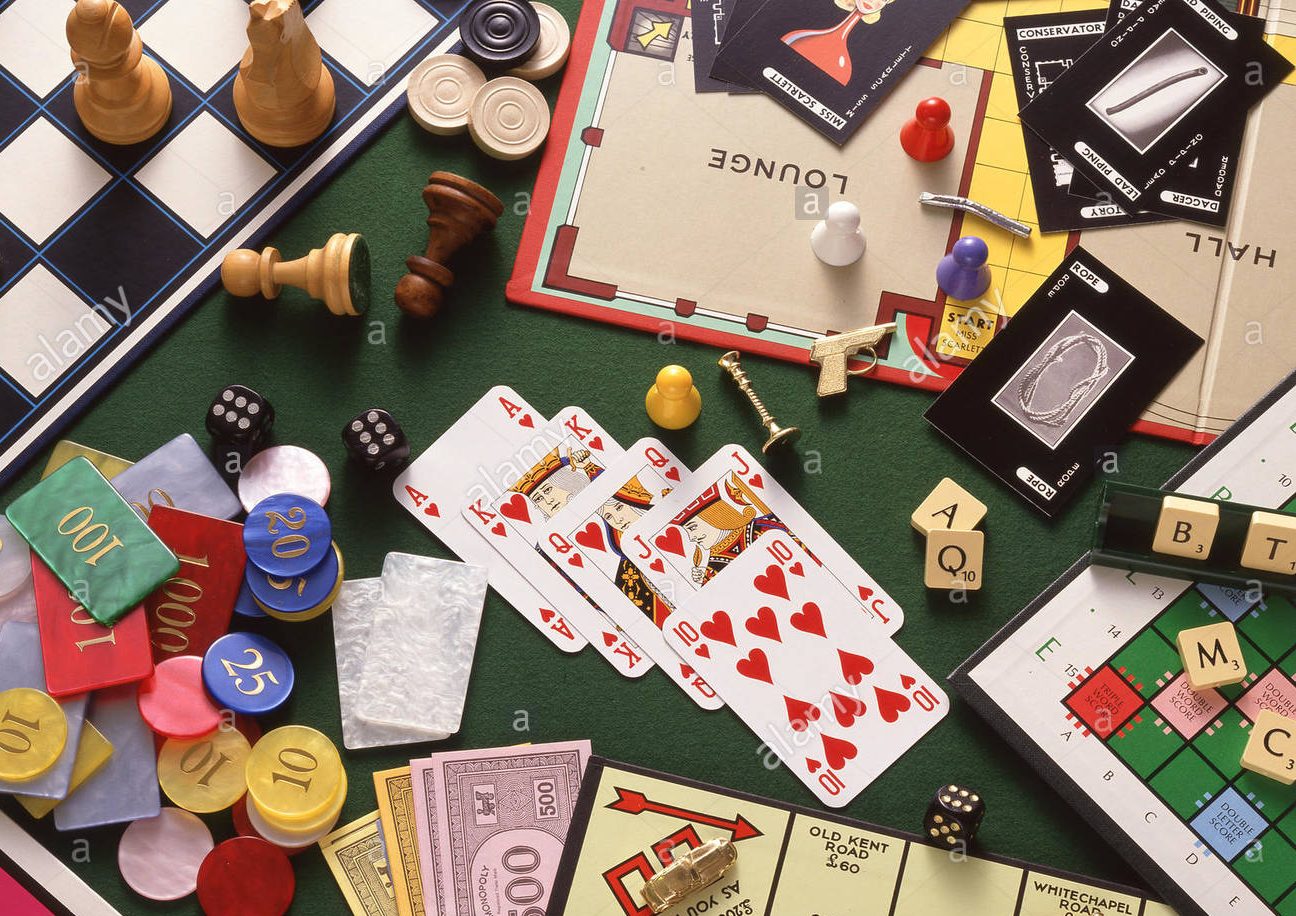
 

GAMES PEOPLE PLAY: N.B., Games, not Sports

 
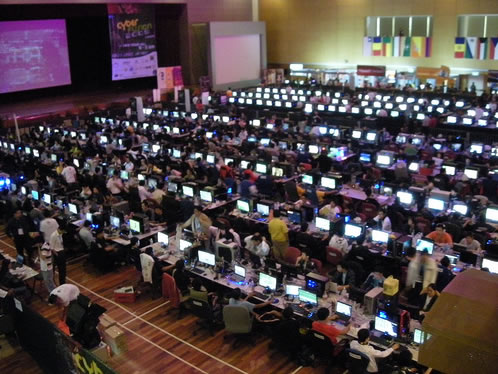
RedEye LAN Party (from Obsolete Geek)

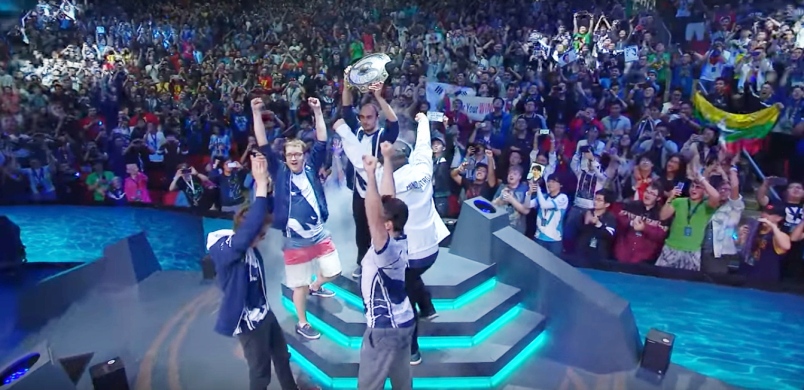
Nearly 70% of Americans play video games on at least one device, and nearly all play on smartphones.  Indeed, if you do an online search for games, best games, or similarly general queries, you will be inundated with info about video games in general as well as individual games.  If game playing is one of your character’s activities (and your story is set in the current time or near future) decide whether s/he is part of the majority or the minority here.  Consider what the game of choice says about the character of your character.  For example,does success depend more on speed or strategy?  Does a round end quickly or take a significant time commitment?  Can it be interrupted/paused?  How violent is it?  And is it mechanized violence or hand-to-hand?  Does s/he play alone, against the program, or with/against other gamers worldwide?

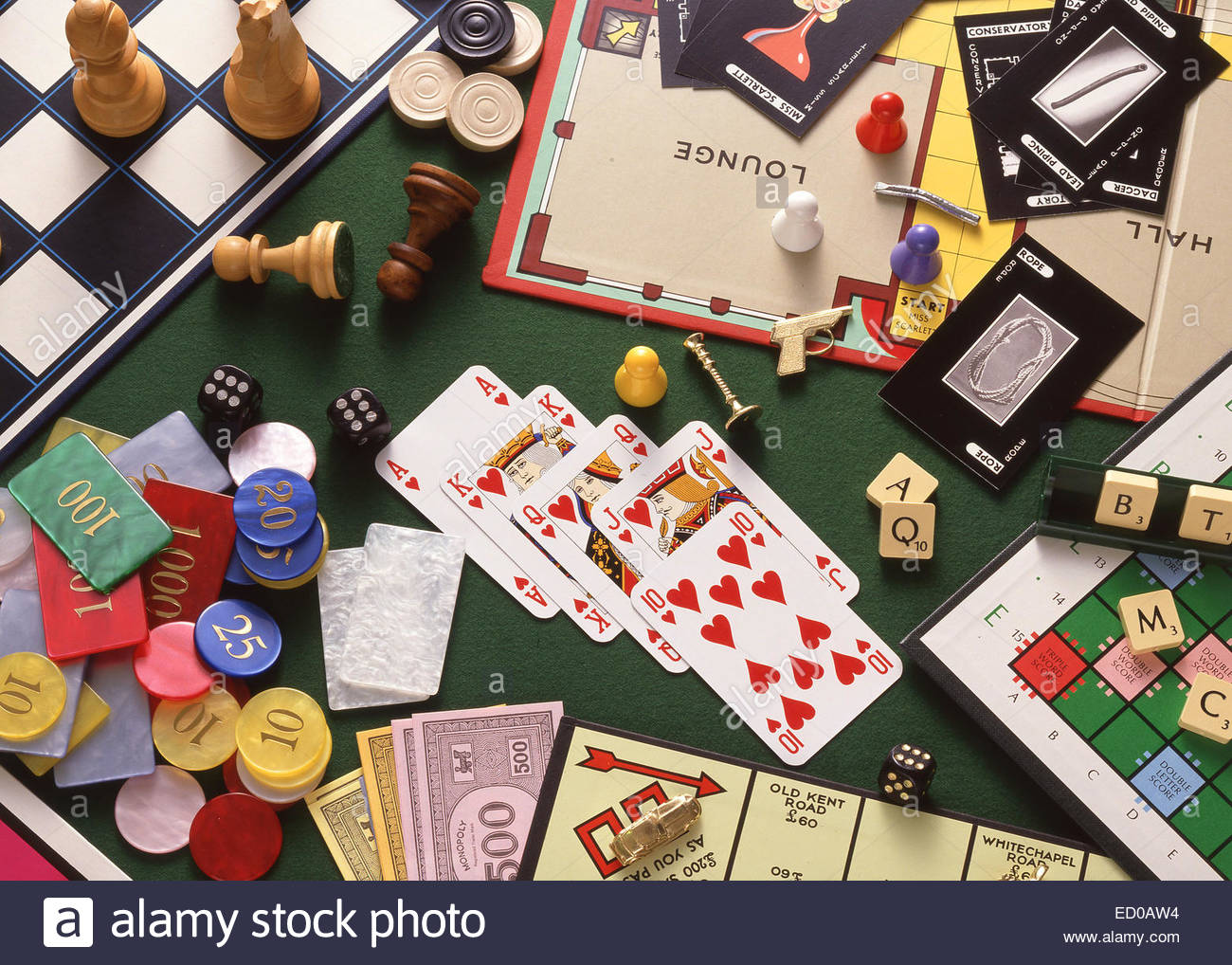
As I indicated in the opening sentence, most people in the U.S. currently play video games, but these are a relatively new phenomenon.  In the remainder of this blog, I shall focus on card games and board games—for three reasons:
  1. They are suitable for current settings as well as throughout history.  Just check out what games were around when the story is set.

  2. I believe that the majority of readers are more familiar with them.
  3. I am not a “gamer” and—truly—I always try not to say too much about any vast canyon of ignorance.
Modern playing cards may have originated in China, India, or Persia, but they were commonly used in Europe by the end of the fourteenth century.  The number and composition of cards in a deck varied throughout history and from country to country.  Some decks had mounted knights, noblemen, peasants, and Church figures.  Some countries used bells, hearts, leaves, acorns, swords, cups, or paving stones to differentiate suits.  Over the years, the royal figures have been labelled as Charlemagne, Julius Caesar, Solomon, Empress Judith, Sir Lancelot, Joan of Arc, Hector of Troy, and various mythological figures, to name a few.  As printing became widely available and playing cards were produced cheaply, the modern deck of cards gradually came into being and was eventually standardized to those we use today.  (For more details, check out the Snopes article on the topic.)[The history of playing cards is kind of interesting:


Advantages of card games:
  •  Equipment is inexpensive
  • They are extremely portable
  • Lots of choices from total luck games to highly skilled strategies
  • Can be played alone or with others
  • Can be totally competitive or in partnerships
  • Suitable for people of almost any age
  • Games with simple rules can transcend language barriers
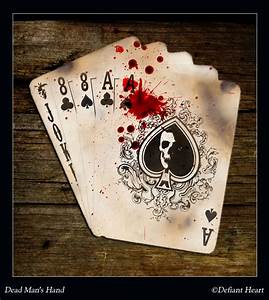
“Dead Man’s Hand” in Poker


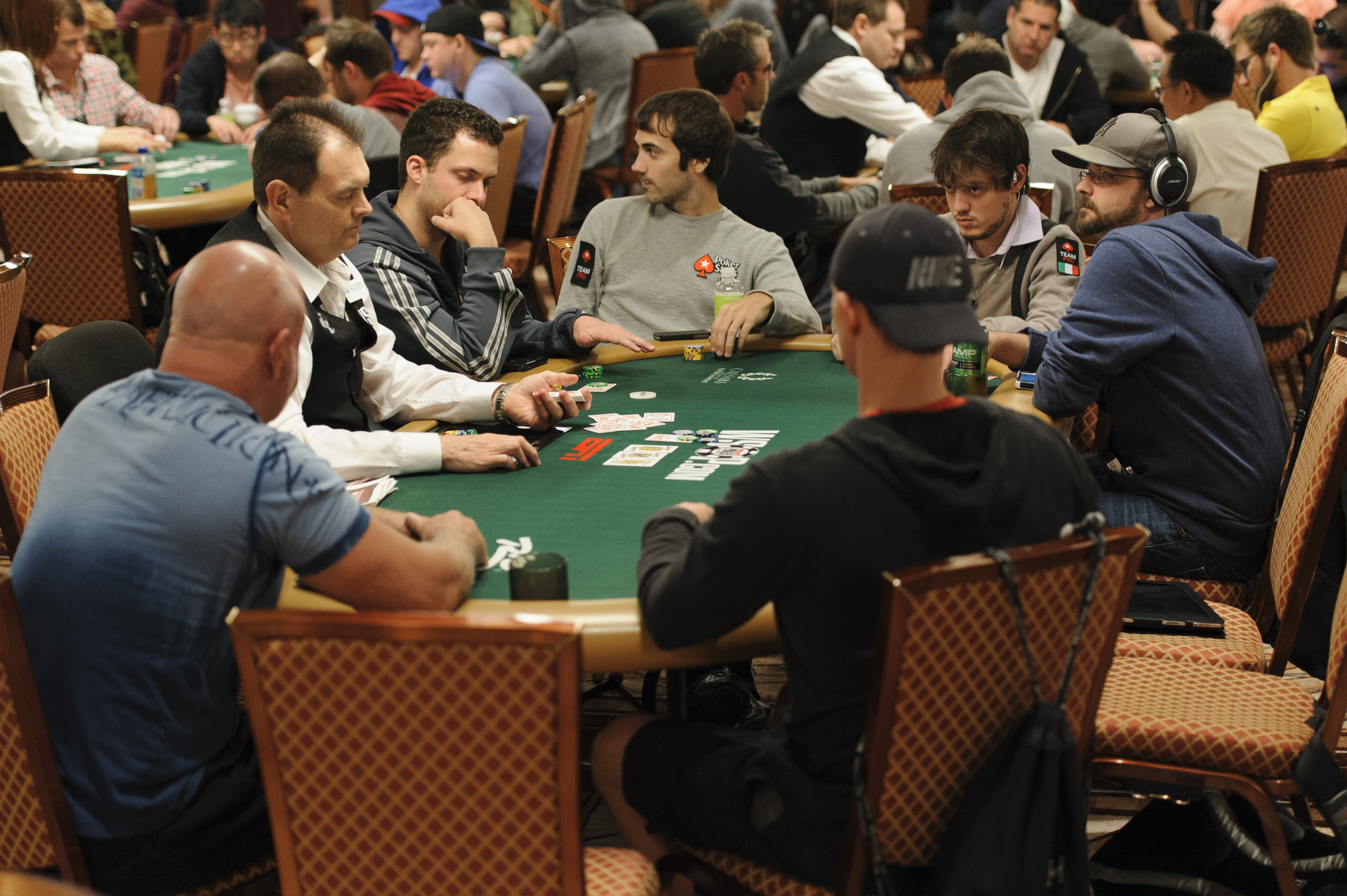
If you search for the most popular card game(s), poker is at or near the top of the list.  Poker is associated with gambling, whether in a casino, bar, country club, or private home.  As the name implies, penny ante poker means minimal stakes.  Other associations with poker include alcohol, smoking, and maybe the Wild West.  It is still a male-dominated game.
Writers: as always, consider the value of going with the flow or defying the images.  Many variations exist, and it can be played online.


Other popular card games in the US:
  • Spades: created nearly 100 years ago, hit its peak in the 90s
  • War: one of the easiest games, suitable for children, no skill involved; also good as a mindless activity
  • Gin: aka gin rummy, is related to rummy (see below); very popular right now, a fun gambling game; started in the U.S in the 1800s and has remained popular ever since; reached its peak in the 1930s and 1940s; faded in favor of canasta in the 1950s
  • Rummy: popular around the world, especially In India; involves matching and memorization; can be played online
  • Blackjack (aka twenty-one): largely a gambling game played in clubs and casinos; lots of luck involved; players play against the dealer rather than each other
    • If a player is able to calculate probabilities and keep track of cards in play, s/he may be able to “count cards” to win nearly every hand.  This technique is outlawed by many casinos, but it can be a good way to demonstrate a character’s extreme intelligence or pattern recognition skills.
  • Crazy Eights: originated in Venezuela; has lots of variations; requires two or more people
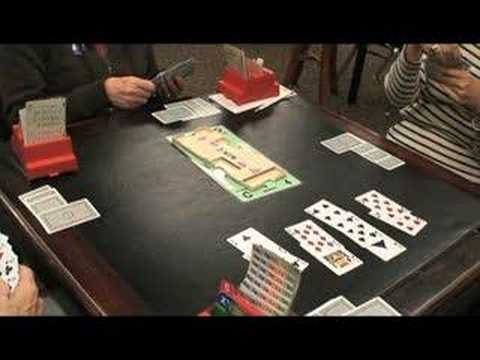
The most difficult card game is bridge.  Some call it the world’s greatest game.  It probably originated in Russia, and was popularized in the Middle East; today, it is played worldwide.  Bridge requires strategy, memory for who played what card, working with a partner, communicating during bidding (which can involve “conventions”—what the heck is a Jacoby transfer, anyway?).  Women take more bridge classes than men and more women than men play, but men dominate in serious competitive play.  For an extended discussion of the pros and cons of bridge, go to WHY PLAY BRIDGE? at bridgeworld.com.


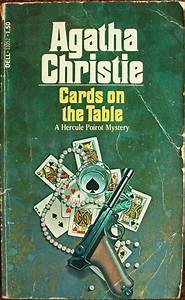
Agatha Christie wrote an entire murder mystery, Cards on the Table, that hinges upon who was playing in what rotation at what time during an evening bridge party.  Hercule Poirot deduces alibis and personalities entirely by studying the notations people made while keeping score, enabling him to identify the murderer.


Card games and board games have been used as a method of teaching and developing military strategy skills throughout history, including by the American CIA An online essay The Appeal (and Manliness) of Card Games includes a subsection on 6 Card Games Every Man Should Know.  The essay notes that men’s games are often symbolic representations of more violent clashes and war.  In my opinion, what this says is that games are a non-violent way of competing to be the alpha male.  When only men are involved, there are often jokes and insults to demonstrate the art of clever talk.  According to this essay, the essential manly card games are:
  • Gin Rummy: game scholars think rummy is a card variation on the Chinese game of mah-jong, perhaps dating to the 1700s, much modified since then; generally played to a specified number, often 100
  • Hearts: a trick-taking game stemming from whist, except the goal is to avoid collecting tricks; the person with the fewest points wins; first appeared in he U.S. in the late 1800s; played online since the 1990s
  • Poker (specifically, Texas hold ‘em): perhaps originated in 1820s New Orleans on Mississippi River gambling boats; poker really took off in the 1980s when Congress passed the Indian Gaming Regulatory Act, legalizing casinos on Native American land
  • Solitaire: first developed in the mid-1700s; originally played with multiple people, it’s now a game played primarily alone—any of more than 1000 variations; surged in popularity with the advent of personal computers
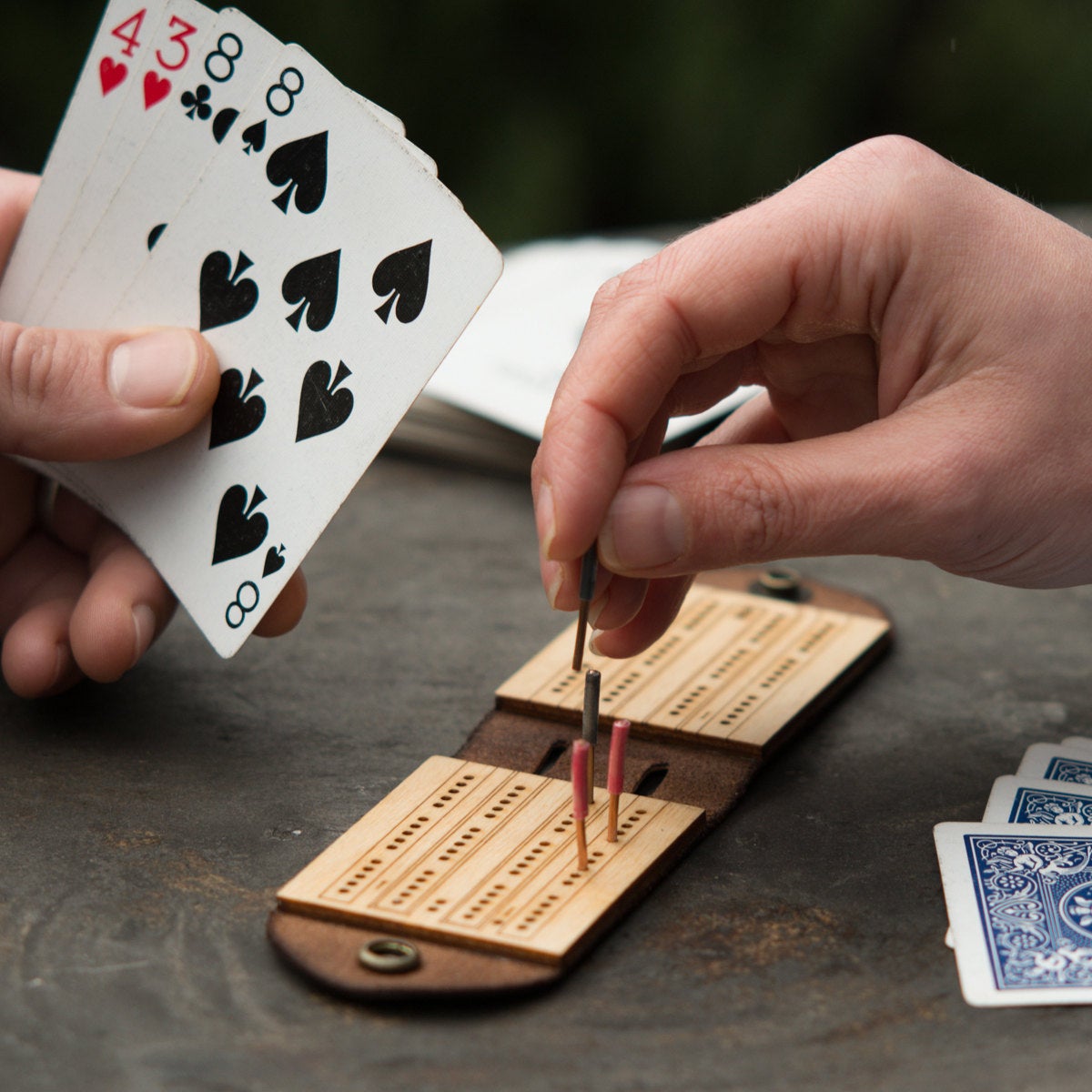
  • Cribbage: beloved for centuries, technically involves a board for score keeping, it’s essentially a card game for 2 (possibly 3 or 4); came to the colonies by English settlers; especially popular in New England
  • Blackjack (aka 21): most widely played casino game; fast and easy to learn; dating to the mid- to late 1500s, became more popular int the U.S. in the late 1950s
Cribbage Hand and Score Board
The Most Popular & Fun Card Games as posted on ranker.com
  1. Uno
  2. Blackjack
  3. Solitaire
  4. Hearts
  5. Gin Rummy
  6. Cards Against Humanity
  7. Go Fish
  8. Bluff (also known as BullSh*t)
  9. Magic: The Gathering
  10. Euchre—a personal favorite with my family
  11. Poker
  12. Crazy Eights
  13. War
  14. Apples to Apples
  15. Rummy
  16. Pokemon trading card game
  17. Spoons
  18. Exploding Kittens
  19. Assh*le
  20. Old Maid—truly classic
  21. Phase 10
  22. Yu-Gi-Oh! Trading card game
  23. Monopoly Deal
  24. Munchkin
  25. Cribbage
Writers: consider the value of a character playing a card game against type, such as a woman playing poker or a man playing bridge.  Yu-Gi-Oh and Pokemon are more commonly played by children, but an adult could play with a child they are caring form.  How would a quintessentially honest person behave in a situation requiring bluffing, such as playing poker or Bluff?  What might a young person discover by learning to play Hearts as a means of bonding with an older relative?


5 Hardest Games to Master in the World: According to Casino.org, these are the most difficult to master, regardless of how long it takes to learn. 
Note: this lists includes 4 board games and only 1 card game


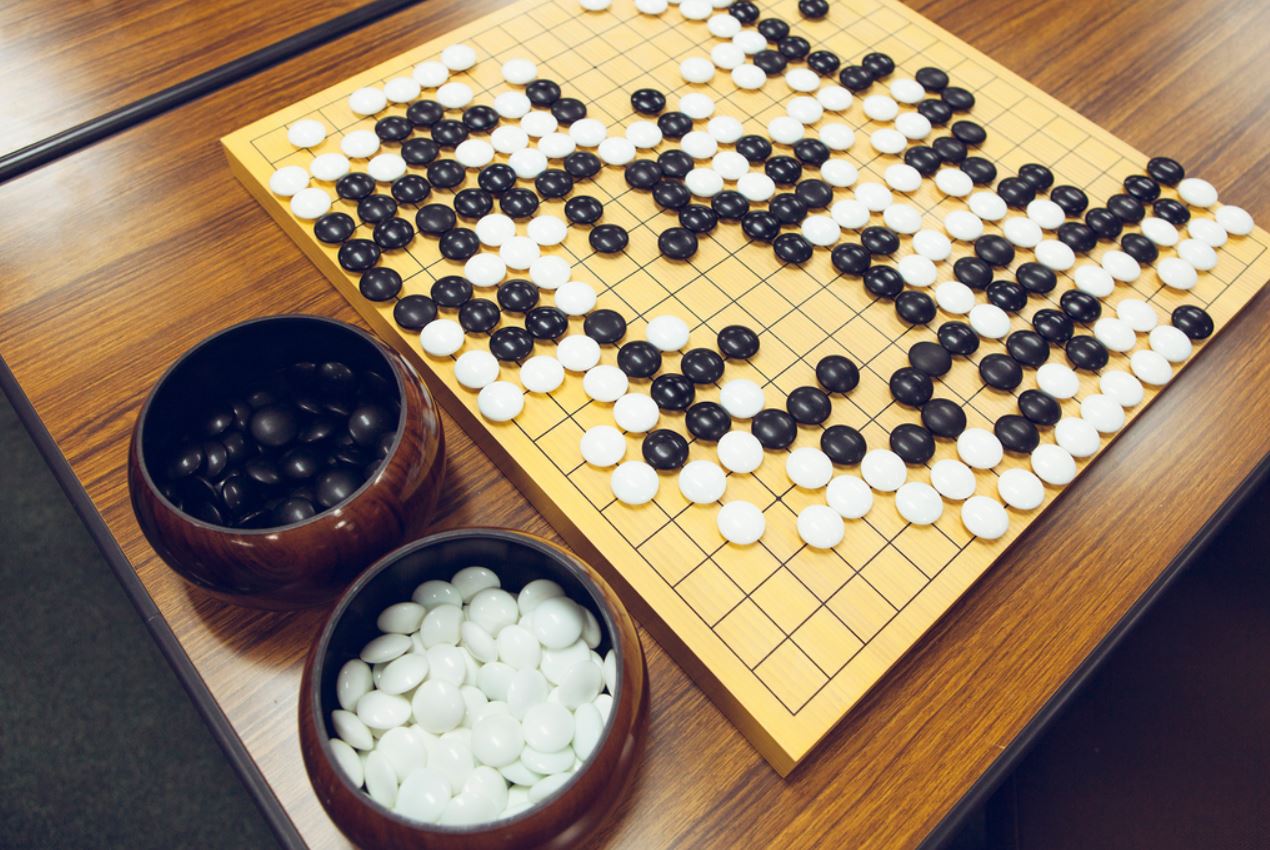
  • Go is an ancient Chinese game dating back over 5,500 years—making it the oldest board game still played today.  It’s also one of the most complex, involving abstract strategy aimed at occupying the most territory on the board. 


    • Go is referenced, played, or used to demonstrate a character’s attitude toward traditional values in lots of Japanese media, including manga and anime.  It is so widespread in Japanese culture that there is an entire anime about a schoolboy haunted by the spirit of an ancient Go master: Hikaru No Go.
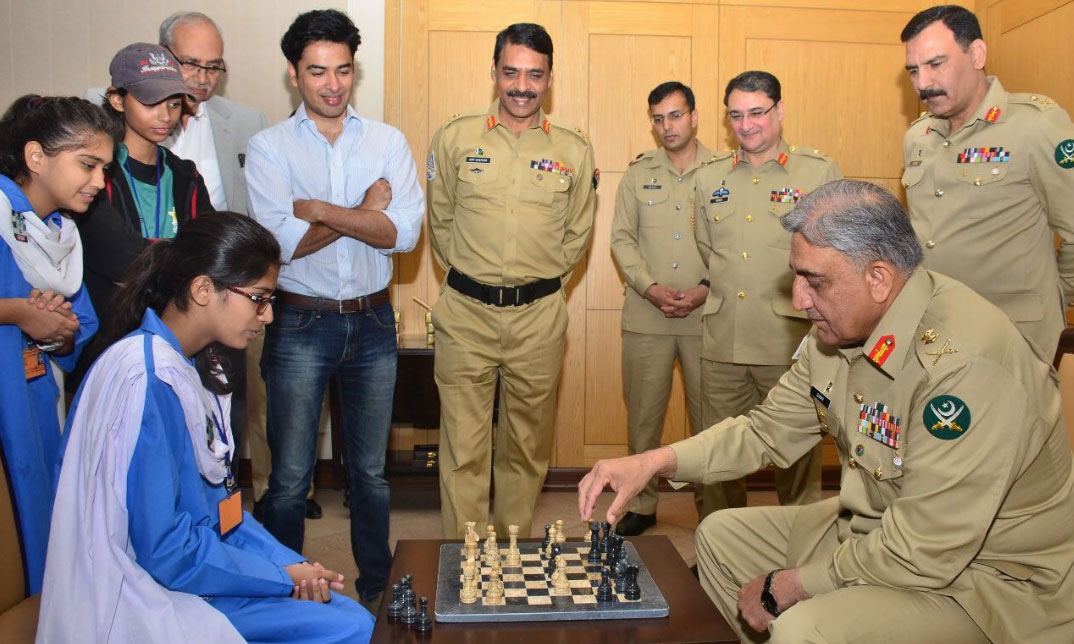
  • Chess, arguably dating back to the 6th century in India, but perhaps it originated in China—as many games did.  It’s a game of strategical conquest played by two people.  The essence of success is forward planning.  Historically, chess has been used as a means of teaching battlefield tactics; that is why, in modern chess rules, the king is relatively constrained but holds such strategic importance.
Pakistani Army Chief Qamar Bajwa playing chess with a student from Islamabad
  • Bridge is the only card game included in this list of hardest games to master. See above.
  • Diplomacy was released in 1959; as games go, it is still in its infancy.  It is a strategic board game for two to seven players, played on a map of 1914 wartime Europe, Middle East, and North Africa, geared toward conquest. There are no dice, but lots of negotiation skills are required.
    • Diplomacy was one of the first games (other than chess) that could be played by mail, which made it available as a form of connection for people who were not able to play together in person.  Writers, consider the possibilities this provides for characters in a historical setting who lived far apart or were shut-ins or prohibited by social taboo from playing together, etc.


  • Hex, released in 1942, was inspired by Go and has since been tweaked.  The goal is to make a connected string of shoes from one side of the board to the other before the other player.
Card Games vs. Board Games
 
As noted above, card games have many positive qualities, especially portability and ease of set-up.  Board games require more complex “equipment,” lengthy set-ups, and can take a long time to complete.  Many board games are quite cerebral, chess being the ultimate example.  In board games, every player is likely aware of the possible moves of the other player(s).
The Top Ten Board Games of All Time
The website hobbylark.com provides a brief history of board games and ranks the top 10.  Many that have been around for literally thousands of years can now be played online. Details of all of these are, of course, available online.
  1. Chess
  2. Stratego
  3. Monopoly
  4. Risk
  5. The Settlers of Catan
  6. Scrabble
  7. Battleship
  8. Clue
  9. Dominion
  10. Ticket to Ride

There is no board game equivalent to solitaire.  By their nature, board games require other players, and thus involve social interactions.

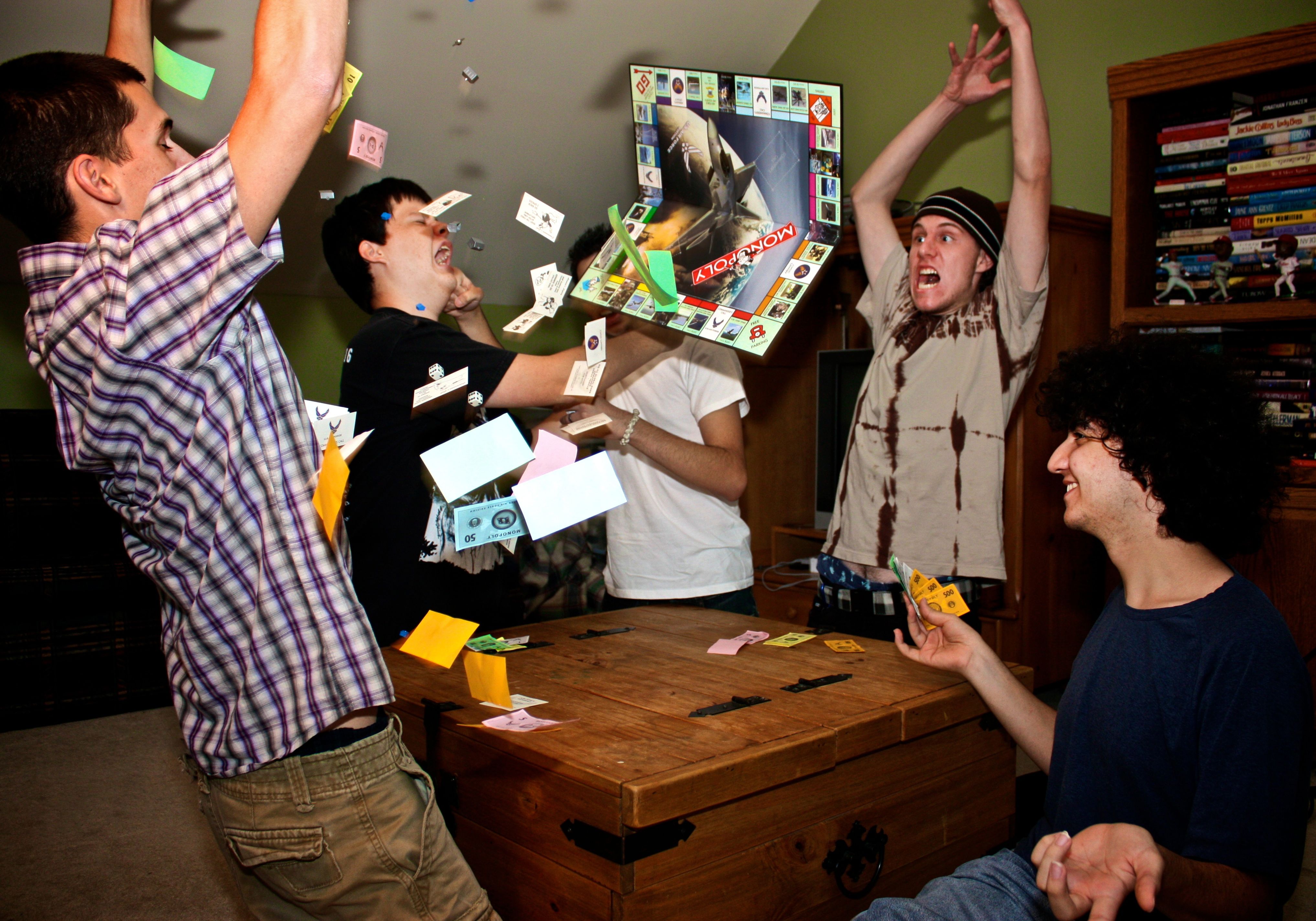
Most people do not follow the correct rules for Monopoly, making games longer and more repetitive.
Game Considerations for Writers (whether cards or board games)
 
  1. If you include a game as a character note, consider the general character of players of that game and whether you want to go with the general image or have a character who goes against the grain.  Why does your character play that particular game?  Where, how, and with whom (if anyone)?  Under these circumstances, chances are you establish the preference and make only brief references to it thereafter—unless the character is addicted.
  2. If the game is an element to advance the plot, it will probably involve a more detailed description of the game itself, so that readers will better understand the important people interactions around the game.  Did playing the game establish or refute an alibi?  Reveal important info through the chat around and over play?  Is someone trying to establish dominance?  Losing more money than s/he can afford?
  3. In associating a character with a game, be aware of the possible correlations: when in history your story is set, age of the character, region of the country (or country in the world), social class, and possibly ethnic background all are considerations.

Bottom line: games can be good for your writing!

2017 Dota 2 Champions

NOTEBOOKS, DIARIES, AND JOURNALS

 
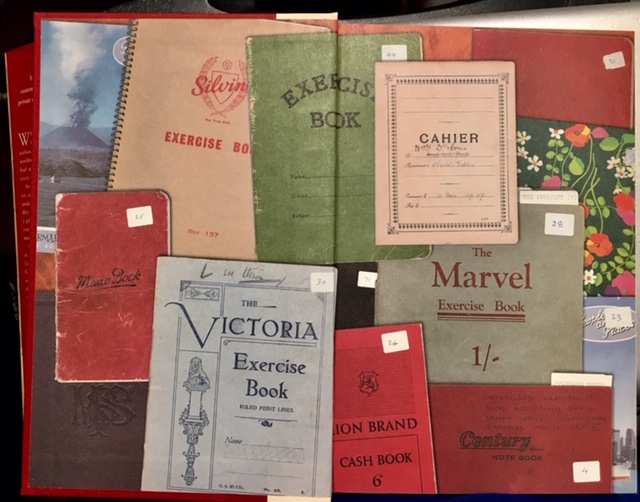
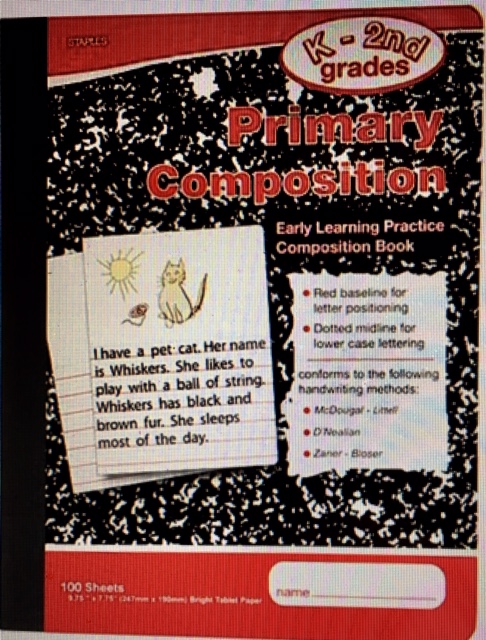
For me—and I venture to say, for most of you reading this blog—the initial exposure to notebooks—books meant to be written in—came with entering school. During the 14th and 15th centuries, notebooks were made by hand, often at home, by folding pieces of paper in half into bundles that were then bound. Binding involved sewing along the fold or punching holes and lacing with twine or other cord. The pages were blank, and any note keeper who wanted lined pages had to make ruled lines across each page. Making and keeping notebooks was so important to effective household, farm, and business management that children learned how to do it in school.


Currently, besides a stitched binding, a buyer can purchase notebooks that are glue-bound, spiral bound, or loose pages in ring binders. People keep notes on everything—food, physical activity, birds cited, blood pressure. . .


Today, notebooks are almost universally commercially produced. You can find them lined or blank or with printed grids, depending on your intentions. Specialized ones are available for virtually any and all needs. One can shop notebooks for elementary, middle, high school, or college. Additionally, one can find notebooks designed for particular interests.


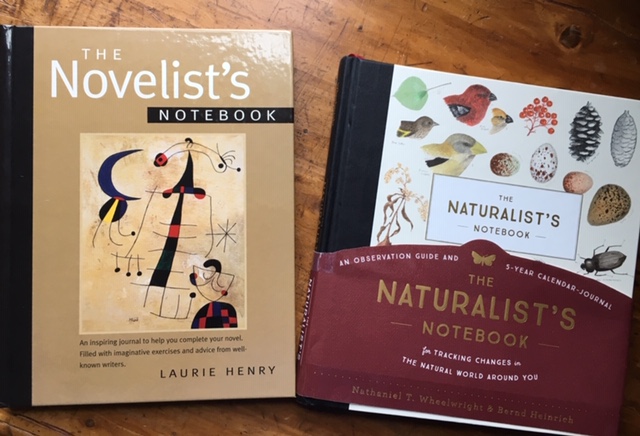
Specialized notebooks often include related information, advice, etc. The Writer’s Notebook is a good example of this, providing tips and exercises to improve writing and creativity. Of the 207 pages of The Naturalist’s Notebook, the first 95 are pages of how-to. The body of the book is called a 5-year calendar-journal, though it’s set up like a diary.


So, segueing from notebooks to diaries: a diary is a record (originally handwritten) set up for discrete entries arranged by date, reporting on what has happened. Generally, a diary has daily entries. Although it might include anything, a diary is essentially a collection of notes, often brief, focused on “just the facts, ma’am.” A war diary would be a good example: a regularly updated official record of a military unit’s administration and activities, maintained by an officer in the unit.


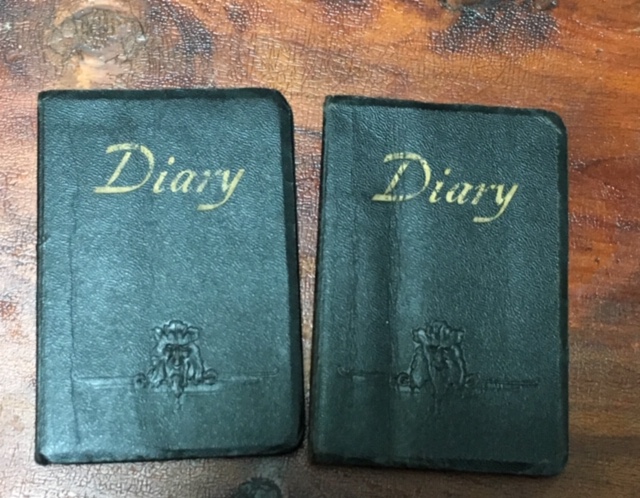
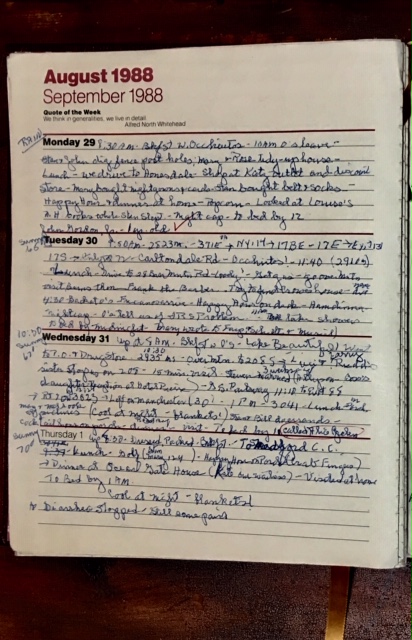
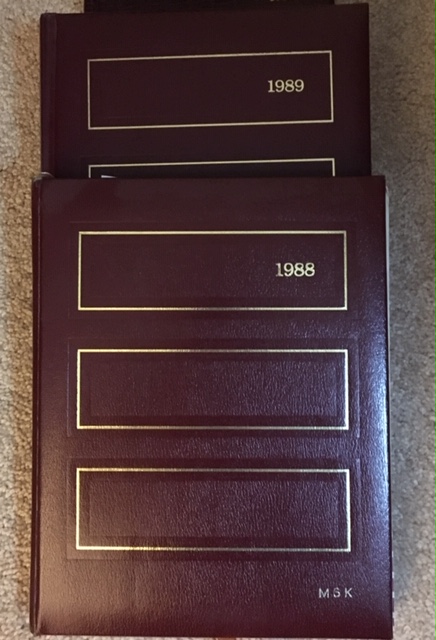
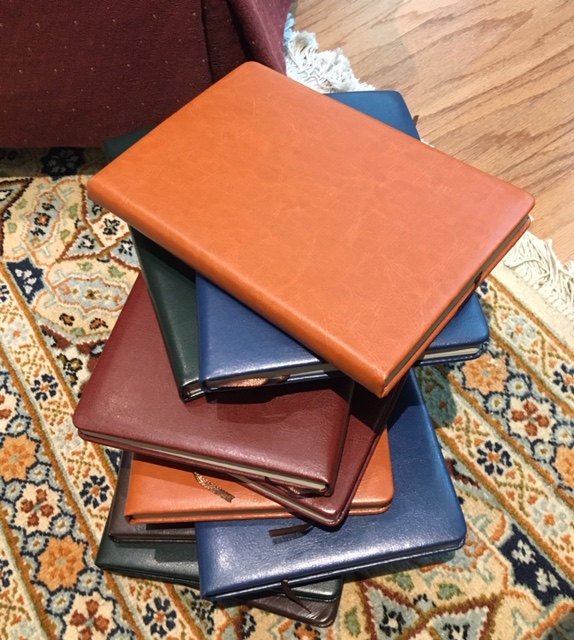
Pre-printed diaries typically allot the same amount of space or number of lines for each day. This forces the diarist to record only the most important events of each day. The diary shown above is set up for one year, with one week on each double-page spread. N.B.: These are a woman’s diaries, and you will see weather notes in the margin of each entry, which is typical of women’s diaries.


One-year diaries can come in any shape or size, though the entry space is often larger than that of multi-year diaries. Typical of diaries are the inserts and write-overs caused by the relatively small amount of space allowed for each day.


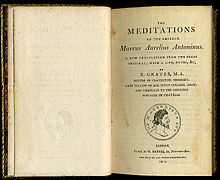
MeditationsMarcusAurelius1811.jpg
To Myself, known today as Meditations, written in Greek by the Roman Emperor Marcus Aurelius in the second half of the 2nd century CE might be the earliest recorded writing displaying many aspects of a diary. The earliest surviving diary that most resembles a modern diary was that of the Moroccan mathematician and scholar Ibn al-Banna’ al-Marrakushi in the 11th century. Needless to say, these were not pre-printed!


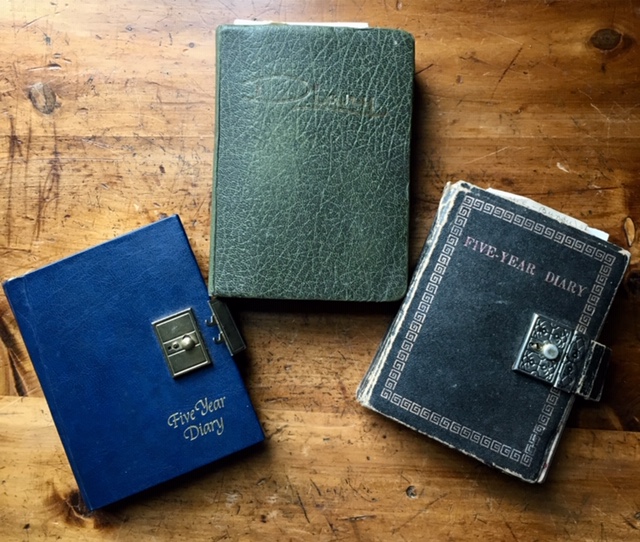
At one point, five-year diaries were very popular. They range in size from 2” x 3” up to 8.5’ x 11” and are still for sale today, priced from $5.59 to $72.00, though the price is not necessarily related to size. The major advantage of a five-year diary, in my opinion, is that it allows easy tracking of events (visits from relatives, weather, flower blooms) across years and seasons. The major disadvantage is the (usually) severely circumscribed space for each entry.


Today one can have a paper diary and/or a digital diary. Digital diaries are often tailored towards shorter-form, in-the-moment writing, similar to what might be posted on social media, but they avoid character limits that have the same effect as the space restrictions noted above.


In its original (French) meaning, the word journal (from the Latin diurnis or diurnalis)refers to a daily record of activities, but the term has evolved to mean any record, regardless of time elapsed between entries. More importantly, it is a record of significant experiences, as well as documenting thoughts, feelings, reflections, emotions, problems, and self-evaluations. In short, a journal is much more personal than a diary. Per Robert Gottlieb, journals have no deliberate shape, they simply accrete.


In writers’ terms, a diary is a fly-on-the-wall POV; a journal is a first person POV, showing everything through the eyes and heart of the writer.


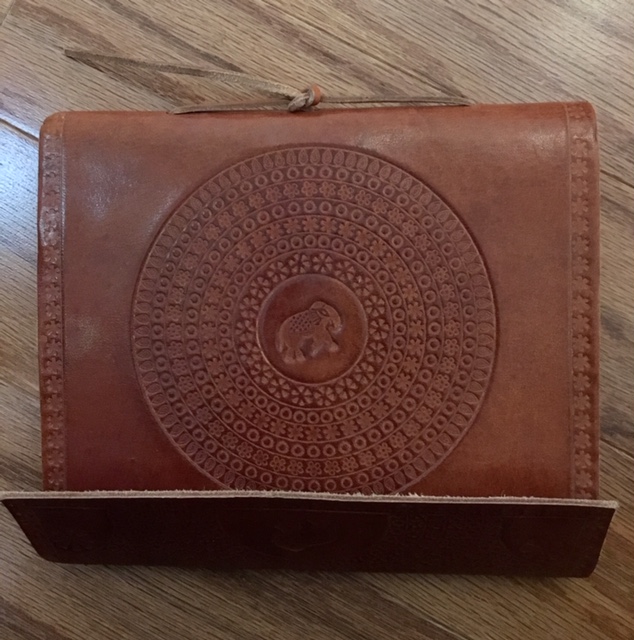
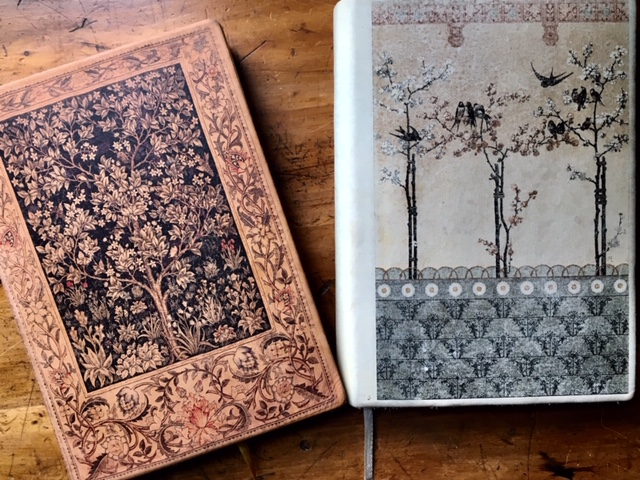
If you want to buy a journal, you are not likely to find books labeled “Journal.” Instead, you buy a blank book. Your first decision is totally blank or lined. It’s a very personal decision. For an artist, this would be totally blank, a sketchbook. But some journal writers also want a totally blank page,feeling freer—unconfined, not squished between lines. Others—somehow more restricted?—prefer lines, perhaps to keep them focused, perhaps to keep their words legible.


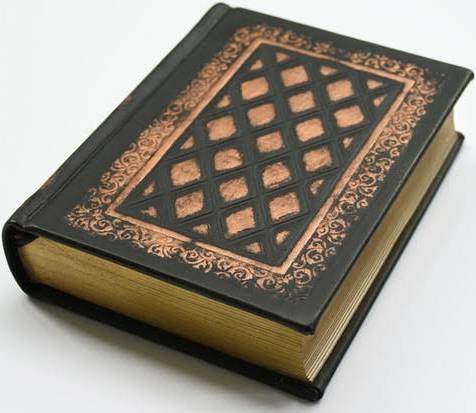
Journals can be broad ranging or focused—for example, dream journals, travel journals, gardening journals. In my experience, the more broad ranging, the more likely the writer will choose an aesthetically pleasing blank book.


For the most part, both diaries and journals are presumed to be personal, shared with no one or only a select few. But many of both have been published. Online, international lists of published journals and diaries are readily available.


An exception to the presumption of privacy, The Diary of Anais Nin was her own publication.


But many others are published posthumously.


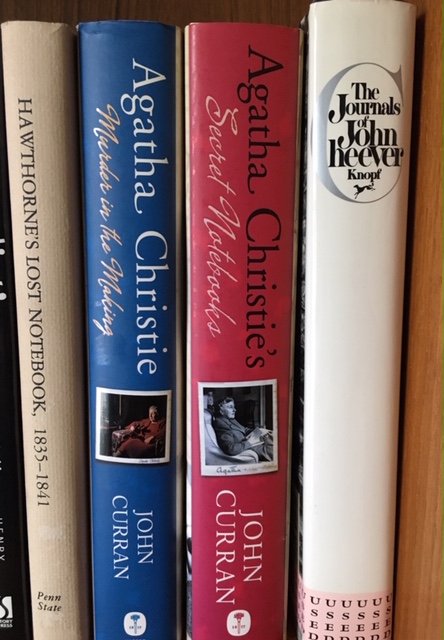
Agatha Christie’s Secret Notebooks—numerous, informal, and not terribly organized—have been perused and edited by John Curran. He quotes lavishly from the originals but also comments and relates the notebook entries to Christie’s published works.


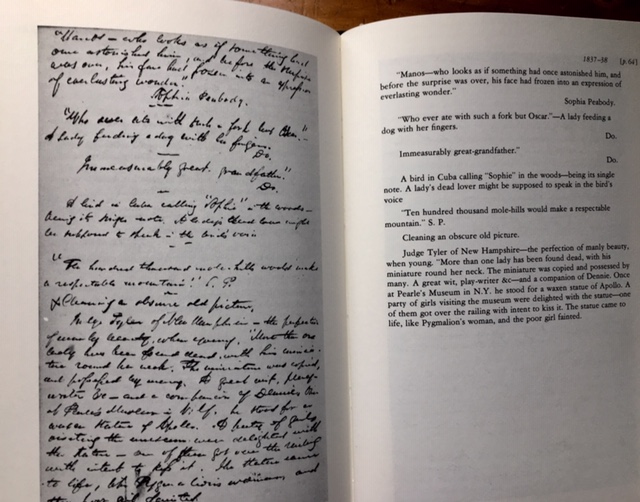
Among published diaries, notebooks, and journals, one of my favorites is Hawthorne’s Lost Notebook 1835-1841. I love this book because it has reproductions of the original hand-written notes side-by-side with readable printed versions of his words.


Another favorite is The Journals of John Cheever. Cheever wrote his inner life, day after day, year after year. His writings span a period from the early 1940s to a few days before his death on June 18, 1982, encompassing some three to four million words. The original journals are small, loose-leaf note books, approximately one per year, usually typed but sometimes written out in longhand, undated. The published version of his journals is, necessarily, a selection. Entries are identified by year, and each is reprinted in its entirety.


This printed version of his journals doesn’t draw punches, even when he made negative comments about his children or himself.


And now I would draw your attention to the similarities between the Hawthorne notebook entry and the Cheever journal entries. They are both open-ended and extremely personal.


Bottom line for writers: a rose by any other name! Call it a notebook, a diary, or a journal, record your days.


Voices from the Past

anne frank house
Anne Frank House on the Prinsengracht in Amsterdam, Netherlands [Creative Commons]
I’m a fan of history—not so much the names and dates of battles and rulers, but the lives of ordinary people. I might say it’s a sociological and/or anthropological approach to history. I was fascinated by Anne Frank—what she wrote and how she lived—long before I visited the Anne Frank House in Amsterdam a few years ago.
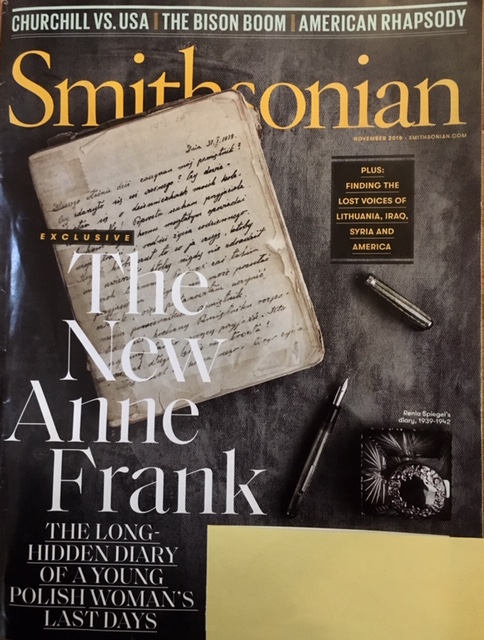
 

smithsonian new anne frank
So, of course the cover of the November 2018 Smithsonian magazine caused me to snatch it up. Pages 39-88 are devoted to bringing us voices from the past, long silenced by war.


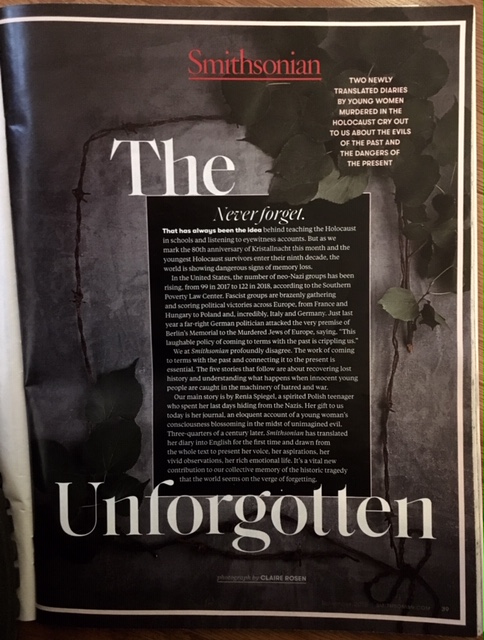
unforgotten smithsonian
This page summarizes the point of this coverage: Never forget, lest we repeat the devastations of the past. This month marks the 80th anniversary of Kristallnacht, so the publication is particularly timely.


voices past
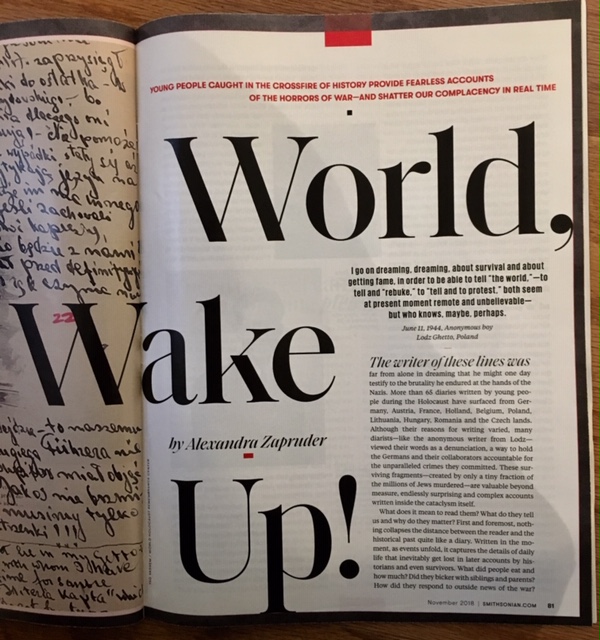
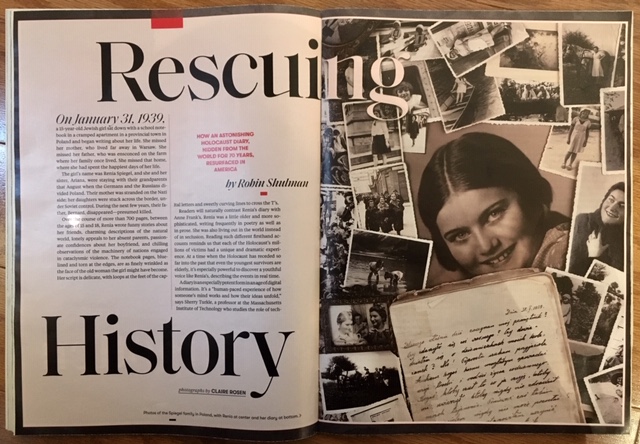
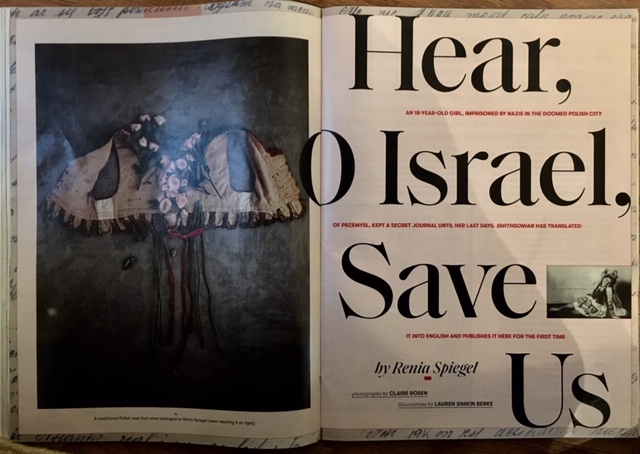
The first article recounts the twisted path by which a Holocaust diary showed up in the United States. Renia Spiegel, a 15-year-old girl in a small Polish town, wrote a diary. Her diary survived her death almost by accident, and had a profound effect on the lives of others.
smithsonian anne frank
The diary was published in Polish in 2016, but is translated into English and published in Smithsonian for the first time. Renia Spiegel was a teenager, not a trained writer, but her words are as powerful an Anne Frank’s, conveying the commonplace, day-to-day against the backdrop and ever impinging horrors of WWII. The diary is a gripping eye-witness record of history in prose, poetry, and sketches.


becoming anne frank
Just after the diary translation, the article by Dara Horn is thought-provoking exploration of the contradictions in attitudes and behaviors that surround people’s reactions to Jews and Jewishness. It includes a quote from Elie Wiesel: “Those of us who went through the war and tried to write about it… become messengers. We have given the message and nothing changed.” Wiesel was a prisoner in Buchenwold when the camp was liberated in April 1945.
anne frank smithsonian
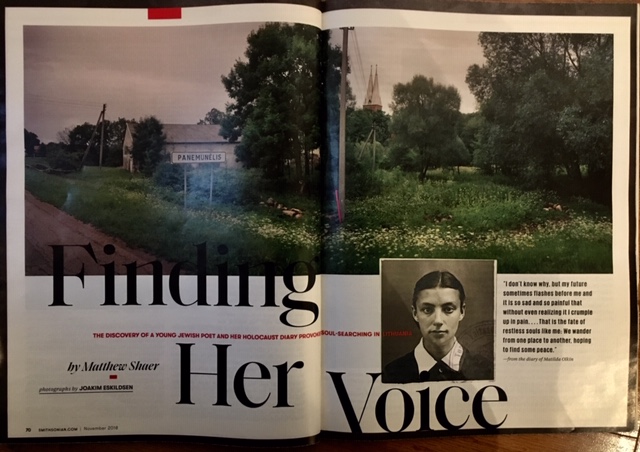
In Lithuania, beginning in 1940, Matila Okin kept a diary of her life and times as a Jew in wartime Europe. Her poetry was published in literary journals and her work solicited by editors, and several are included in the article, which also talks about the Catholic priest who hid Okin’s notebooks in the wall of the church before the Soviets deported him to Siberia.
voices past
The last of the articles quotes from diaries written in the Lodz Getto in Poland, but also U.S. internment camps, Bosnia during the Serbian aggression, Syria, Iraq, and considers the impact of today’s digital war diaries.


Bottom line: This Smithsonian makes clear that history isn’t dead—and testifies that it isn’t even past. Every writer should read it.

1968 Was a Hell of a Year

smithsonian 1968 hell year
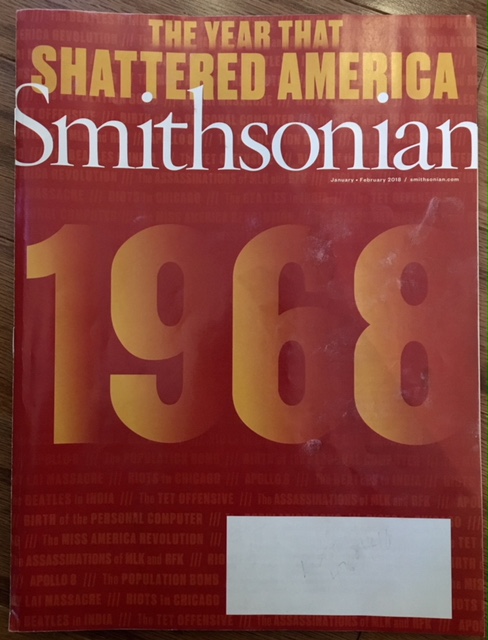
The January-February issue of Smithsonian is a must read. Whether you lived through it or not, you will learn something new on every page. (Well, maybe not the ads at the back!) Many people living through turbulent times experience some segment of the turmoil so deeply that it changes them forever, but I’d venture to say few grasp the whole.
And if you were a child in ’68—or not even born yet—you definitely need to read this. The year still reverberates through our lives, and this issue of Smithsonian is a vivid panorama of the times.

smithsonian contents 1968
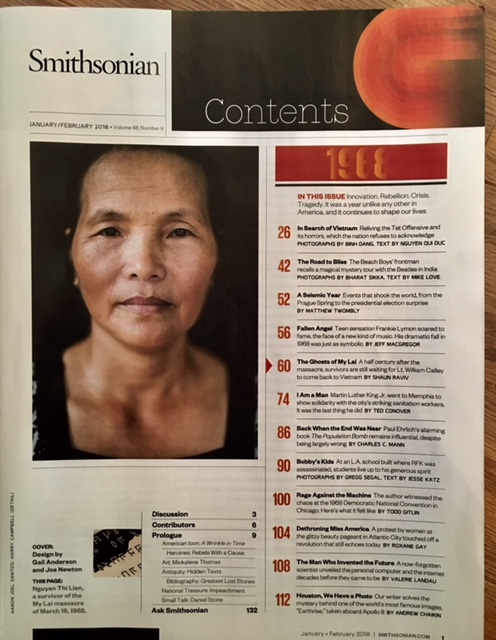
The grief and anger surrounding the Vietnam war are made clear, from the war itself to the riots during the Democratic National Convention in Chicago. Popular culture is highlighted: the Beach Boys and the Beatles in India and teen sensation Frankie Lymon. It was a year of protesting the Miss America Pageant, and getting the first pictures of earth from outer space. What Martin Luther King, Jr. was doing days before his assassination, and the legacy of Bobby Kennedy’s assassination—it’s all there. It was a year of violence, but also of innovation as the groundwork was laid for personal computers and the internet.

Issues of street violence to threats of world hunger made 1968 a year of fear and anger. Read all about it!

Reading History and Geography

I have mixed feelings here. In fourth grade, my geography book was the most exotic, fascinating thing I’d ever seen. In high school, I hated history so much that I vowed never to take a non-mandatory class. And I didn’t, avoiding history all through college. But like so many, I find both topics not just palatable but absolutely fascinating when presented in literature and/or experienced during travel.


Virtually any good writing set abroad gives a vivid sense of place, so I’ll put geography aside for a bit, and urge you to consider all the ways you can enjoy history.
 

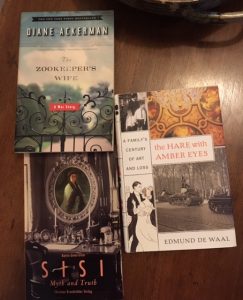
nervous splendor budapest 1900 norway 1940
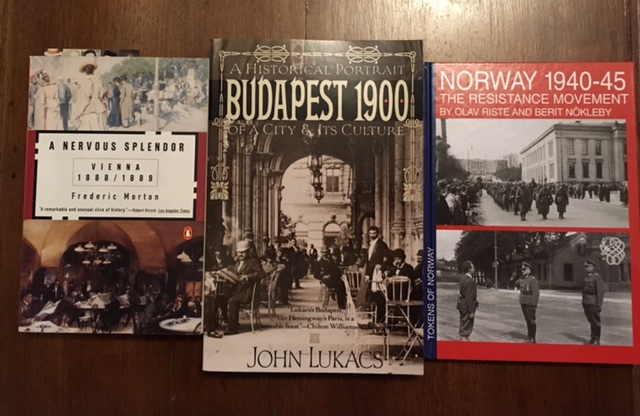
Consider historical events or periods of interest to you. Your reading options are myriad. I grew up in a house with few books, but we did have a two-volume pictorial history of World War II that had pictures of concentration camp survivors that are seared in my mind’s eye still.


At least as common is to read history by reading about people. Queens, kings, generals, popes—biographies abound. Think Queen Elizabeth, Marie Antoinette, Joan of Arc, or Catherine the Great—to name a few women. Often travel sparks an interest. I was unaware of Sisi the Empress Elizabeth of Austria, or Maria Theresa, one of the most outstanding and powerful personalities in the Habsburg dynasty.


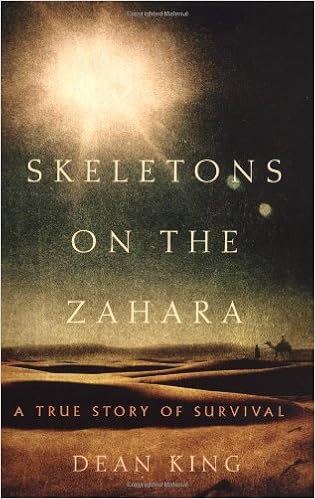
dean king skeletons zahara
[Photo credit: Amazon]
I won’t belabor the point, but geography can be equally personal. Consider Dean King’s book, Bones in the Zahara. Vivid and personal, immediate and gripping. (Indeed, I recommend any of Dean King’s non-fiction books.)


Bottom line: History and geography can be as gripping as fiction. Try it!

First Women

Celebrating First Women

Is there anyone out there who doesn’t know that Hillary Clinton is the presumptive Democratic Party nominee for president? Or that she is the first woman to run for president on a major ticket? Her achievement reminds us all that women have long been making history. Some of you will remember that I mentioned Victoria Claflin Woodhull, the Equal Rights Party candidate in 1872. She was a fascinating woman—a stockbroker and publisher as well as a suffragist.
 

TO ALL THE READERS OUT THERE

Find out about other amazing first women. Lots of them are listed in references such as this.
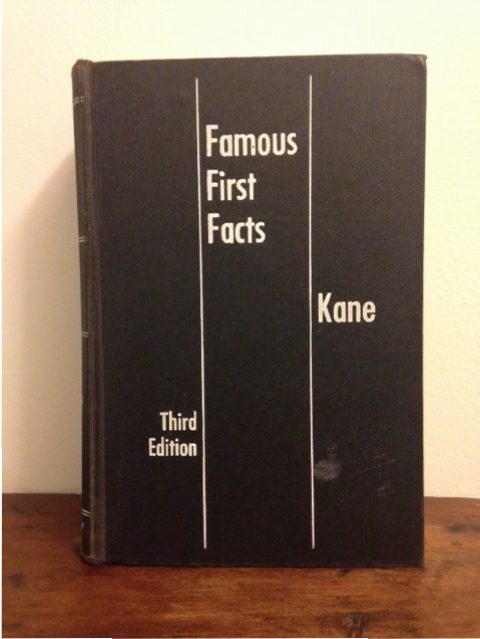
Famous First Facts: Third Edition, book by Kane,
Famous First Facts
Lady Astor (birth name Nancy Witcher Langborne), the first American-born woman to become a member of Parliament in Great Britain in 1919.
Nancy Astor
By Bain News Service (Library of Congress) [Public domain], via Wikimedia Commons
Harriet Maxwell Converse, the first white woman to become an Indian chief, made a chief of the Six Nations Tribe in 1891. She had been adopted as a member of the Seneca tribe. You can read a poem by Harriet Maxwell Converse at the Poetry’s Foundation website. 

Elizabeth Cady Stanton, the first woman to appear as a congressional hearing witness in 1869. She was trying to keep the women of DC from being debarred from voting.
Elizabeth Stanton
Elizabeth Cady Stanton, c. 1880, [Public domain], via Wikimedia Commons
Sally Stearns, the first woman coxswain of a men’s collegiate varsity team, 1936.


Nan Jane Aspinwall, the first woman horseback rider to make a solo transcontinental trip from SanFrancisco to New York City, 1910.


Susanna Medora Salter, the first woman mayor, elected in Argonia, Kansas, 1887.
Susanna Madora Salter
By Unknown photographer (Kansas Historical Society) [Public domain], via Wikimedia Commons
Belle Martell, the first woman licensed to be a prize fight referee, 1940.


Nellie Tayloe Ross, Director of the Mint, the first woman to have her name on the cornerstone of a US government building, 1936.
 
Nellie Tayloe Ross
Nellie Tayloe Ross (1876-1977), Wyoming Governor, 1924-1926. Wyoming State Archives, photo published 1922 [Public domain]
Sybilla Masters, the first woman to obtain a patent—for a machine for cutting and cleaning Indian corn, 1715.


And many others, in books such as this.
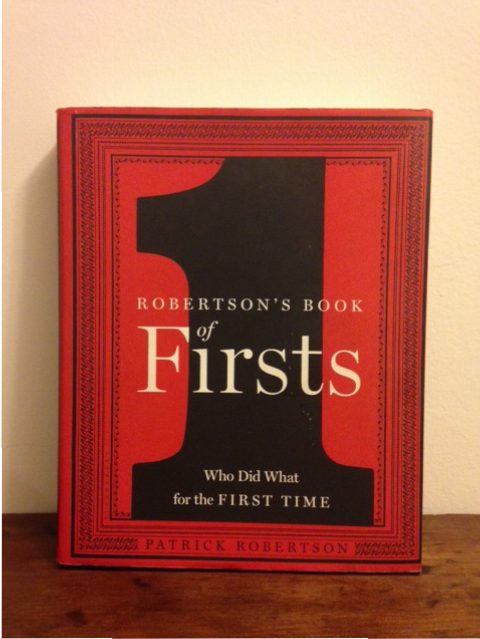
Robertson's Book of Firsts: Who Did What for the First Time, book by Patrick Robertson
Robertson’s Book of Firsts: Who Did What for the First Time
Alternatively, one could go to any field of interest—from playwright to astronaut—and find the first woman in those fields.

FOR THE WRITERS OUT THERE

Consider these pioneers as inspiration. What sort of character does it take to be a first? What might daily life be like for the first woman licensed as an electrical engineer? What price might such a woman pay in terms of family or love relationships? And ultimately, is it a story of triumph or tragedy?


Please share other first women in the comments or on social media. Please tag me on Facebook and Twitter to continue the celebration of first women.

Love Your Research!

writing 101: love your research

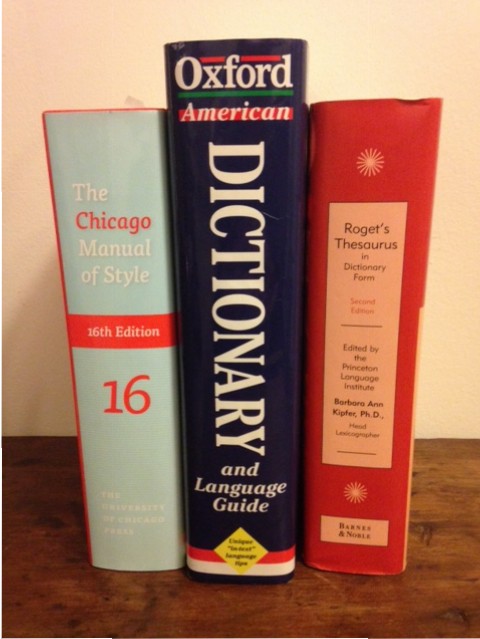
I can’t imagine a writer without some tools of the trade, even if those are only a good dictionary and a thesaurus, preferably a good manual of style as well.

research books: Chicago Manual of Style, Oxford Dictionary, Thesaurus

Most of us have much more than the basics, however. I often set stories in times that are not now. Therefore, in order to get the details needed to enrich the prose and draw the reader into the period, I often rely on bits of dialogue about what something costs, or what’s being eaten or worn.

A few of my favorite references

For the cost of things, I turn first to The Value of a Dollar.

research book: The Value of a Dollar
The Value of a Dollar, Grey House Publishing

The most recent volume is 1860-2014, and new it costs $155. I first came across this book in the reference section of a library in Clifton Forge, VA, when I was researching my novel Nettie’s Books, which is set 1930-1935. I was delighted to learn that ham was 8¢ a pound back then, and that Sears was selling 25 Hershey’s 5¢ Almond Bars for $1. I wanted that book! The price of a new one was prohibitive, but by dropping back to the previous edition (pictured above), it was very reasonable. Indeed, I just ordered the one that covers 1860-2009 for $7.91 plus shipping.

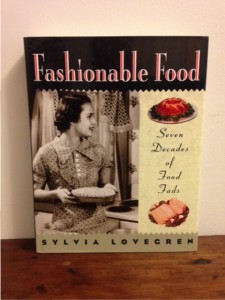
As you know from other parts of this website, I collect cookbooks. But I also collect food reference books for writing, such as the two pictured here.

Being able to put waffle irons, Kool-Ade, Spam, and Jiffy Biscuit Mix in the right period is highly tempting! Among other things, such references may trigger childhood memories for readers and help draw them in.

In addition, I find it very helpful to have good references for popular culture and slang. In fact, I have several of each. I often write stories set in Appalachia some decades past, when saying an overweight woman wears clothes so tight she looks like ten pounds of potatoes in a five-pound sack can create just the right vivid image of the woman in question as well as giving insight into the speaker. A character saying, “What a hoot!” is clearly older than the one who says, “Whatever.” The two books pictured here are rather specialized ones, but more comprehensive options are readily available both new and used.

research books: "Remember That?" and "Butter My Butt and Call Me a Biscuit"
Remember That? and Butter My Butt and Call Me a Biscuit

I revel in dipping into these and other references even when I’m not researching a particular writing project. Some of my favorites don’t fall into any of the above categories, but they are great stimulants to striving for better, richer language.

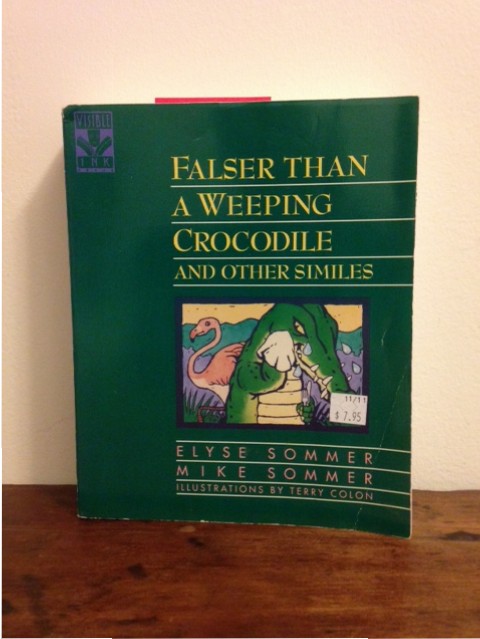
research book: "Falser Than a Weeping Crocodile and Other Similes"
Falser Than A Weeping Crocodile And Other Similes

I was a reader before I was a writer (weren’t we all?) and for me, these are great reads! Advice to writers: choose research and writing tools you can enjoy.
What are your favorite research books and tools?

research: library
Photo by Tamás Mészáros

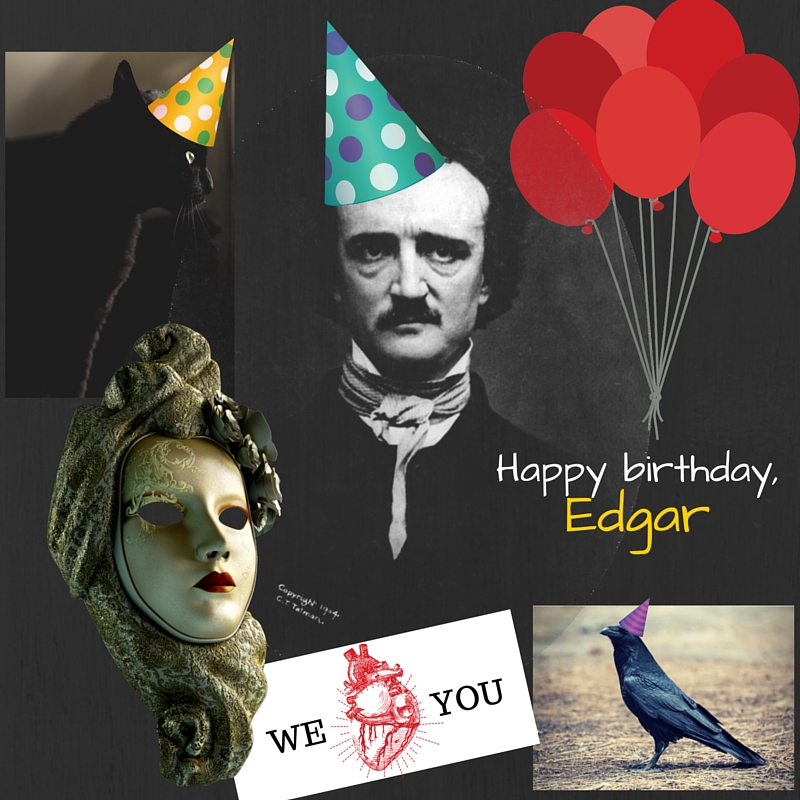
Today is the 207th Anniversary of Edgar Allan Poe’s Birth

Edgar Allan Poe 2 retouched and transparent bg
Edgar Allan Poe. Somewhat retouched. Original daguerreotype taken by Edwin H. Manchester on the morning of November 9th, 1848.
Poe was a writer, literary critic, and editor, the first well-known American writer to try to earn a living exclusively through writing. In spite of his prolific output, he didn’t earn enough to support himself, let alone live comfortably.
 
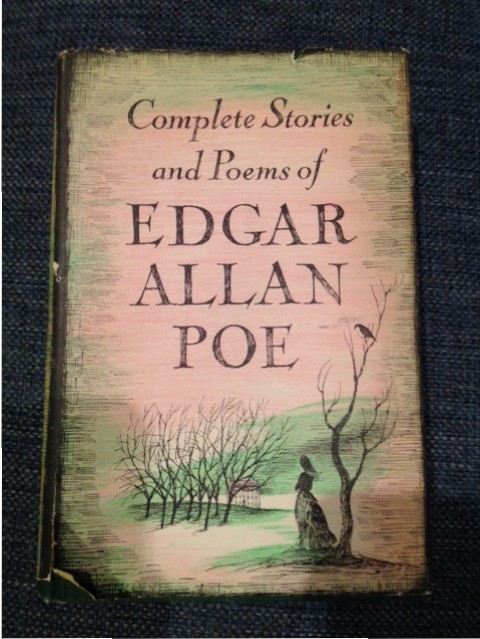
Complete Stories and Papers of Edgar Allan Poe
Complete Stories and Poems of Edgar Allan Poe


Although Poe died at the age of forty, this book contains 119 short stories and poems and one novel. His literary criticism isn’t represented at all in this volume, nor are his essays on writing, such as “The Philosophy of Composition,” “The Poetic Principle,” and “The Rationale of Verse.” His first publications were poetry, and he published 53 of them, but his work covers a much broader spectrum: 27 tales of mystery and horror; 25 stories of humor and satire; 14 that veer toward fantasy and science fiction. His novel is an adventure yarn. “Eureka” is a disquisition on the nature of the universe, and his vision has been largely confirmed by science, for example the Big Bang Theory.


Despite the breadth of his writing, he is best known for poetry and suspense/horror. He is often called the father of detective fiction—preceding Arthur Conan Doyle and Wilkie Collins by decades—while his contributions to cosmology and cryptography are known to relatively few. Besides being brilliant, Poe was a fine athlete. (He once set a broad jump record of 21’6″.)  But he is most remembered as a man who suffered bouts of depression, whose career and life were burdened if not destroyed by gambling and alcohol, and who was plagued by scandals ranging from his marriage to his 13-year-old cousin to courting multiple women simultaneously.


To this day his death is shrouded in mystery. Where had he been for the previous several days? What was he doing? Why was he wearing someone else’s clothes? And who was the “Randal” he called out for from his deathbed?


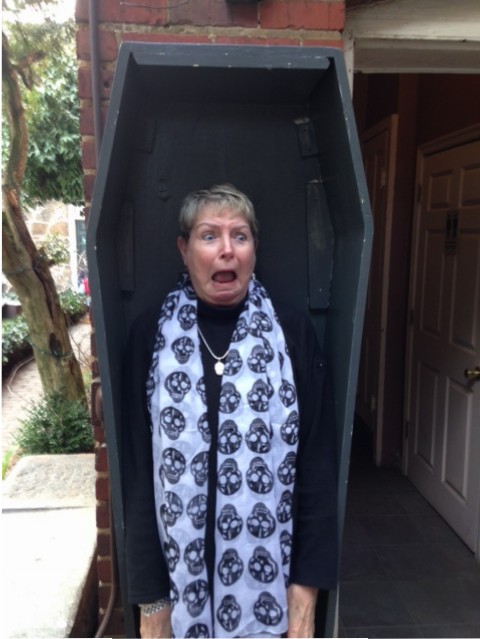
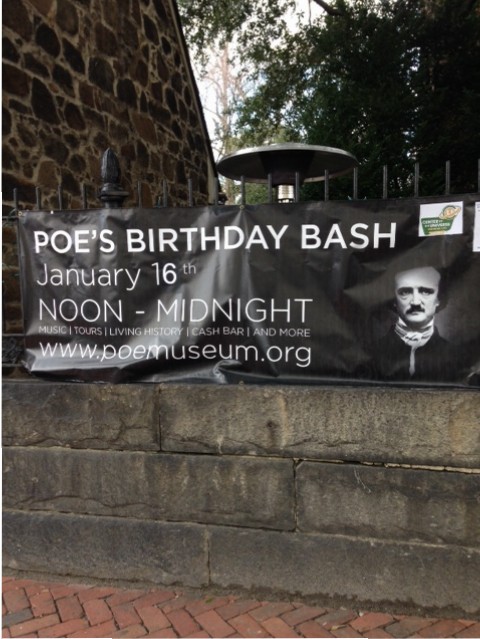
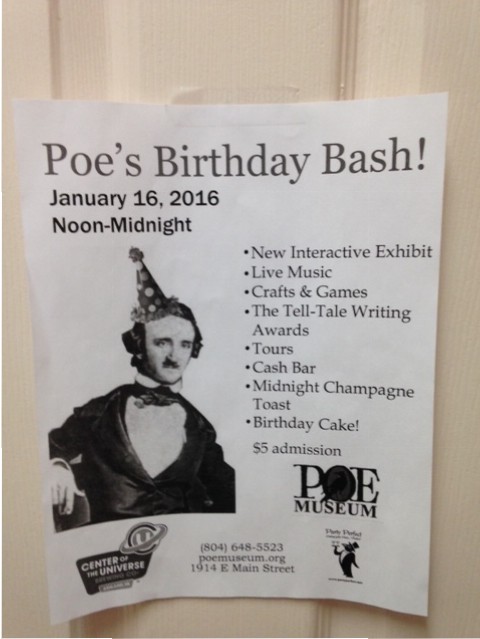
Nevertheless, he is celebrated and honored across the country, including an annual Birthday Bash in Richmond, Virginia.


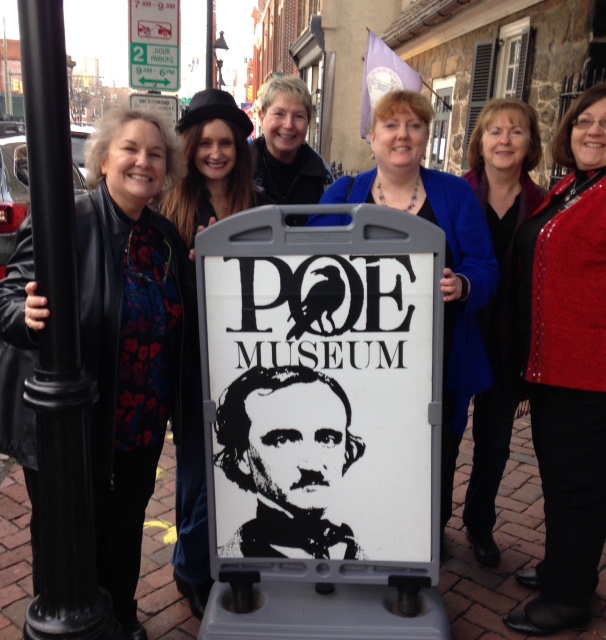
This year the event included a panel presentation and book signing by members of two local chapters of Sisters in Crime. Among other things, we spoke about Poe’s influence on our writing.


Sisters in Crime at Poe Museum for Poe's Birthday Bash
Sisters in Crime
Left to right: Rosemary Shomaker, Teresa Inge, Vivian Lawry, Heather Weidner, Maggie King, Yvonne Saxon
Sisters in Crime presenting Virginia is for Mysteries at Poe Museum for Poe's Birthday Bash, Edgar Allan Poe
Virginia is for Mysteries signing table
Seated, left to right: Teresa Inge, Maria Hudgins, Vivian Lawry; standing, left to right: Yvonne Saxon, Rosemary Shomaker, Maggie King, Heather Weidner


This is the biggest celebration of Poe’s birthday, the events and fun running from noon till midnight. Let Poe’s lights shine on!
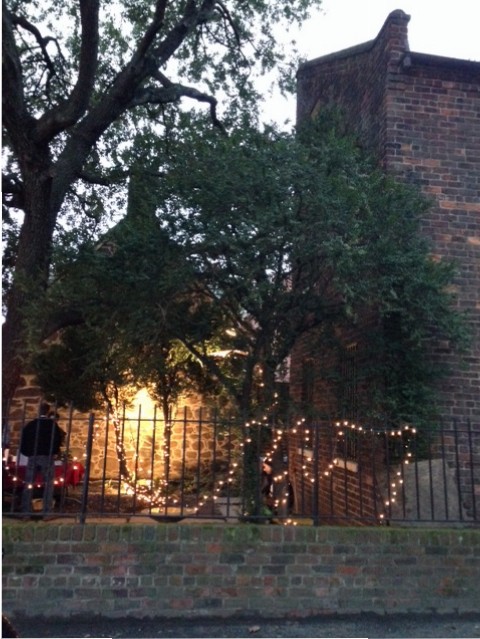
Poe Museum, Richmond, Virginia
Evenfall at the Poe Museum, Richmond, Virginia

happy birthday, edgar allan poe; edgar allan poe's birth

Why is Christmas Celebrated on December 25th?

Darwin's Christmas! December 25th

This post is part of a series that might be characterized as Darwin’s Christmas. I will be taking a number of our current traditions and tracing their evolution.

The logical answer would be, “We celebrate the birth of Christ on December 25th because that’s when He was born. ” But in this instance, the logical answer is wrong.


Neither the Bible nor any other record dates Jesus’s actual day of birth. In addition, the season when shepherds would be watching their flocks by night and when the census was taken would argue that the actual birth was either spring or autumn.


According to Stephen Nissenbaum, author of The Battle for Christmas, early Christians weren’t bothered by not knowing Jesus’s birthday for “It never occurred to them that they needed to celebrate his birthday.” Further, according to Nissenbaum, the Church got into something of a crisis, with people tending to believe that Jesus never existed as a man. Instituting a birthday celebration was a way to counteract that trend.
The Battle for Christmas by Stephen Nissenbaum
The first recorded date of Christmas being celebrated on December 25th was 336AD, during the time of the first Christian Roman Emperor, Constantine. Perhaps he chose that date because Pagan Romans would be celebrating the Winter Solstice, Saturnalia, and “Dies Natalis Solis Invicti” (birth of the unconquered sun) anyway. A few years later, Pope Julius I officially declared that the birth of Jesus would be celebrated on the 25th of December.


One very early Christian tradition held that on March 25th God told Mary she would have a very special baby.The Annunciation is still celebrated on March 25th—and nine months later is December 25th.
Henry Ossawa Tanner - The Annunciation
The Annunciation, Henry Ossawa Tanner
[Public domain], via Wikimedia Commons
The early Church celebrated Christmas, the Epiphany, and the Baptism of Jesus all on January 6th. In some parts of the UK, January 6th is still called Old Christmas.


Then, too, not everyone celebrates Christmas on December 25th even today. Some Christians use other dates or December 25th on non-Gregorian calendars. The dates below are all Gregorian.


January 6The Armenian Apostolic Church and the Armenian Catholic Church
January 7Eastern Orthodox and Byzantine Rite Catholics in Russia, Georgia, Ukraine, Macedonia, Moldova, Montenegro, Serbia, Greek Patriarchate of Jerusalem, Ethiopian Orthodox Tewahedo Church
January 7 or 8–Coptic Orthodox Church of Alexandria
January 19–The Armenian Patriarchate of Jerusalem.


Still, for many Eastern Orthodox Churches, Western Christian churches, and the secular world, Christmas is over.
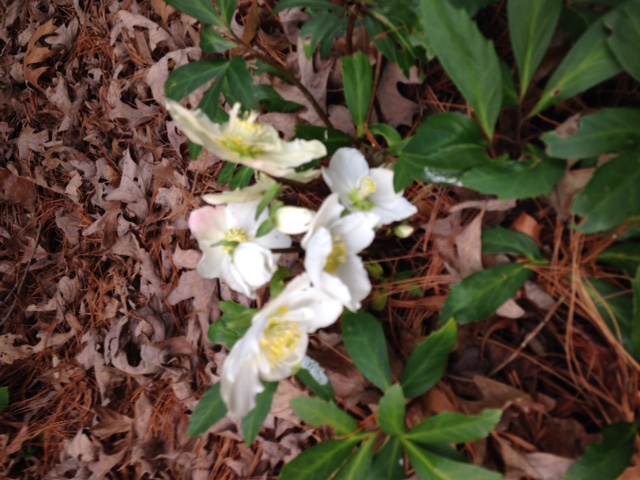
Christmas rose, hellebore niger
Christmas rose