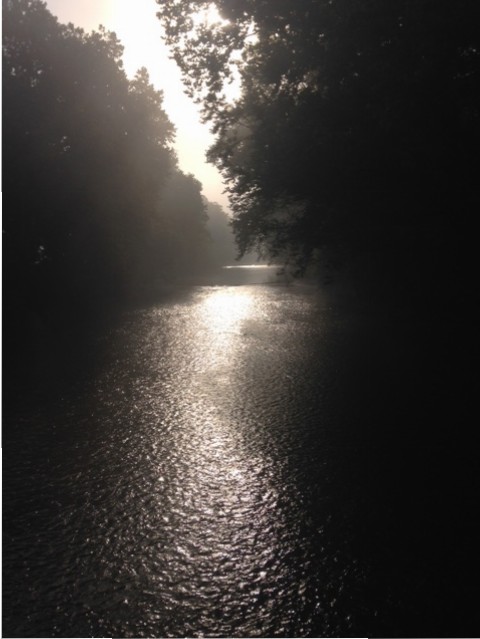
Although some people write to put food on the table, more write to feed their souls.
According to an article by Alison Flood of The Guardian, a 2014 survey revealed that 54% of “traditionally-published” authors and nearly 80% of self-published authors earn less than $1,000 a year. In this same survey, only a minority of respondents listed making money as “extremely important”—around 20% of self-published writers and 25% of traditionally-published authors.Overall, Flood concluded, “Most authors write because they want to share something with the world or gain recognition of some sort.” Clearly, most writers aren’t in it to put food on the table.
The joys of writing to feed one’s soul can be summarized in the word freedom.
Free to write on your own schedule.
Free from worry about sales covering the advance.
Free to write in any genre, not just the one(s) that sell best.
Free to ignore industry guidelines/standards for works of a certain genre, such as page length, structure, and language.
Free to switch genres or to write in many genres.
Free to write a series with a different protagonist.
Free to write anything and everything under one name.
Many big-name authors (i.e., those who make a lot of money writing) find themselves limited in the previous three freedoms. The reading public wouldn’t let Arthur Conan Doyle kill off Sherlock Holmes. Many authors write under more than one name. Search online under “famous authors who use multiple pen names” and go from there. Some authors do so to reinvent themselves—e.g.Stephen King/ Richard Bachman, J.K. Rowling/Robert Galbraith. Some use different names for different genres—e.g., Jenna Peterson writes historicals but uses the name Jesse Michaels for erotic romance. Other multiple-name authors include Dean Koontz, Richard Matheson, Joyce Carol Oates, Agatha Christie, C.S. Lewis, and Isaac Asimov. There are more.
Diana Gabaldon started off writing to feed her soul—in my opinion! She says that she wrote Outlander for practice, to learn the craft, with no intention of showing it to anyone. Not only did she write an impossibly long book (by industry standards) but she mixed romance, adventure, history, time-travel, and magical elements.
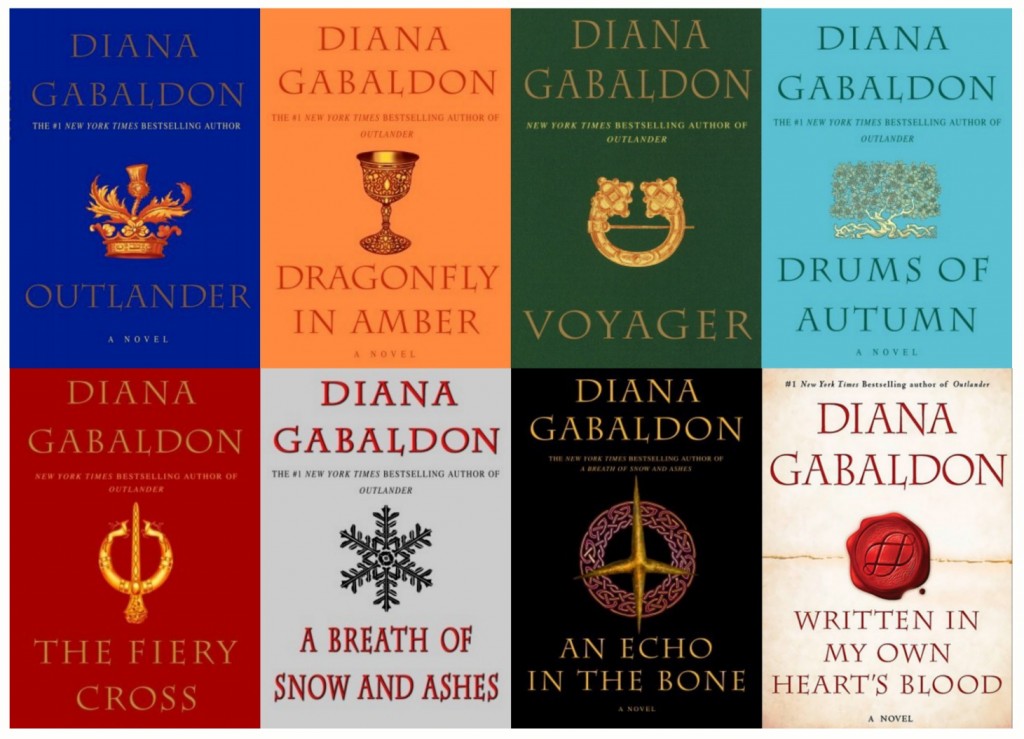
You can also read over seventy comments on this piece online. She starts with a discussion of how writers’ brains work and moves on to the limitations of genres.
When you write to feed your soul, the only real requirement is that you write.
Definitions of magical realism abound. Merriam-Webster defines it as “a literary genre or style associated especially with Latin America that incorporates fantastic or mythical elements into otherwise realistic fiction.” Here’s the definition I am using for this blog: supernatural, paranormal, or unexplainable phenomena which are included and accepted as reasonable within a work of fiction. It could be spiritual, or just plain weird.
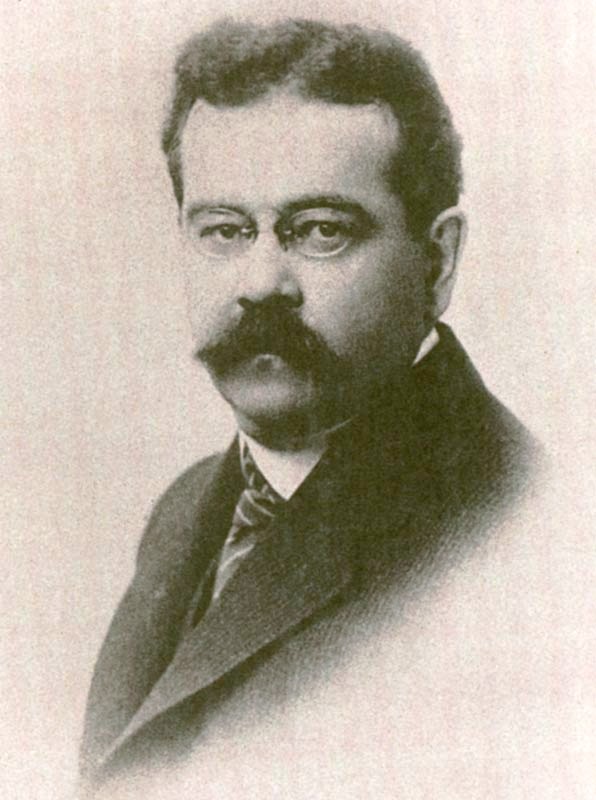
Charles Hoy Fort [Image is in the public domain]
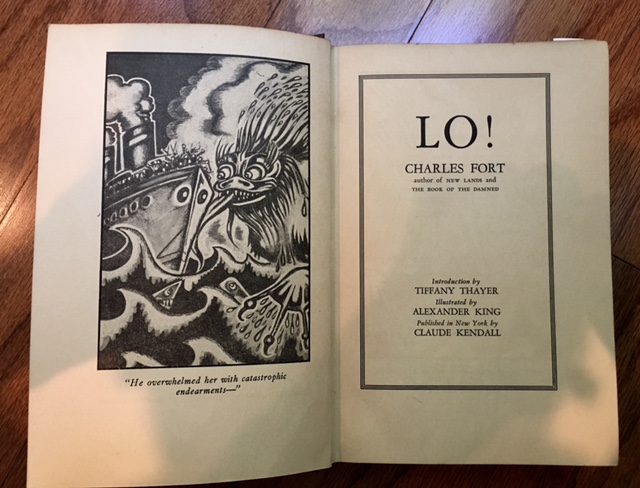
Charles Hoy Fort is a goldmine for writing magical realism. He was an American writer and researcher into “anomalous phenomena” who combed scientific writing, libraries, and newspapers to find reports of such phenomena. He is best known for four books, still available today: The Book of the Damned (1919), New Lands (1923), Lo! (1931), and Wild Talents (1932). He doesn’t try to explain the phenomena he reports, nor does he posit theories. He takes a “just-the-facts-ma’am” approach. Each phenomenon gets a few pages, with various instances cited—providing a solid base from which writers can launch into literary magic.
Lo! (1931)
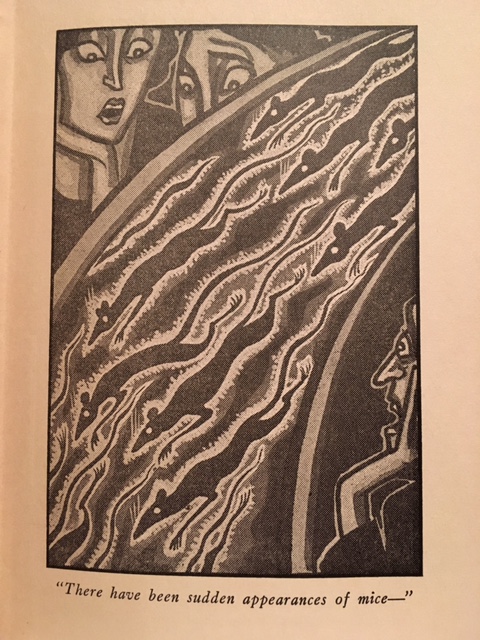
In my opinion, Fort’s reports are timeless. He covers things like showers of frogs and blizzards of snails—many extraordinary, and unexplained, skyfalls. He reports having collected 294 records of showers of living things. He writes of ice images, millions of years old, that are later expressed botanically in an onion. He writes of teleportation, spontaneous fires, ball lightning, unexplained disappearances, and alien abduction. Such phenomena have subsequently been labeled Fortean, and Forteana used to characterize collections of them.
Although I consider Fort’s original works timeless, if you want something more contemporary, check out The Fortean Times magazine, in print since 1973.
Although Charles Hoy Fort has been recognized for his influence on science fiction writing, consider the writings of Fort as a source of inspiration for writing magical realism!
Lillian Glass defines a “Toxic Man” as one who elicits negative emotions from you, behaves badly toward you or doesn’t treat you right, or makes you feel bad about yourself (thus affecting your behavior and lowering your self-esteem). Substitute “your character” for “you” and voila! You have the makings of a great deal of tension in scene after scene and a lot of sympathy for your character.
Glass’s book includes questionnaires to identify specific ways in which the Toxic Man elicits negative emotions.
Under the heading “How Does He Behave Toward You?” there are several subheadings: sadistic behavior, manipulative behavior, dishonest behavior, selfish behavior, non-communicative behavior, critical and judgmental behavior, angry behavior, embarrassing or shaming behavior, controlling behavior, and jealous behavior.
And under the heading “How Does He Make You Feel about Yourself?” the subcategories are: feeling emotional changes (feeling depressed, hopeless, frustrated, anxious or panicky, angry, empty, etc.); feeling afraid or fearful; feelings of self-doubt; physical changes (such as sickness, headache, weight gain or loss); feelings of guilt and shame; or just not feeling like your old self.
The Eleven Toxic Types of Men:
The jealous competitor
The sneaky passive-aggressive silent-but-deadly erupting volcano
The arrogant self-righteous know-it-all
The seductive manipulative cheating liar
The angry bullying control freak
The instigating backstabbing meddler
The self-destructive gloom-and-doom victim
The wishy-washy spineless wimp
The selfish me-myself-and-I narcissist
The emotional refrigerator
The socio-psychopath
Glass’s book is accessible, gripping, and a great read. I recommend it to writers in any genre!
Dr. Lillian Glass
AND REMEMBER: role-reversal is always a great alternative! For every toxic man, there’s a toxic woman!
Want to publish a best-seller? Consider hiring a ghostwriter—or being one! In this blog, I will use as my case in point Tony Schwartz’s ghostwriting of Donald Trump’s memoir, The Art of the Deal.
The Art of the Deal
My impression is that most ghost-written books are memoirs, books about people of interest to the public who lack the skill and/or the time to write a book themselves. But there’s no reason that a book of any sort couldn’t be ghostwritten, with the possible exception of textbooks.
Tony Schwartz, Trump’s ghostwriter
Ghostwriting is a recognized profession, and can be lucrative. The Canadian Writers Union sets the minimum fee for ghostwriting a book at $25,000. But it’s an individually negotiated contract, and less experienced writers might be paid $10,000-$15,000. According to Writer’s Digest in 2011, one experienced ghostwriter averaged $15,000-$25,000 for a book of 50,000-75,000 words. Another made $12,000 for a 30,000-word book. A third was paid $22,500 for a 65,000-word book.They say that very successful collaborators earn $30,000-$50,000 per book.
Cover of The New Yorker, July 2016
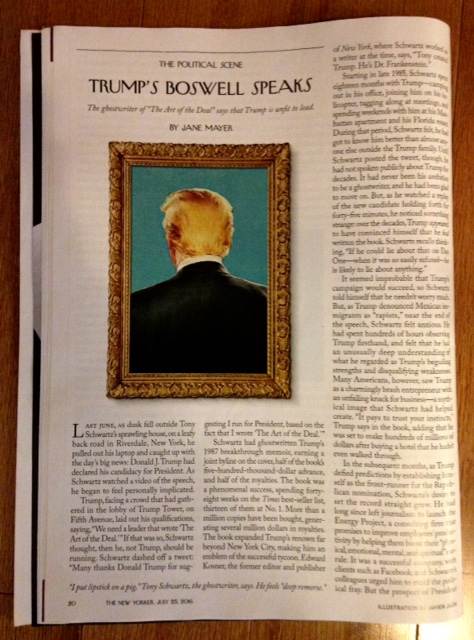
But there are other arrangements. According to Schwartz, in his interview with Jane Mayer for “Trump’s Boswell Speaks” in the July 25th, 2016 issue of The New Yorker, Schwartz earned 50% of the book’s $500,000 advance and half of the royalties. Given that the book spent 48 weeks on the Times best-seller list, that was truly substantial!
Jane Mayer, staff writer for The New Yorker
Money is clearly an upside to ghostwriting. But there are downsides as well. If one’s client doesn’t interview well, you might need a work-around. Schwartz was virtually joined at the hip with Trump for eighteen months, traveling with him, listening in on his phone calls, etc.
Then, too, check out “The Brutally Honest Truth About Ghostwriting” from 2013. They advise that one does the job, gets paid, and gets out. There can be personality issues, as discussed by Schwartz. And post-best-seller remorse.
Mayer’s article about Schwartz and Trump
So maybe ghostwriting isn’t for you, from either side of the contract. But it’s always good to know the options!
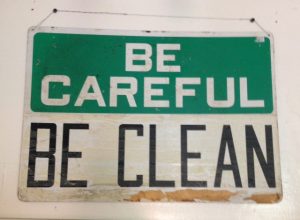
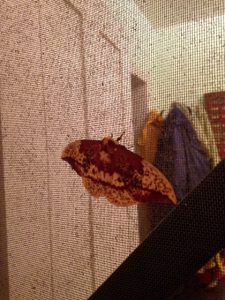
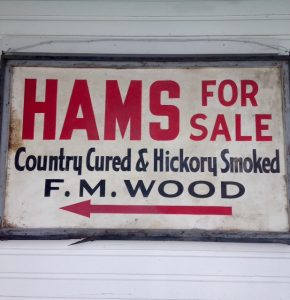
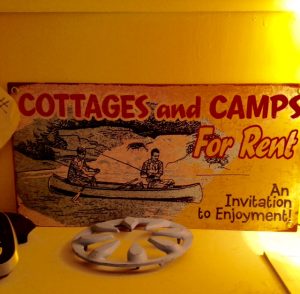
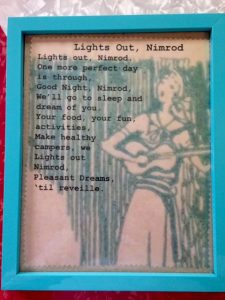
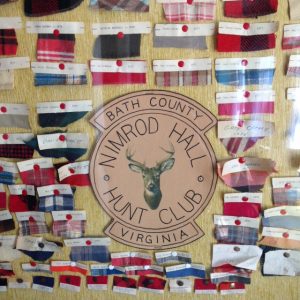
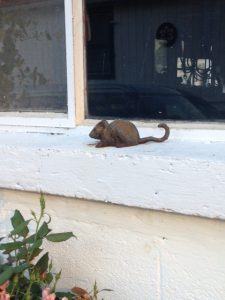
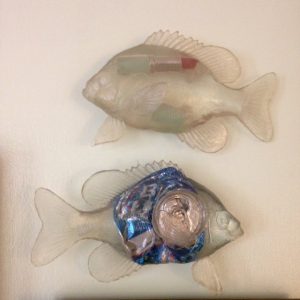
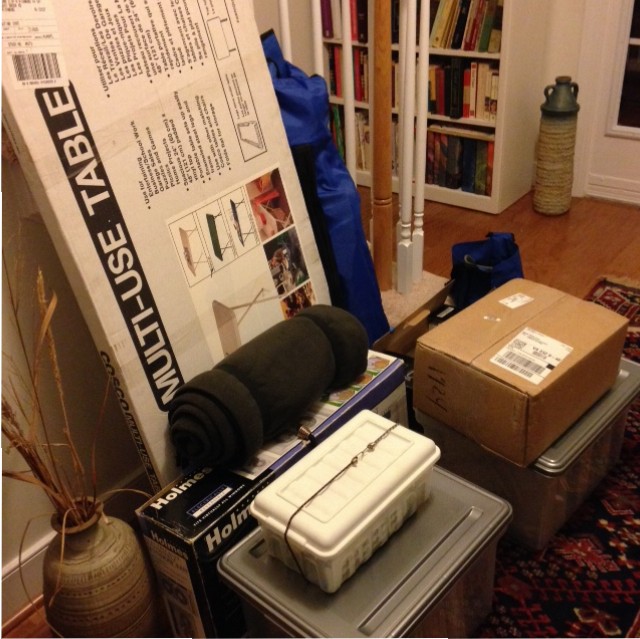
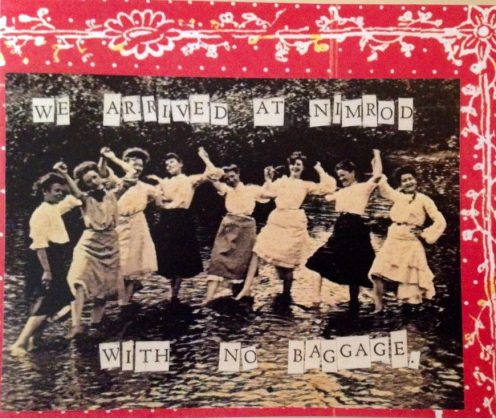
I’m still working on re-entry. The thing about Nimrod is that there is always something to see. Here is a selection of things you might use as writing prompts:
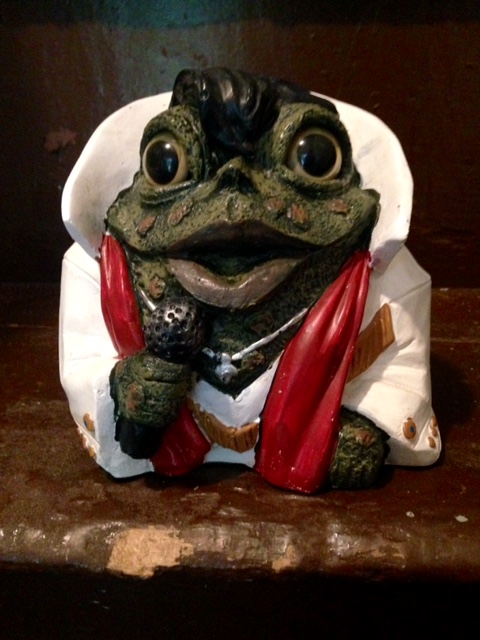
The frog statue is supposed to be Elvis. You know the story of the princess kissing a frog and turning him into a prince. Who might have kissed The King to turn him into a frog?
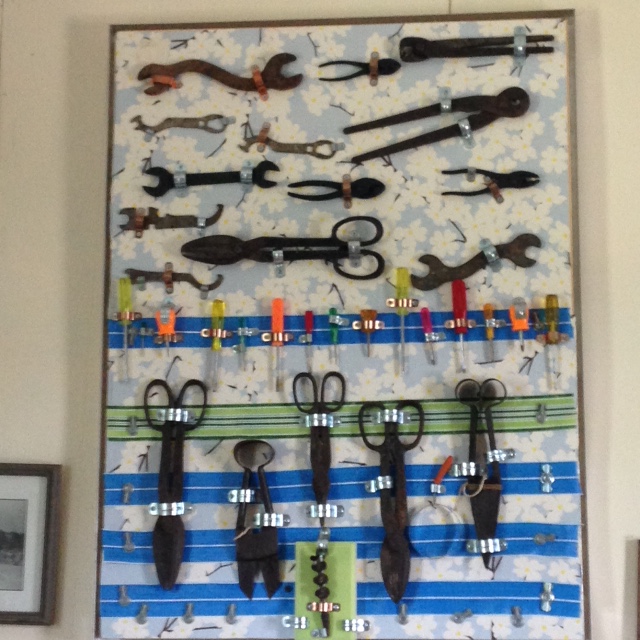
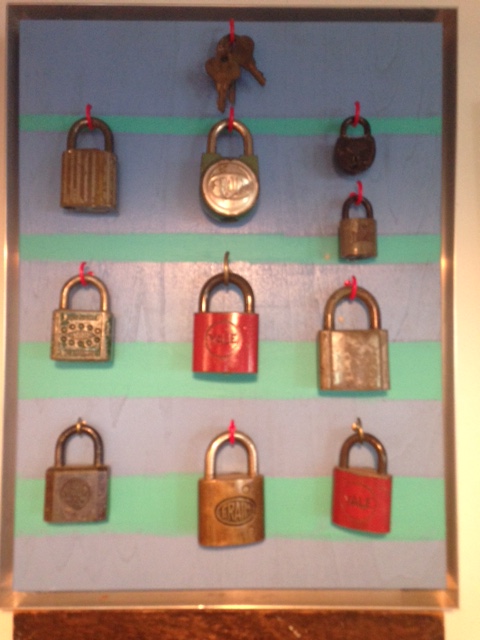
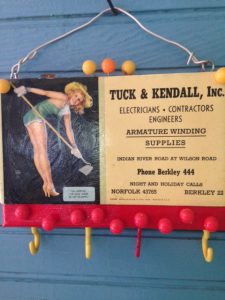
Who might have curated these collections, and why are these particular items of interest?
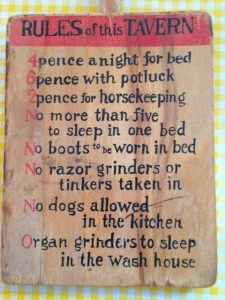
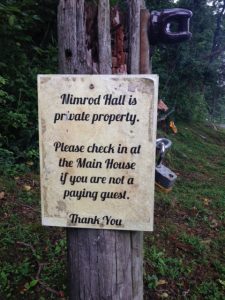
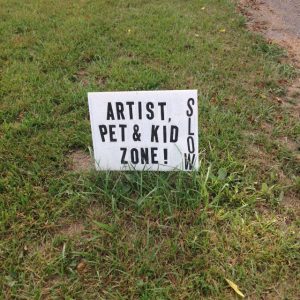
Write your own rules. Or write about a place that would post the ones below. What happens if someone breaks the rules?
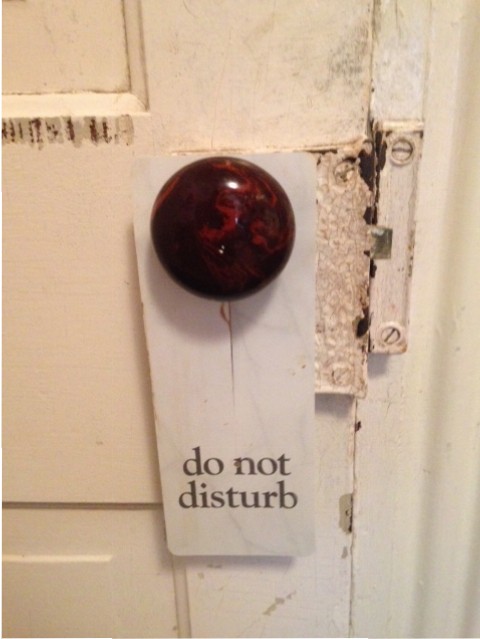
What if an uninvited guest drops by?
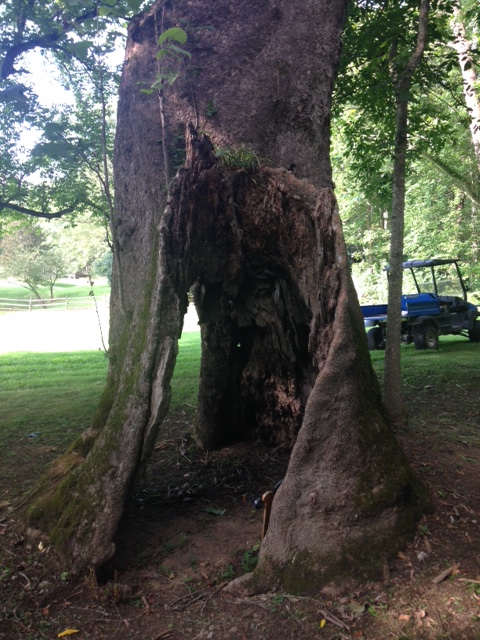
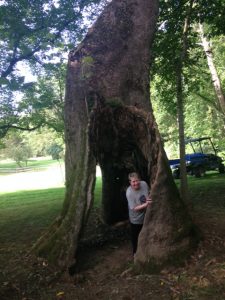
Notice the edge of a folding chair just visible in the big, hollow sycamore. Write about who might be using that chair, and why.
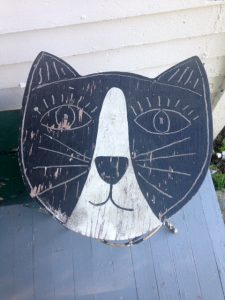
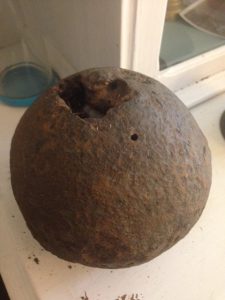
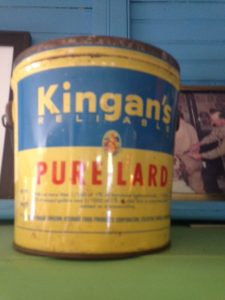
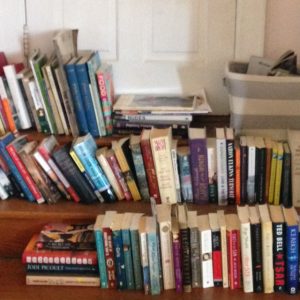
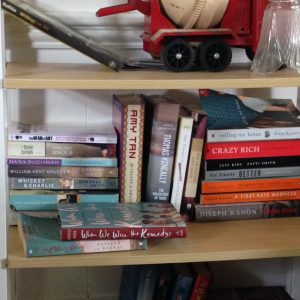
Or try your hand at writing flash fiction and include all the items from one–or more–of these groups.
#1
#2
#3
#4
#5
#6
And when all is said and done, if you aren’t writing at or about Nimrod, read!
And this really is all till next year!
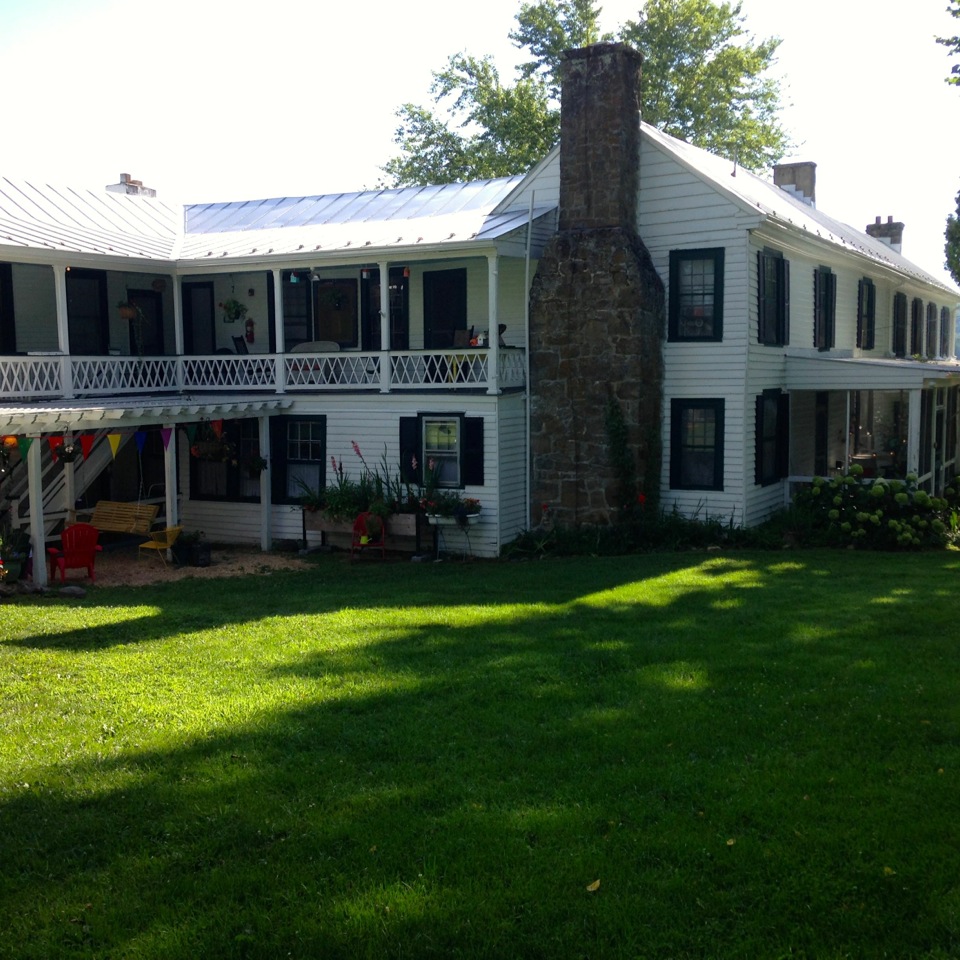
Nimrod Hall, established in 1783, has been providing summer respite from everyday stress since 1906. It has been operating as an artist and writer colony for over 25 years. The Nimrod Hall Summer Arts Program is a non-competitive, inspirational environment for artists to create without the distractions of everyday life.
Energy is always high when I arrive at Nimrod on Sunday: getting settled, reuniting with friends, meeting the new writers, and getting the schedule for the week ahead.
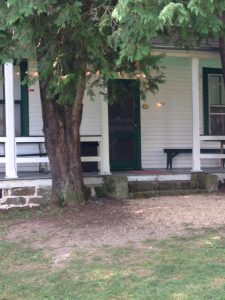
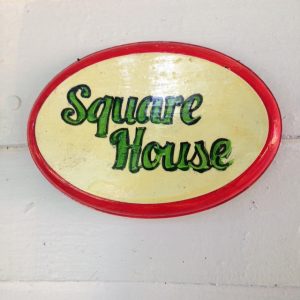
The Square House at Nimrod Hall
I was in Square House again this year, my favorite room! It’s downstairs, dim, and I know where my things will fit and how many extension cords I’ll need.
Cathy Hankla in our workshop
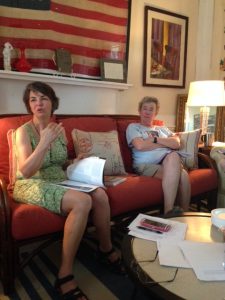
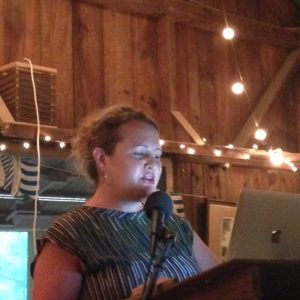
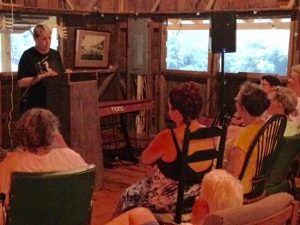
One of our wonderful evening readers
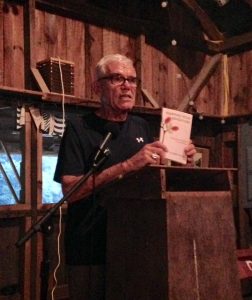
Another wonderful evening reader
Monday through Thursday at Nimrod is intense: focused writing, talk with fellow writers—who often ask how your work is going, which certainly reinforces that focus and productivity are expected and rewarded—reading every day for workshop, sharing opinions with other readers, then listening to the 8:00 readers after dinner…
All of this happening across varied genres leaves me feeling worn. I suspect others do as well.
So an open day on Friday was cherished! I walked in sunshine for the first time.
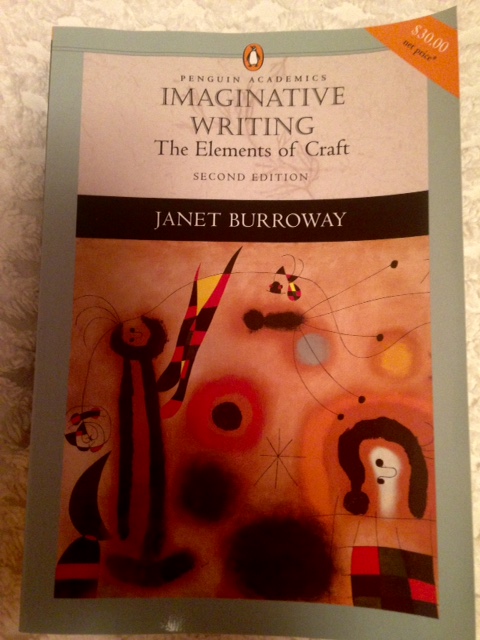
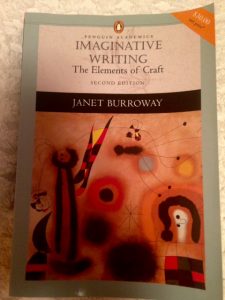
Imaginative Writing by Janet Burroway
It’s also a chance to tie things up. I (finally) turned to to the reference Cathy Hankla had given me on Monday! Unfortunately, I could not send off “Repair or Redecorate?” because my computer went all wonky. The touch-pad didn’t control the cursor. Damn! But at least it’s ready to go. I started packing to leave on Saturday.
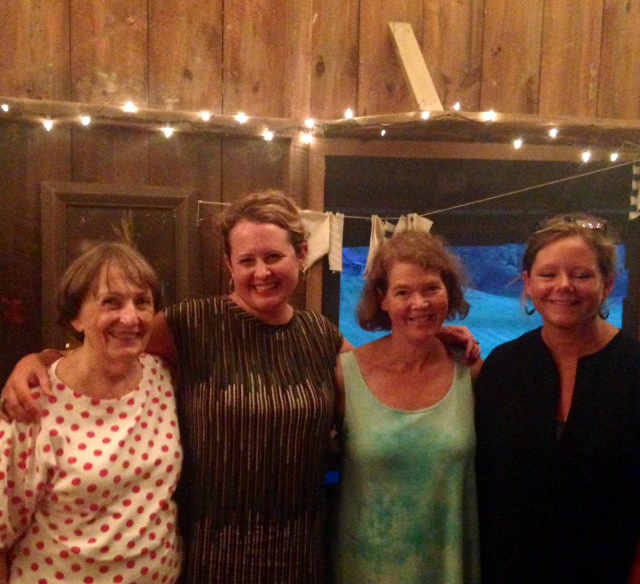
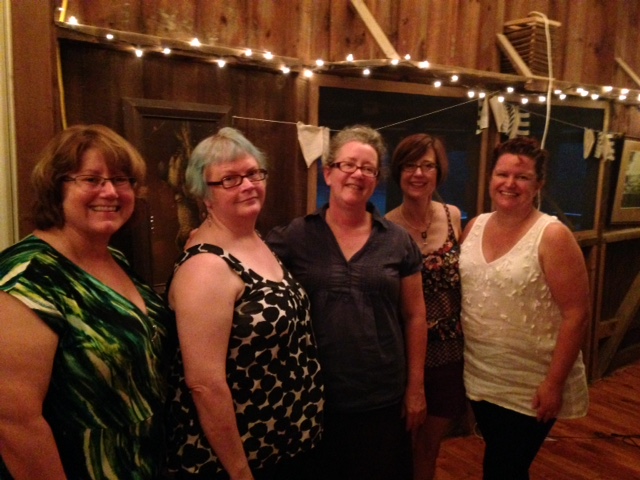
I got a photo of Thursday’s readers on Friday evening, in the course of a most entertaining variety show! This was new to my years at Nimrod. Kristy Bell did an incredible job as MC! We had multiple readings of poetry, fiction, memoir, and all the other genre’s represented here, up and down the emotional spectrum. But we also had musical interludes!
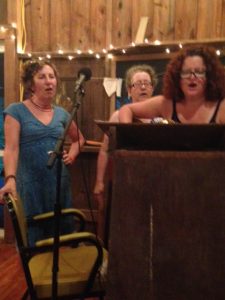
Singers L-R: Judy Bice, Amelia Williams, and Terry Dolson
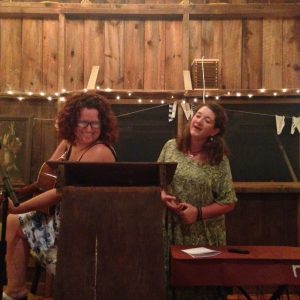
Terry Dolson and Sheri Reynolds
Terry Dolson accompanied Judy Bice, Amelia Williams, and Sheri Reynolds while the rest of us joined in as well as we could on such classics as “Country Road” and “Bobbie McGee.” I’m here to tell you, Sheri Williams does a mean Janis Joplin!
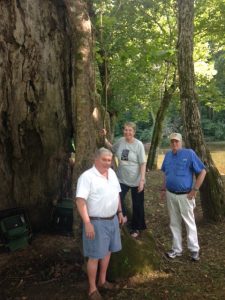
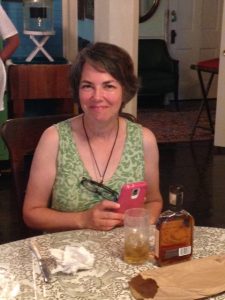
Most year I’ve gone to the Jefferson Baths. This year, I mourn missing it. But several of us had accepted a neighbor’s invitation for drinks and a visit to the champion sycamore tree: 10 feet across, 33 feet around. It was good viewing and very good scotch!
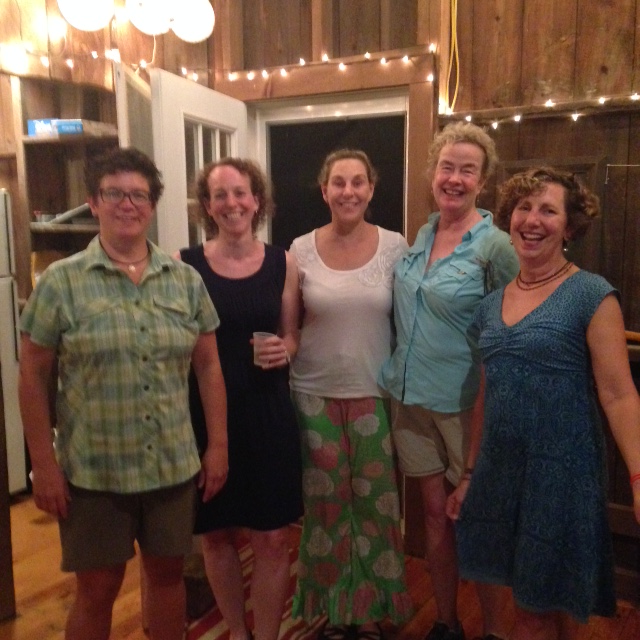
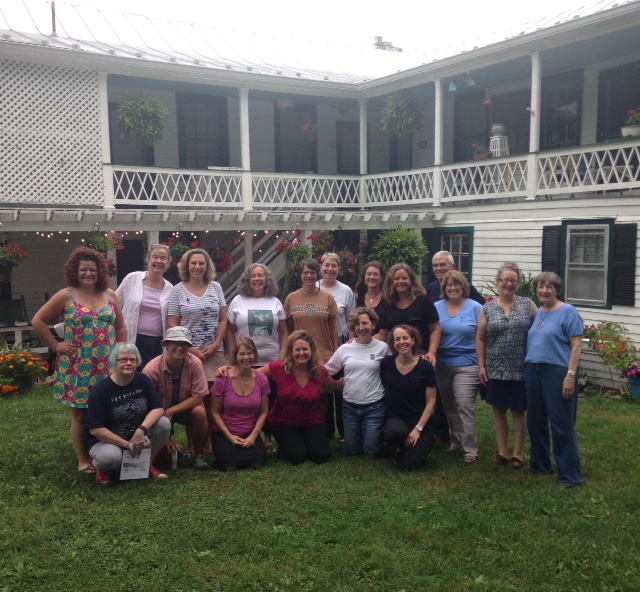
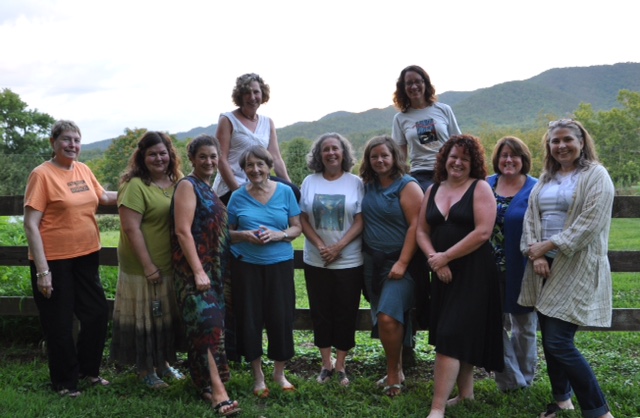
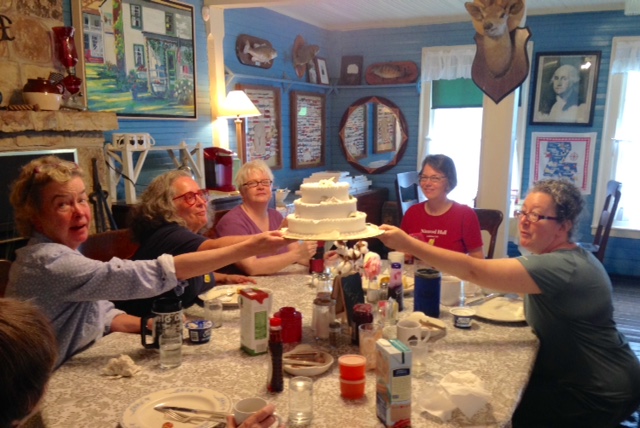
Every year we take a group picture. This one came was Saturday morning, just after breakfast.
L-R, kneeling: Foust, Kristy Bell, Nancy Hurrelbrinck,Jennifer Dickinson, Judy Bice, Ruth Gallogly; L-R standing, Terry Dolson, Jane Shepherd, Kit Wellfod, Charlotte Morgan, Cathy Hankla, me, Sheri Reynolds, Molly Todd, David Cooper, Betsy Arnett, Amelia Williams, Frances Burch.
Unfortunately, several people left on Friday. Oh, sigh. Maybe next year!
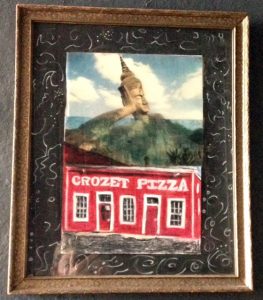
By 10:00 Saturday morning, Frances Burch and I were on the road. We followed our usual routine: we stopped in Crozet, Virginia for shopping at Over the Moon Bookstore and lunch at Crozet Pizza. For the first time ever, we had their specialty pizza that is a white base, topped with herbs, summer squash, and peanuts! It was excellent.
I was home by 3:00, but Nimrod lingers. There’s always a long re-entry time!
Nimrod Hall, established in 1783, has been providing summer respite from everyday stress since 1906. It has been operating as an artist and writer colony for over 25 years. The Nimrod Hall Summer Arts Program is a non-competitive, inspirational environment for artists to create without the distractions of everyday life.
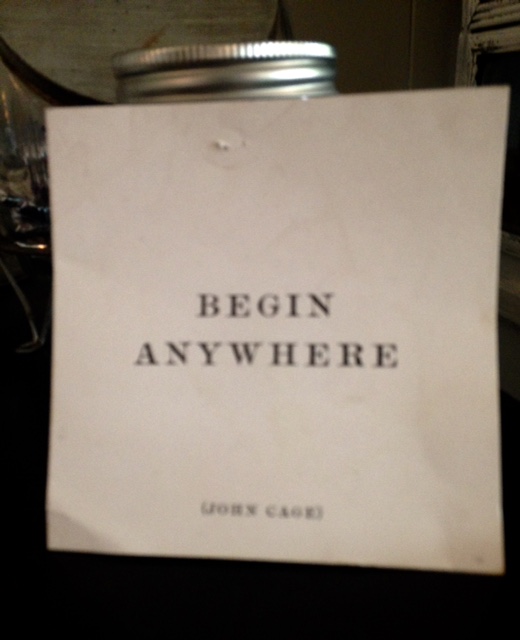
What a week it’s been! Where to begin? Well, I guess with this message:
“Begin Anywere.” -John Cage
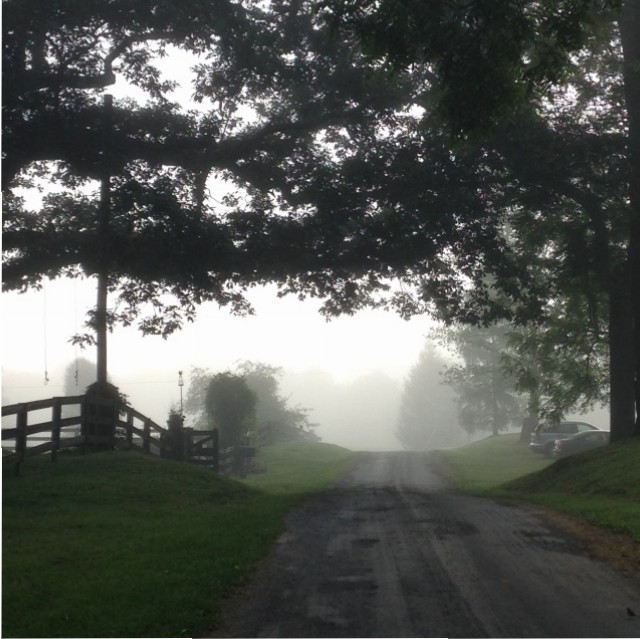
So, how about walking through a typical day? As you know, I’m fond of before-breakfast walks—usually damp and misty. But glories abound, from wildlife and flowers along the way, to the little graveyard up the hill, to the Cowpasture River down the hill.
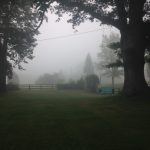
A misty morning at Nimrod Hall
We found a rabbit!
Flowers in a field found during a morning walk
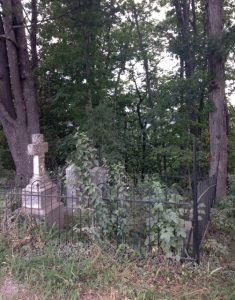
A graveyard along the walking trail
The river nearby
People gather to await the breakfast bell, still slightly groggy. But after a coffee infusion and a more-than-ample breakfast, we are hyped for the sacred writing time, which lasts till 1:00 lunch.
Waiting for the breakfast bell
This year I finished and revised a 6K word short story mystery AND submitted it! So thanks to my fearless leader Cathy Hankla and my workshop/critique group members for comments and suggestions.
Cathy Hankla
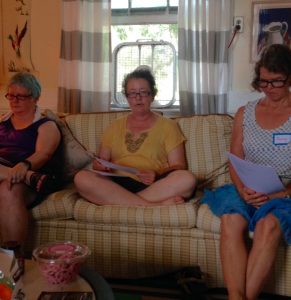
Amelia William, flanked by Foust and Nancy Hurrelbrinc.
One of Cathy’s great strengths as a teacher is that she always seems to come up with targeted reading for specific writers. This year she brought Imaginative Writing for me. It contains “Interpreter of Maladies” by Jhumpa Lahiri, a wonderful example of showing an incident from the POV of a hired worker. But of course, Cathy is incredibly talented herself.
Imaginative Writing by Janet Burroway
Cathy’s book, Great Bear
I tend to be a cave-dweller, so while others hike, run, do yoga, or go tubing on the river, I keep writing. And everyone understands.
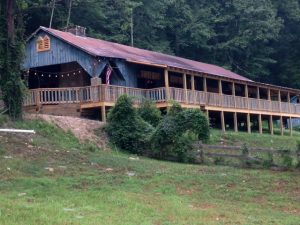
Happy half-hour was typically celebrated with our workshop group, followed by dinner during which we dispersed among the other writers present. Then we adjourn to the renovated Rec Hall for 8:00 readings. On Sunday night, Cathy Hankla and Sheri Reynolds read and Charlotte Morgan gave us our marching orders about the week’s structure.
The Rec Hall
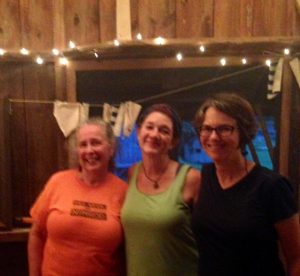
(L-R) Cathy Hankla, Sheri Reynolds, and Charlotte Morgan
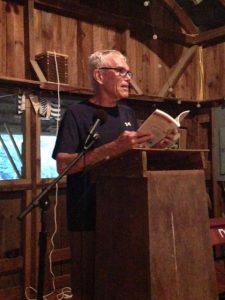
David Cooper and I read the first night. I read 600 words on “Repair or Redecorate?” which I hope you’ll have an opportunity to read in the Richmond Times-Dispatch sometime soon. David is a “retired” man of the cloth and counselor who bicycles, does yoga, and seemed perfectly comfortable surrounded by all these writer women!
David Cooper’s reading
My reading
Tuesday night’s readings were by Frances Burch, Jennifer Dickinson, Nancy Hurrelbrinck, and Molly Todd.
Wednesday night we had Betsy Arnett, Foust, Amelia Williams, Heath Lee, and Terry Dolson.
Thursday night it was Judy Bice, Jane Shepard, Ruth Gallogly, and Kristy Bell—and I didn’t get a picture! Maybe I can rectify that later.
This diverse group of writers includes poets, fiction writers, memoirists, inspirational writers, historians—you name it. Several are from the Richmond area, and therefore likely to be available for local readings, signings, etc. Besides me, Elizabeth Smart, Frances Burch, Judy Bice, Molly Todd, Kristy Bell, Terry Dolson, David Cooper, Foust, and Suzanne Munson fall into this category. But we also had writers from Roanoke, Boyce, and Afton, Virginia (Heath Lee, Betsy Arnett, and Amelia Williams, respectively), and two from Charleston, WV (Jane Shepherd and Kit Wellford). And then there were the outliers, Ruth Gallogly (Brooklyn, NY) and Denny Stein (Freemont, CA).
These are wonderful, interesting, dear people. What are the chances that I’ll see them again before next year?
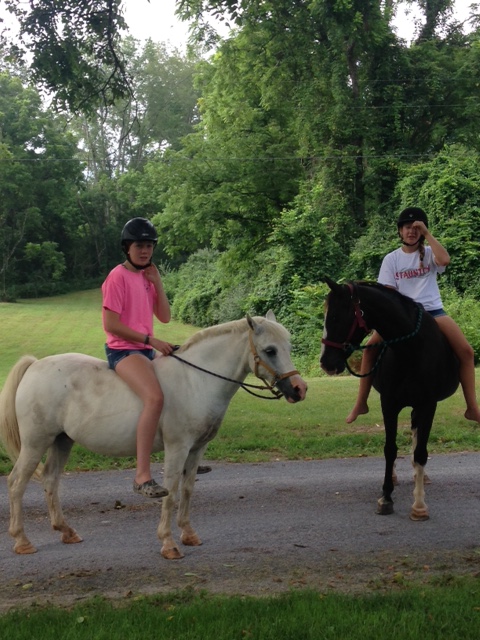
One reason I love Nimrod is that I never know what I’ll come across. It might be riders from Vinyard Farms next door. These are Amber and Frankie—the horses, not the riders.
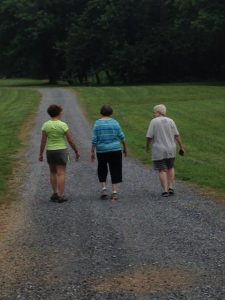
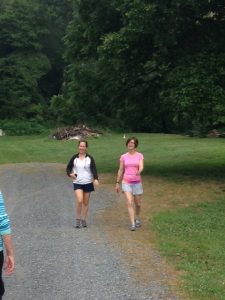
It might be fellow walkers…
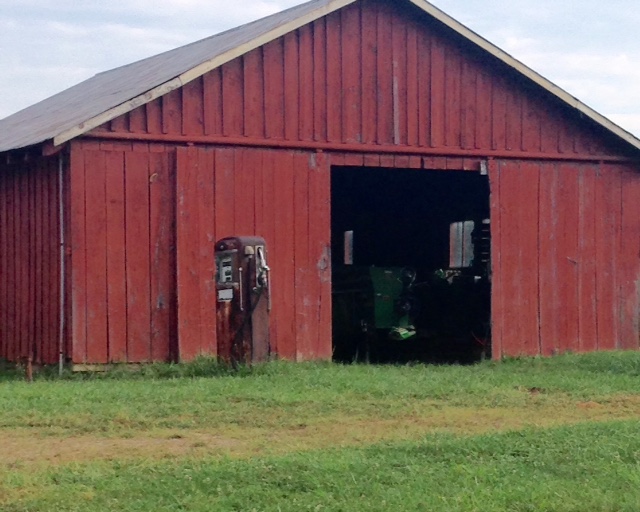
…or it might be an abandoned barn and gas pump. It’s always something!
And it’s always great company, great energy, and unstinting support! We don’t leave till tomorrow, but I’m missing it already! Stay tuned next week for a final wrap-up.
Nimrod Hall, established in 1783, has been providing summer respite from everyday stress since 1906. It has been operating as an artist and writer colony for over 25 years. The Nimrod Hall Summer Arts Program is a non-competitive, inspirational environment for artists to create without the distractions of everyday life.
We talk about why a character might act “out of character,” group mentality, behavior matching, why people might be more passive in groups or more likely to riot, and more.
Excerpt from “The Company You Keep – Does Your Character Act ‘Out of Character’ in a Group Dynamic?”
In this article, we’re talking about what happens to a character when they get into a group where a character might act “out of character”, which is a fun way to develop the plot.
Can you first give us a working definition for “group”
Vivian – We usually think three or more, but some “group” effects are present even with only two. Also, the “group” needn’t be physically present to exert influence.
Fiona – Can you explain that last sentence?
Vivian – Some group memberships are literal memberships–for example, a church congregation, sorority, bridge club, etc. such groups are often in our thoughts, and serve as a reference or standard for behavior even when the member is alone.
Fiona – Does “group mentality” work both ways? For example, people in a riot become riotous, but people in a disaster, where they see all hands on deck, become heroes?
People in a religious forum feel more religious. . .sort of like a magnifier?
Vivian – Absolutely. I just mentioned formal groups–which are the ones having the strongest influence at a distance– but crowds, mobs, any physical gathering of people, shapes our behavior to act or remain passive.
Fiona – Can you give us a short tutorial on what we need to know about group dynamics to help write our characters right?
Vivian – Well, there is a phenomenon known as behavior matching, a tendency to do what others around us are doing. This is reflected in everything from eating to body language. Even a person who has eaten his or her fill will eat more if someone else comes in and starts eating. If others are slouching, your character isn’t likely to remain formal.
Fiona – Yes, it’s hard to pass up a piece of chocolate cake when everyone else is moaning about how delicious it tastes.
Just sayin’
Vivian – A related phenomenon–I suppose it could be a subset of behavior matching– has the label diffusion of responsibility. This is the tendency for people to stand passively by when others are present. There was a classic case, decades ago, in which a NYC woman named Kitty Genovese was murdered in the courtyard of her apartment. The murder took approximately half an hour, and dozens of her neighbors watched from their windows. No one came to help or even called the police. The more people who could help, the less likely anyone will take responsibility for doing so.
And then there is group disinhibition. This is sort of the opposite. It is that people are more likely to take risks, break the law, be violent when others are doing so. Think looting, or harassing a homeless person. Disinhibition is even more powerful when alcohol is involved. I recently posted a blog on alcohol for writers that goes into that a bit.
But the bottom line is that we behave differently with others present than when alone.
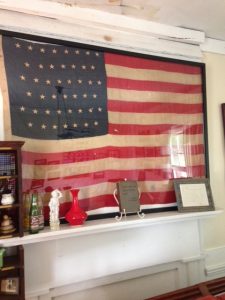
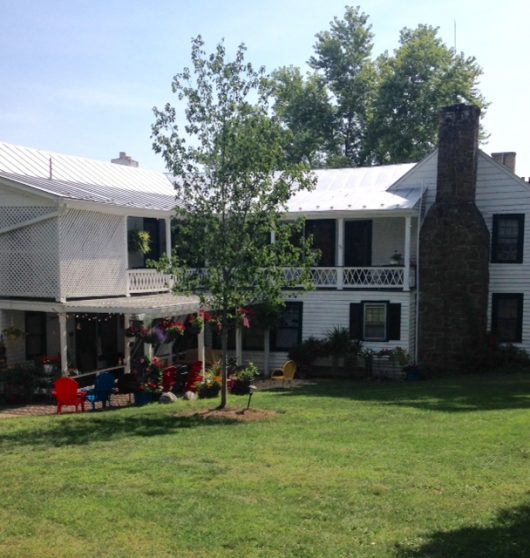
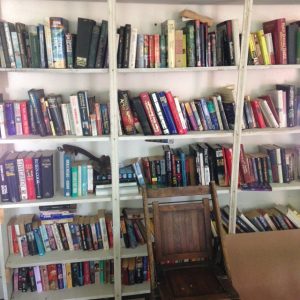
I treasure the constancy of Nimrod—all the things that stay the same. The physical surroundings have been spiffed up a bit from five or so years ago, but it’s basically unchanged: the main building, where hummingbirds gather and people wait for meal bells…
The main building of Nimrod Hall
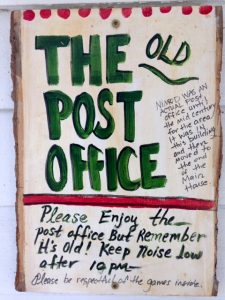
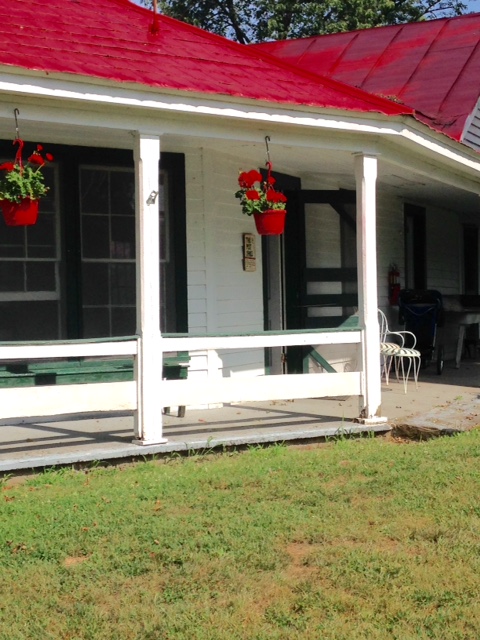
. . . the Old Post Office—which is the only pace where smoking is allowed. You will notice that the smoking porch doesn’t get much business!
The Old Post Office porch
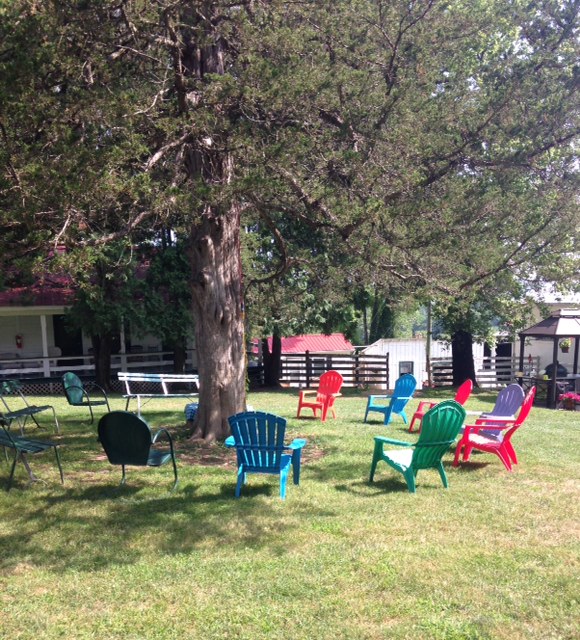
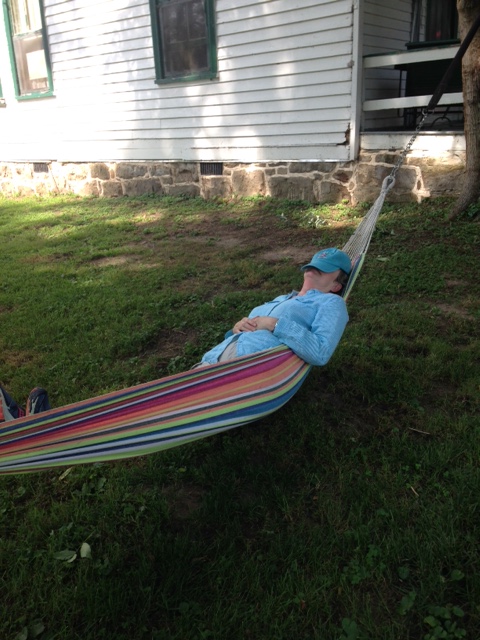
. . . and all the spaces where people could lounge but aren’t, for these pix were taken during the morning, which is sacred writing time, and therefore all good little writers are sequestered in their rooms…
Another thing that hasn’t changed about Nimrod is, as Charlotte Morgan says often, “There’s no such thing as a forced march!” So if one chooses not to write in the morning, that’s fine—as long as one is quiet and doesn’t encourage others to sluff-off.
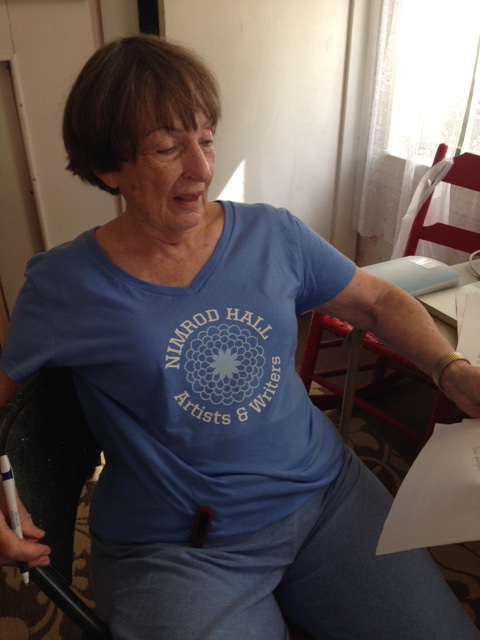
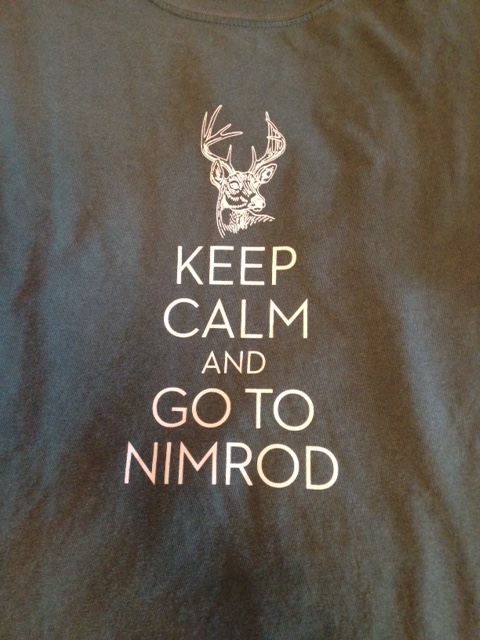
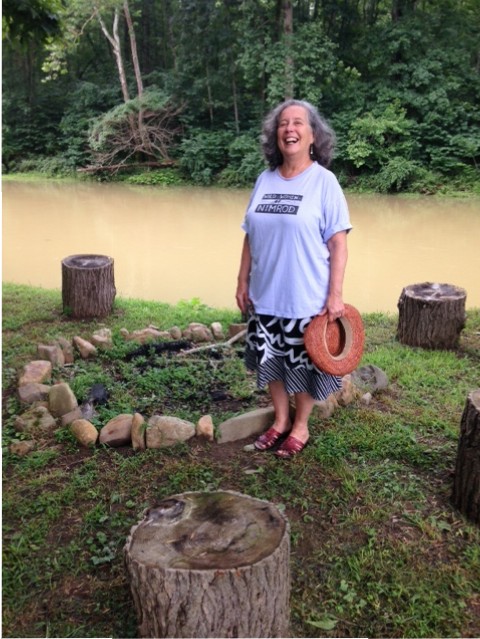
And one more thing that hasn’t changed: every year there are new t-shirts!
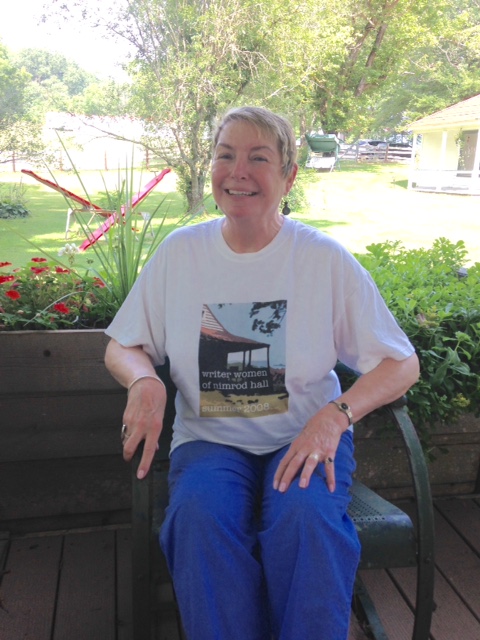
Frances Birch wearing a Nimrod t-shirt
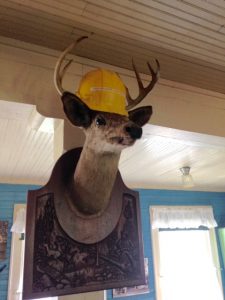
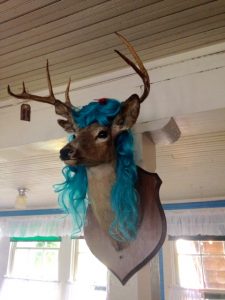
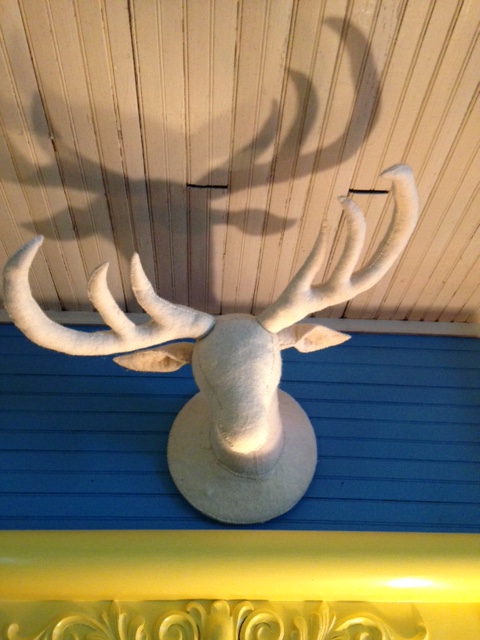
Once upon a time, Nimrod was a hunting camp, and reminders of that past are here still. As you can see from the following pix, the image has morphed over the years from the traditional trophy head to my personal favorite:
There are two new deer this year:
What’s new at Nimrod Hall?
This year, for the first time, there are three writers in residence present at the same time—Cathy Hankla, Charlotte Morgan, and Sheri Reynolds. Oh, if I could work with them all!
Cathy Hankla
Charlotte Morgan
Sheri Reynolds
This year, all the writers mingle over meals and at the 8:00 evening readings:
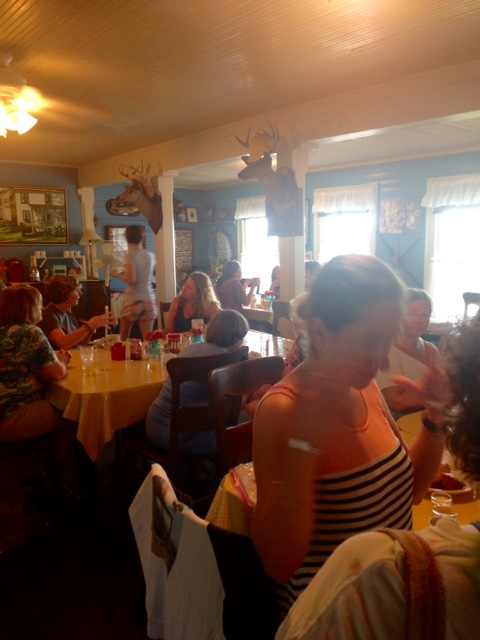
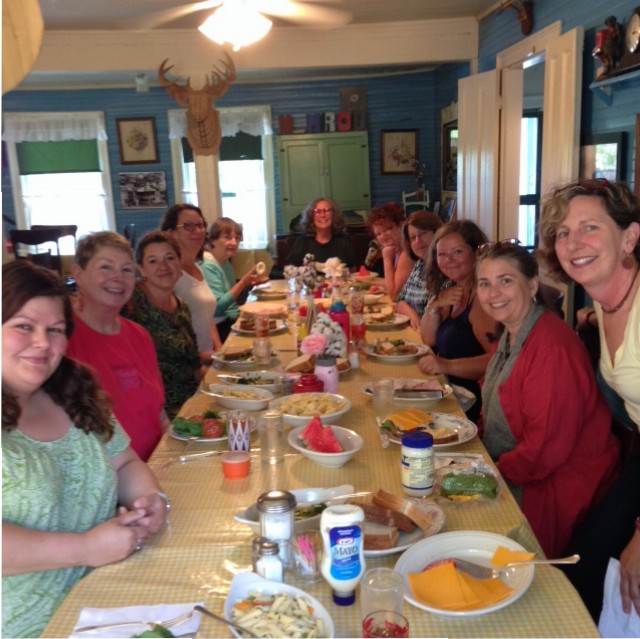
The dining room of Nimrod Hall
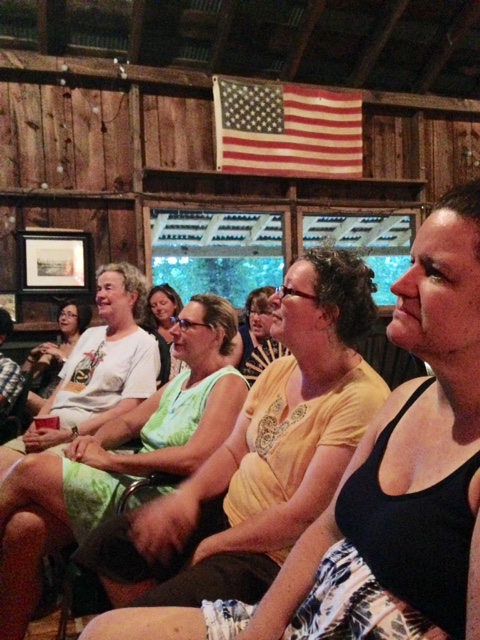
Evening reading at Nimrod Hall
Other meeting are much as before—i.e., critiques in small groups and a one-on-one conference with one writer-in-residence. I will meet with Cathy. I’m happy to be here!
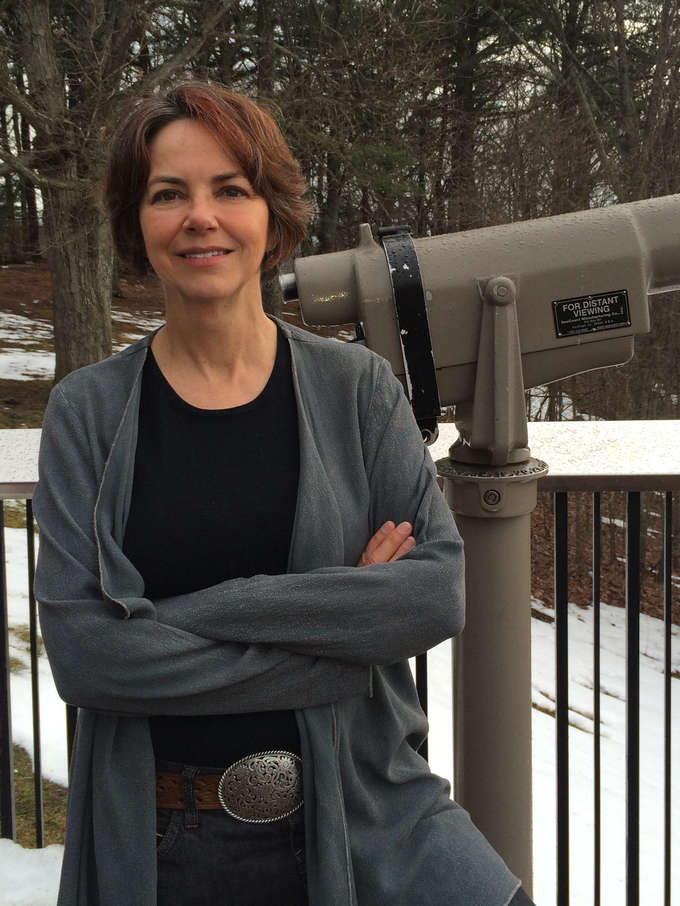
Nimrod Hall, established in 1783, has been providing summer respite from everyday stress since 1906. It has been operating as an artist and writer colony for over 25 years. The Nimrod Hall Summer Arts Program is a non-competitive, inspirational environment for artists to create without the distractions of everyday life.
For many years I’ve traveled to Nimrod Hall in Millboro, Virginia, for their annual writing retreat. Nimrod has inspired several of my stories and given me hours of valuable writing time.
Cowpasture River near Nimrod Hall during my morning exercise
Nimrod Hall, established in 1783, has been providing summer respite from everyday stress since 1906. It has been operating as an artist and writer colony for over 25 years. The Nimrod Hall Summer Arts Program is a non-competitive, inspirational environment for artists to create without the distractions of everyday life.