True confession—in case you hadn’t figured this out yet: I’m a book hoarder. So, you might ask, why does someone who seldom sees a book she doesn’t want to own love libraries? Let me count the ways!
My local libraries all have book sales on-going, and I can pick up all sorts of interesting books, CDs, DVDs, etc., for $1-$2—some good enough to gift!
I can borrow audio books for those times when I can’t actually read—e.g., when I have a raging case of conjunctivitis or I’m driving 200 miles
Many people—even writers!—think research means Google, but sometimes that comes up short. In my experience, nothing beats the reference section of a library and a friendly librarian for helping to ferret out the tidbits you need to make your story real.
Probably less important for writers than for others—except in emergencies—but libraries offer free access to computers, and thus the internet.
Libraries host programs that are free to the public, often talks by writers or about writing.
Study rooms and meeting rooms are available free for non-profit use—such as critique group meetings. IMHO, every writer should have at least one good critique group that meets regularly, and meeting at a library means no one has to make the house suitable for visitors!
Inter-library loan is a godsend!
So why do I love libraries? Because I’m a writer!
Tell me your reasons for loving libraries. Leave a comment below, or find me on Facebook or Twitter.
When I was reading about snow for my blog of XXX, a number of non-snow tidbits caught my eye. Whether any of these make it into your writing or not is up to you!
In “Love and Lust Are Seasonal,” Jane J. Lee reported that men rated pictures of women’s breasts and bodies as more attractive in the winter months, although they rated pictures of women’s faces the same. Could it be that men don’t see women’s bodies as much during the winter, and so are more excited when they do?
“Have Your Hottest Sex Ever This Winter” (Men’s Health, 2014) claims that cold weather dulls sexual sensations, and cooler body temperatures decrease arousal for both men and women.
Winter cold increases a person’s appetite which can, in turn, lower libido. One more reason to diet: weight gain decreases libido and makes both men and women less sexually adventuresome.
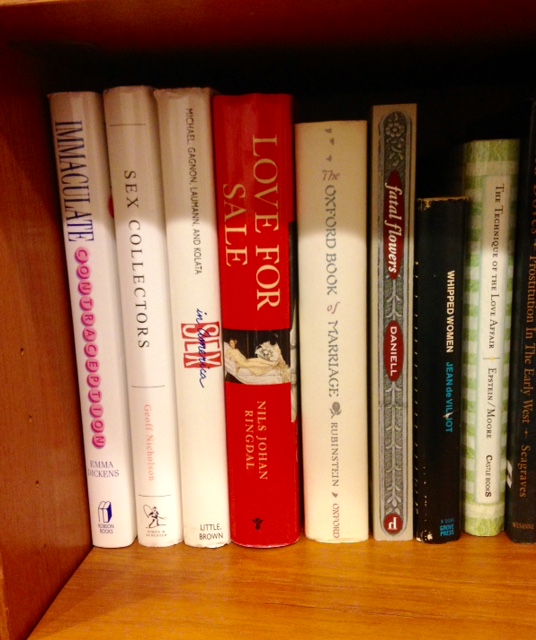
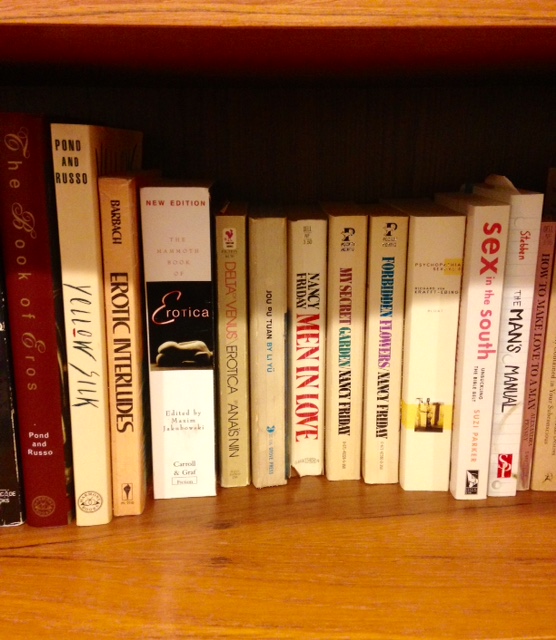
My book shelf
Men’s Health also reported that women are 30% more likely to have an orgasm if their feet are warm. This one may be a tough sell. At a dinner party discussion among young married couples about wearing socks to bed, the men were unanimous in declaring that no matter what else is (or isn’t) worn, socks are not sexy! (A social scientist would call this a sample of convenience.)
Google searches for porn, boobs, XXX, massage parlor, e-Harmony andMatch.com all peak in early summer and around the winter holidays.
More than twice as many condoms are sold in the week before Christmas than the week after.
Even so, the most frequent birthday in the United States is September 16. You do the math. Conversely, August has the fewest conceptions. (Summer heat kills sperm? The diurnal cycle affects ovary function?)
Who knew winter is the season for sex!
A final word of warning: Compared to other times of the year, couples are more than twice as likely to think about splitting up between the year-end holidays and Valentine’s Day.
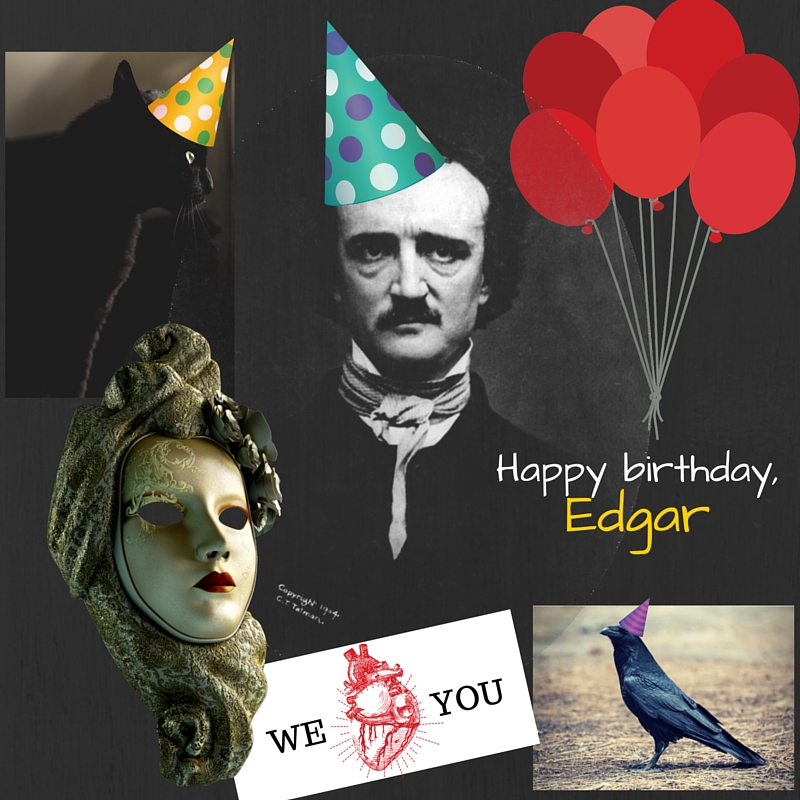
Edgar Allan Poe. Somewhat retouched. Original daguerreotype taken by Edwin H. Manchester on the morning of November 9th, 1848.
Poe was a writer, literary critic, and editor, the first well-known American writer to try to earn a living exclusively through writing. In spite of his prolific output, he didn’t earn enough to support himself, let alone live comfortably.
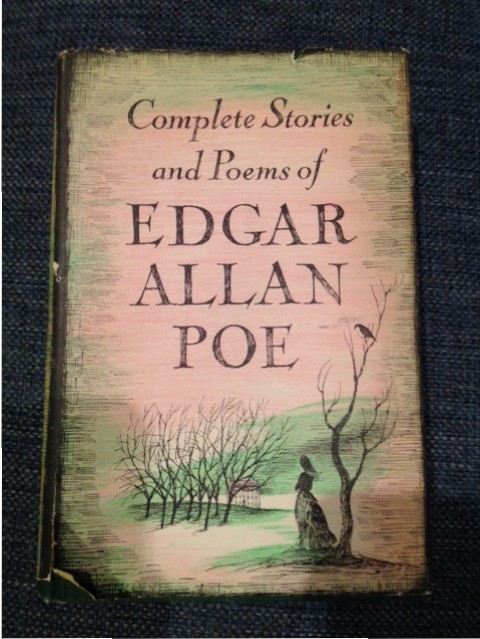
Complete Stories and Poems of Edgar Allan Poe
Although Poe died at the age of forty, this book contains 119 short stories and poems and one novel. His literary criticism isn’t represented at all in this volume, nor are his essays on writing, such as “The Philosophy of Composition,” “The Poetic Principle,” and “The Rationale of Verse.” His first publications were poetry, and he published 53 of them, but his work covers a much broader spectrum: 27 tales of mystery and horror; 25 stories of humor and satire; 14 that veer toward fantasy and science fiction. His novel is an adventure yarn. “Eureka” is a disquisition on the nature of the universe, and his vision has been largely confirmed by science, for example the Big Bang Theory.
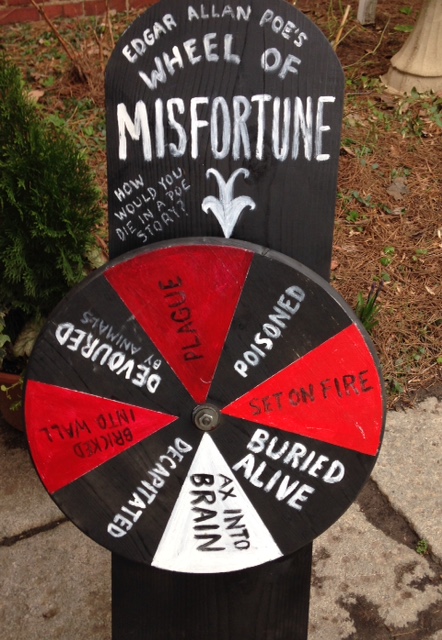
Wheel of Misfortune
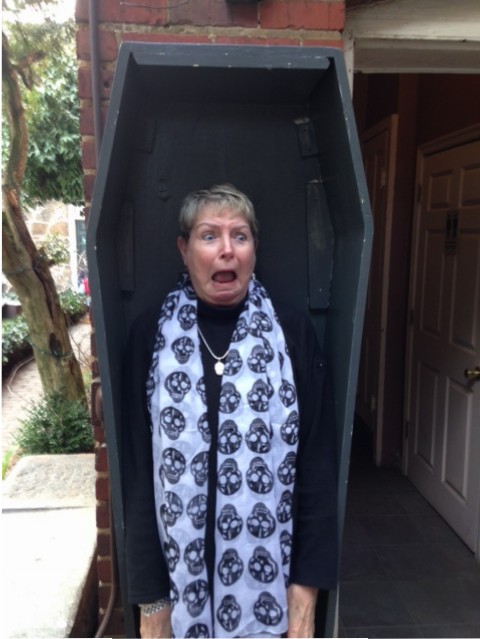
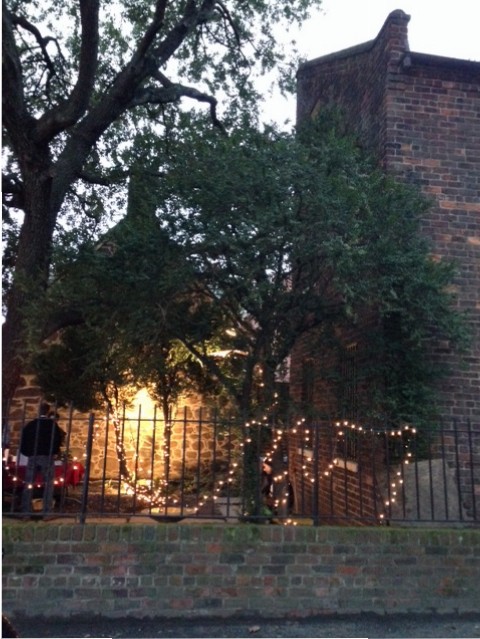
I’m buried alive at Poe’s Birthday Bash
Despite the breadth of his writing, he is best known for poetry and suspense/horror. He is often called the father of detective fiction—preceding Arthur Conan Doyle and Wilkie Collins by decades—while his contributions to cosmology and cryptography are known to relatively few. Besides being brilliant, Poe was a fine athlete. (He once set a broad jump record of 21’6″.) But he is most remembered as a man who suffered bouts of depression, whose career and life were burdened if not destroyed by gambling and alcohol, and who was plagued by scandals ranging from his marriage to his 13-year-old cousin to courting multiple women simultaneously.
To this day his death is shrouded in mystery. Where had he been for the previous several days? What was he doing? Why was he wearing someone else’s clothes? And who was the “Randal” he called out for from his deathbed?
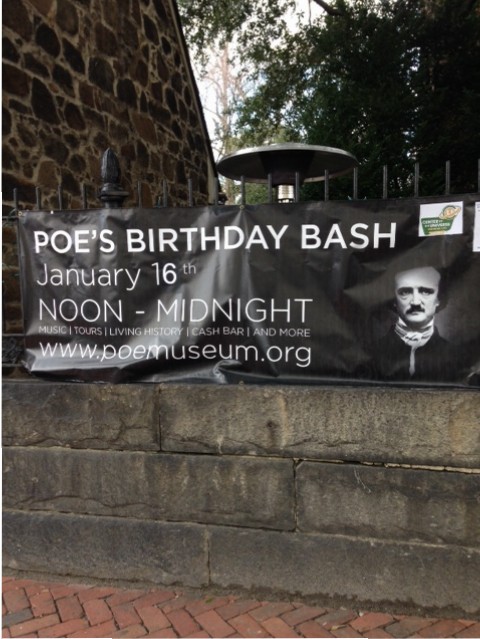
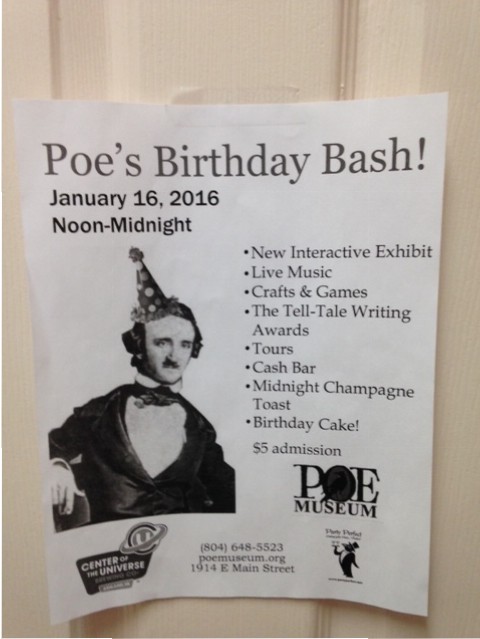
Poe’s Birthday Bash at the Poe Museum, Richmond, Virginia
Poe’s Birthday Bash flyer
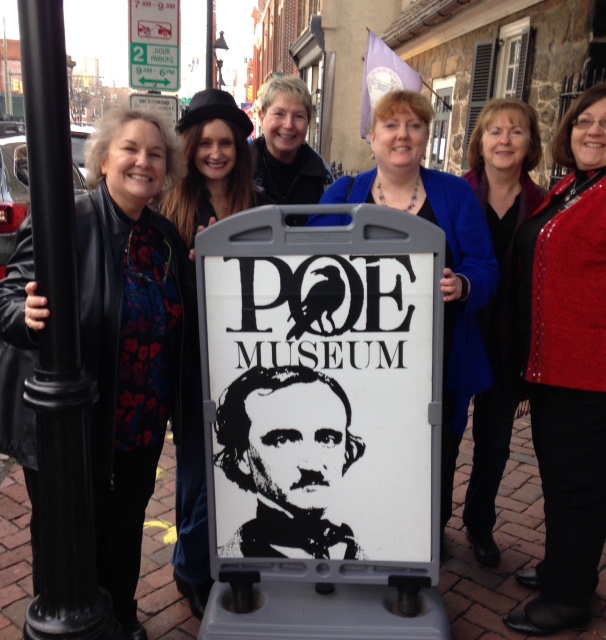
This year the event included a panel presentation and book signing by members of two local chapters of Sisters in Crime. Among other things, we spoke about Poe’s influence on our writing.
Sisters in Crime Left to right: Rosemary Shomaker, Teresa Inge, Vivian Lawry, Heather Weidner, Maggie King, Yvonne Saxon
Virginia is for Mysteries signing table Seated, left to right: Teresa Inge, Maria Hudgins, Vivian Lawry; standing, left to right: Yvonne Saxon, Rosemary Shomaker, Maggie King, Heather Weidner
This is the biggest celebration of Poe’s birthday, the events and fun running from noon till midnight. Let Poe’s lights shine on!
This post is part of a series that might be characterized as Darwin’s Christmas. I will be taking a number of our current traditions and tracing their evolution.
Currently, most people around the world begin New Year’s celebrations on December 31, the last day of the Gregorian calendar. But as with so much in the modern world, it wasn’t always so. Although people have celebrated the beginning of a new year for millennia, astrological or agricultural events typically marked the new year.
The earliest recorded celebration of the beginning of a new year was in ancient Babylon, some 4,000 years ago. For Babylonians, the new year began with the first full moon following the vernal equinox, a date falling in late March. It was a massive religious festival that required a different ritual every day for 11 days.
By Patrick Kwan from New York City, USA (Dragon in Chinatown NYC Lunar New Year) [CC BY 2.0 (http://creativecommons.org/licenses/by/2.0)], via Wikimedia CommonsChinese new year was tied to the second new moon after the winter solstice. In Egypt the new year began with the annual flooding of the Nile, coincident with the rising of the star Sirius.
For early Romans, each new year began with the vernal equinox. A year had 304 days divided into 10 months. Over time, the calendar year deviated significantly from the sun year. In 46 B.C. Julius Caesar consulted astronomers and mathematicians to solve the problem. He added 90 days to that year, adjusted the length of months, and declared January 1 as the first day of the year. January honors the Roman god of beginnings—Janus—who has two faces that look forward and back. In 1582, Pope Gregory XIII established January 1 as new year’s day for Christians.
Bust of Janus by Fubar Obfusco [Public domain], via Wikimedia Commons Vatican museum, Vatican CityWe’re all familiar with New Year’s celebrations that involve eating special foods for good luck on New Year’s Eve and/or New Year’s Day: legumes, such as lentils or black-eyed peas, signaling financial success; pork, associated with prosperity; ring-shaped cakes and pastries, because the year has come full circle; sometimes cakes or puddings with something hidden inside, to bring especially good luck to the one who gets the nut or prize. Sometimes the number of courses (3, 5, 7, 9, or 12) are specified. In several Spanish-speaking countries, eating 12 grapes, accompanied by 12 wishes, as the clock strikes 12 is traditional. (In Portugal, it’s 12 raisins.)
Making a lot of noise—shooting guns, banging pots and pans, blaring car horns, playing loud music, setting off firecrackers—is supposed to scare away bad luck and evil spirits. Partying with family and/or friends is common, as is fireworks displays or other ritual midnight activities.
In the U.S., the dropping of the giant ball in Times Square, begun in 1907, is now watched by millions. Spin-offs involve publicly dropping items that represent an area’s culture, geography, or history: the Peach Drop in Atlanta, GA; Pickle Drops in Dillsburg, PA, and Mount Olive, NC; the Possum Drop in Tallapoosa, GA; Wylie the Walleye Fish Drop in Port Clinton, OH; the Bologna Drop in Lebanon, PA; a Watermelon Drop in Vincennes, IN; the Midnight Muskrat Dive in Princess Anne, MD; a Big Cheese Drop in Plymouth, WI; a Pine Cone Drop in Flagstaff, AZ; a Grape Drop in Temecula Valley, CA; a Donut Drop in Hagerstown, MD; a Flip-flop Drop in Folly Beach, SC; a Wrench Drop in Mechanicsburg, PA; Beach Ball Drop in Panama City Beach, FL; the Music Note Drop in Nashville, TN; Chile Drop in Las Cruces, Mexico. Surely I’ve missed some! Please feel free to comment on your favorites.
by Nichole A. Hall (https://www.dvidshub.net/image/511672) [Public domain], via Wikimedia CommonsIn England, the national icon is the tolling of Big Ben. Similar striking clocks or bells are widespread in Europe. In Albania, people watch a lot of comedy shows because one should enter the new year laughing and full of joy. In the Czech Republic and Slovakia, playing the Czechoslovak national anthem at midnight honors the time they were one nation. In Turkey and Russia, New Year’s involves many of the traditions of Christmas in other parts of the world. In Costa Rica, running across the street with luggage is to bring travel and new adventures in the year ahead. But in Venezuela, only those traveling in January pull a suitcase around the house. In Japan, people clean their homes and Buddhist temples ring their bells 108 times, representing the mental states that lead people to take unwholesome actions.
In the Philippines, many wear new, bright, colorful clothes with circular patterns. In Brazil, wearing white on the beach to ring in the new year is supposed to bring good luck. In Italy, wearing red underwear on New Year’s Eve is traditional. Spanish tradition holds that wearing new red underwear brings good luck. In Venezuela, the underwear is yellow.
In Scotland, Hogmanay is celebrated with First-Footing (going to each other’s houses with gifts of whiskey and sometimes a lump of coal); Edinburgh hosts a 4 or 5 day festival, beginning on December 28th, including cannon fire and fireworks displays.
By John Lord from Edinburgh, Scotland (Edinburgh Hogmanay 2010) [CC BY 2.0 (http://creativecommons.org/licenses/by/2.0)], via Wikimedia Commons
North and South Korea celebrate New Years twice, a Lunar New Year which varies, and a Solar New Year which is always January 1.
The practice of making resolutions for the new year is thought to have been popular first among the ancient Babylonians.
And thus we come full circle—a fine New Year’s tradition!
This post is part of a series that might be characterized as Darwin’s Christmas. I will be taking a number of our current traditions and tracing their evolution.
The earliest gift-bringer I read about was Odin, a Pagan Germanic god who is thought to have influenced concepts of Father Christmas in numerous ways, including long white beard and riding through the night sky.
Odin’s influence is seen in blue Santas
Odin wore a blue-hooded cloak and rode through the midwinter sky on an eight-footed horse named Sleipnir, visiting his people with gifts. According to pre-Christian Norse tradition, he entered through chimneys or fire holes on the solstice.
In 16th century England (during the reign of Henry VIII), Father Christmas was pictured as a large man in green or scarlet robes lined with fur. He was associated more with good cheer, peace, joy, good food and wine, and revelry.
Father Christmas merged with St. Nicholas (Sinterklaas), which morphed into Santa Claus. Suffice it to say that most people around the world have a tradition of a Christmas gift-bringer: Santa Claus, St. Nicholas, Father Christmas, Christkind, the Wise Men, an old gift-giving witch called Befana (in Italy). In Scandinavia a jolly elf named Jultomten delivered gifts in a sleigh drawn by goats. And in Russia, an elderly woman named Babouschka (grandmother) leaves gifts by children’s bedsides on January 5th.
Representations of Santas around the world, L-R: Hungary, 1884; Austria, 1904; Russia, 1903; Canada, 1930; U.S.A., 1935; Mexico, 1923; U.S.A., 1925; Holland, 1920.
Presents are left in different places. In much of Europe, presents are left in shoes or boots put out by the children. In Italy, the UK, and the USA presents are left in stockings—and, of course, under the Christmas tree.
Presents are opened on different days as well. Children in Holland often receive the earliest presents, on December 5th for St. Nicholas’ Eve. On St. Nicholas’ Day (6th of December), children in Belgium, Germany, Czech Republic, and some other European countries open some of their presents. Christmas Day (25th of December) is the most popular gift day for the UK, USA, Japan, and many other countries. The last presents are opened on Epiphany, January 6th, especially in Catholic countries such as Spain and Mexico.
Who gets presents has shifted dramatically over the centuries. Odin gave presents to “his people.” St. Nicholas gave to the poor. According to the Christian Science Monitor, in early modern Europe, gift giving also had roots in Christmas begging, when bands of young men, often rowdy, would wassail from house to house, demanding handouts from the gentry. It wasn’t till the mid-1800s that gift-giving shifted from the poorer classes to children.
On the other hand, giving gifts to heads of state, kings and queens, emperors, etc, pre-dates the birth of Jesus.
Today, it seems everybody gives gifts to everybody—an impression strongly supported by advertising and merchant specials! Christmas begging from charities is rampant. Salvation Army kettles (which first appeared in 1891) are on sidewalks all over the world. Employers often give actual gift baskets or holiday bonuses. Co-workers, neighbors, and friends exchange gifts. Parents give gifts to children, but people also give gifts to parents, grandparents, aunts, uncles, siblings and step siblings, and second cousins twice removed.
By now, all the glittery wrappings are probably torn asunder, the gifts put away, exchanged, maybe saved for re-gifting, and the leavings look more like this.
And I’m left wondering, how many Christmas presents are gifts and how many are perceived obligations.
This post is part of a series that might be characterized as Darwin’s Christmas. I will be taking a number of our current traditions and tracing their evolution.
The logical answer would be, “We celebrate the birth of Christ on December 25th because that’s when He was born. ” But in this instance, the logical answer is wrong.
Neither the Bible nor any other record dates Jesus’s actual day of birth. In addition, the season when shepherds would be watching their flocks by night and when the census was taken would argue that the actual birth was either spring or autumn.
According to Stephen Nissenbaum, author of The Battle for Christmas, early Christians weren’t bothered by not knowing Jesus’s birthday for “It never occurred to them that they needed to celebrate his birthday.” Further, according to Nissenbaum, the Church got into something of a crisis, with people tending to believe that Jesus never existed as a man. Instituting a birthday celebration was a way to counteract that trend.
The Battle for Christmas by Stephen Nissenbaum
The first recorded date of Christmas being celebrated on December 25th was 336AD, during the time of the first Christian Roman Emperor, Constantine. Perhaps he chose that date because Pagan Romans would be celebrating the Winter Solstice, Saturnalia, and “Dies Natalis Solis Invicti” (birth of the unconquered sun) anyway. A few years later, Pope Julius I officially declared that the birth of Jesus would be celebrated on the 25th of December.
One very early Christian tradition held that on March 25th God told Mary she would have a very special baby.The Annunciation is still celebrated on March 25th—and nine months later is December 25th.
The Annunciation, Henry Ossawa Tanner [Public domain], via Wikimedia Commons
The early Church celebrated Christmas, the Epiphany, and the Baptism of Jesus all on January 6th. In some parts of the UK, January 6th is still called Old Christmas.
Then, too, not everyone celebrates Christmas on December 25th even today. Some Christians use other dates or December 25th on non-Gregorian calendars. The dates below are all Gregorian.
January 6—The Armenian Apostolic Church and the Armenian Catholic Church
January 7—Eastern Orthodox and Byzantine Rite Catholics in Russia, Georgia, Ukraine, Macedonia, Moldova, Montenegro, Serbia, Greek Patriarchate of Jerusalem, Ethiopian Orthodox Tewahedo Church
January 7 or 8–Coptic Orthodox Church of Alexandria
January 19–The Armenian Patriarchate of Jerusalem.
Still, for many Eastern Orthodox Churches, Western Christian churches, and the secular world, Christmas is over.
This post is part of a series that might be characterized as Darwin’s Christmas. I will be taking a number of our current traditions and tracing their evolution.
For centuries Christmas was celebrated as a season, not a single day, and the beginning of that season was on Christmas Eve. Western Christianity and the secular world recognize December 24th as Christmas Eve. The most widely practiced Christmas Eve tradition or custom that is still practiced today is the attendance at a church service.
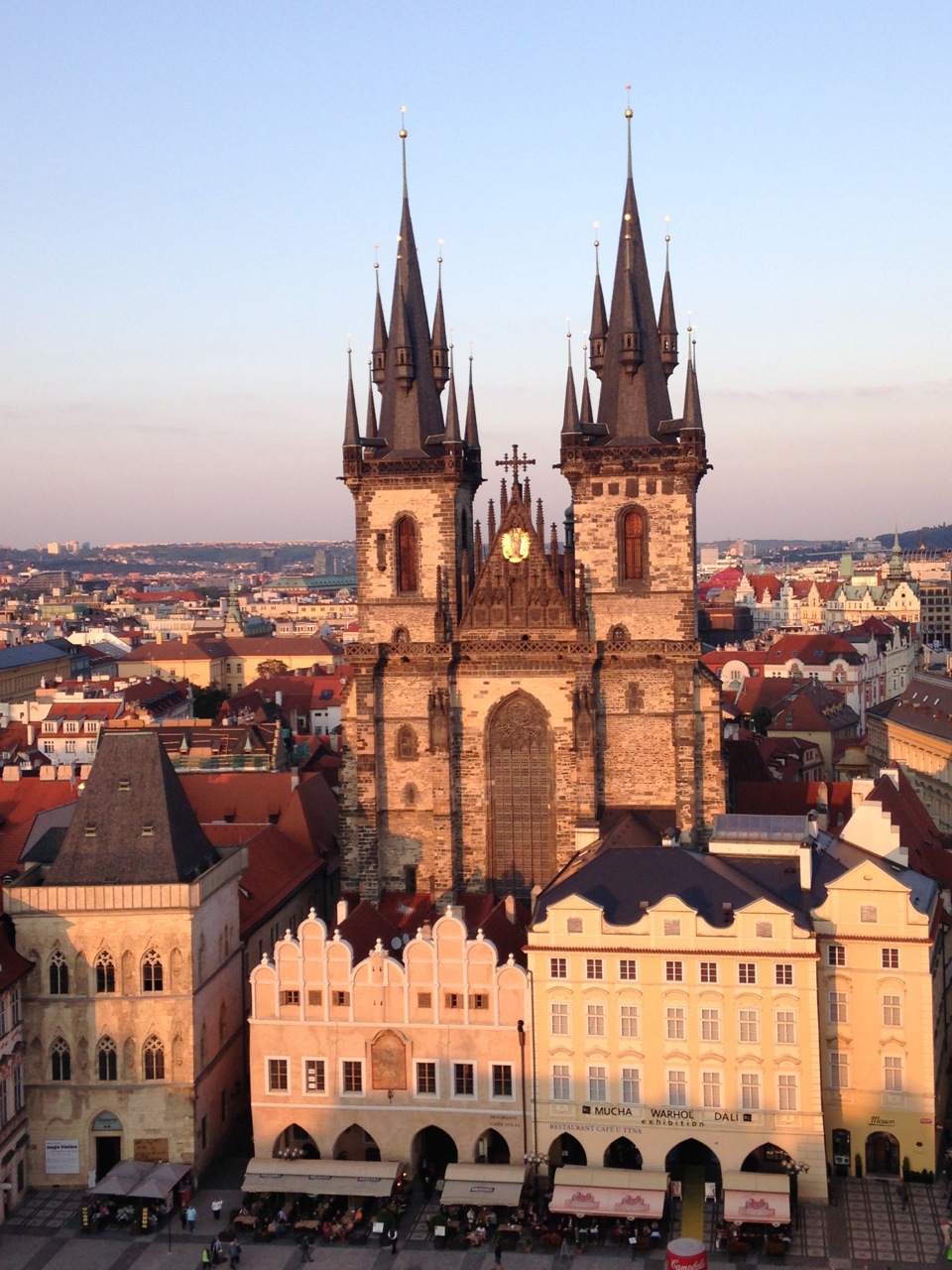
Church of Our Lady before Týn Prague, Czech Republic
In predominantly Catholic countries (e.g., Spain, Mexico, Poland, and Italy) a Midnight Mass is the most important service in the Christmas season. People often abstain from meat or fish on Christmas Eve and then eat the main Christmas meal after the Midnight Mass Service. In other countries (e.g., Belgium, Finland, Lithuania, and Denmark) the meal is eaten before the Midnight Service.
Tradition dictated that greenery such as holly, ivy, and mistletoe should only be brought into the house on Christmas Eve. We all know what’s happened with that one in the United States! In some European countries (e.g. Serbia and Slovakia) the Christmas tree is brought into the house and decorated on Christmas Eve, as well.
In Norway the decorating of the tree is traditionally done by the parents behind closed doors while the children wait outside. “Circling the tree” follows, where everyone joins hands to form a ring around the tree and they walk around it singing carols. Gifts are distributed afterwards.
In Germany, the Tannenbaum (Christmas tree) was traditionally decorated by the mother, in secret, with lights, tinsel, and ornaments. It was lit and revealed on Christmas Eve with cookies, nuts, and gifts under it.
In the United States, the decorating of trees, houses, lawns, and people begins weeks before Christmas.
Another wide-spread custom is the hanging of Christmas stockings, preferably on the fireplace, since that’s where Santa Claus is supposed to enter. Traditionally, Christmas stockings are filled on Christmas eve.
Even the Smithsonian can’t trace the origins of hanging stockings, but clearly it was well-established by the time Clement Clarke Moore wrote “A Visit From St. Nicholas” (better known as “The Night Before Christmas”). In Tuesday’s blog, I mentioned the legend that St. Nicholas provided dowries for three pious but impoverished sisters. One version of that legend has St. Nicholas coming down the chimney at night and putting a gold ball in the toe of each girl’s stocking, recently laundered and hung by the fire to dry.
Of course families have their own traditions of activities, food, and decoration passed on from generation to generation. But one that is nearly universal is that the bringer of gifts now does so on Christmas Eve.
P.S. I have focused on Christmas Eve from the Western Christian perspective. I urge you to explore more broadly, including Eastern celebrations and Jewish Christmas traditions!
This post is part of a series that might be characterized as Darwin’s Christmas. I will be taking a number of our current traditions and tracing their evolution.
By Bjoertvedt (Own work) [CC BY-SA 3.0 (http://creativecommons.org/licenses/by-sa/3.0) or GFDL (http://www.gnu.org/copyleft/fdl.html)], via Wikimedia Commons
Saint Nicholas, born around 280 AD in Patara (in modern-day Turkey) was a Greek Christian bishop famous for giving to the poor, perhaps giving away all his inherited wealth and traveling the country helping the poor and sick. One much-reported story is that he presented three impoverished daughters of a pious Christian with dowries so that they could marry, rather being sold into slavery or prostitution—which, incidentally, says a lot about women’s options then! Saint Nicholas is the patron saint of many, including archers, sailors, children, and pawnbrokers. He is typically portrayed as a bearded bishop in canonical robes, often thin and dour. But his image, too, has morphed.
During the Middle Ages, on the evening before December 6th, the name day of Saint Nicholas, children received gifts in his honor. Traditionally, this was considered a lucky day to make large purchases or to get married. The Reformation opposed the veneration of saints and the giving of gifts to children moved toward December 24th and/or 25th.
Saint Nicholas came to America and underwent a sea change during the 18th century. Newspapers in New York City (in New Amsterdam at the time) reported groups of Dutch families gathering to honor the anniversary of Saint Nicholas’s death. The name Santa Claus evolved from the name, Sinter Klass, a form of Sint Nikolaas, Dutch for Saint Nicholas. In 1809, Washington Irving published his “Knickerbocker History of New York” in which he mentioned St. Nick 25 times and referred to Saint Nicholas as the patron saint of New York. Some assert that he is responsible for remaking the original old, often stern bishop into the new “jolly St. Nick.”
In 1822, Clement Clarke Moore wrote a Christmas poem for his three daughters, “An Account of a Visit from St. Nicholas.” This poem—now commonly known as “Twas the Night Before Christmas”—established the visual imagery of the modern Santa Claus and his behavior. The image was solidified in 1881, when cartoonist Thomas Nast drew on the poem to create the first pictorial representation of Santa Claus.
Library of Congress
Ta-da! We have Santa Claus: rotund, cheerful, full white beard and mustache, bright red suit trimmed with white fur, holding a sack laden with toys for lucky children. He travels by sleigh and climbs down the chimney.
Everyone knows today’s mall Santas. In 1841, thousands of children visited a Philadelphia shop to see a life-size Santa Claus mannequin. Not long after, stores attracted children and parents to see a “live” Santa Claus. Our current images of Santa Claus were further popularized by the Coca-Cola Company’s Christmas advertising in the 1930s
Education is the key to everything, and in 1937, Charles W. Howard established his Santa School, the oldest continuously-run such school in the world, teaching good Santa behavior and techniques.
There was a time, after the popularization of Santa keeping a list of who was naughty and who was nice, when Santa was thought to deliver a bundle of switches or a lump of coal to naughty children. This has largely dropped by the wayside.
Psychology has no clear position on whether perpetuating the myth of Santa Claus is healthy or unhealthy. On the healthy side are assertions concerning creativity and imagination. On the unhealthy side are assertions that it is disrespectful of children and undermines their trust in their parents. If this is an issue for you, Google “Psychology on Santa Claus” and make up your own mind.
I will end in the spirit of the season, by noting TV producer Jonathan Meath’s observation that Santa is really the only cultural icon we have of a male who does not carry a gun, is all about peace, joy, giving, and caring for other people. Yay, Santa, in all your forms!
This post is part of a series that might be characterized as Darwin’s Christmas. I will be taking a number of our current traditions and tracing their evolution.
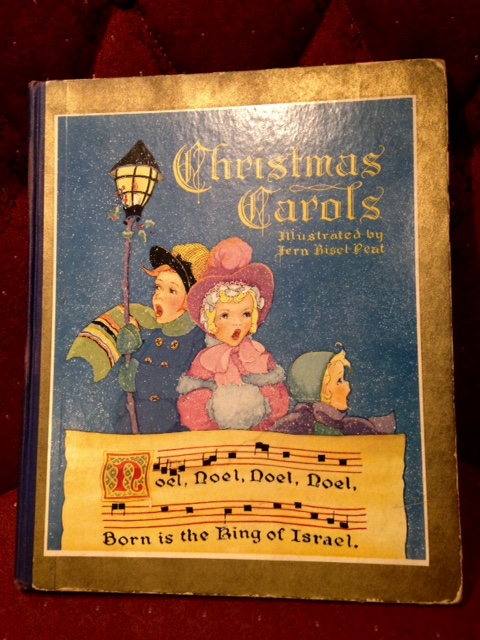
Christmas Carols have always been around, right? No, not exactly.
Carols were sung in Europe thousands of years ago. The word “carol” means dance or song of praise and joy, and they used to be common during all four seasons. Pagan carols at Winter Solstice celebrations were sung as people danced around stone circles. The Winter Solstice is the shortest day of the year, usually falling around Dec. 22. Carols at other seasons of the year have largely disappeared. Perhaps winter carols have survived because early Christians took over the pagan solstice celebrations for Christmas and gave people Christian songs to sing instead of pagan ones.
In AD 129, a Catholic Bishop said that a song called Angel’s Hymn should be sung at a Christmas service in Rome. Another early Christmas Hymn was written in AD 760, by Comas of Jerusalem for the Greek Orthodox Church. In subsequent years, composers all across Europe wrote such hymns. They never became popular, some say because they were written in Latin, which common people didn’t understand.
In AD 1223, St. Francis of Assisi started Nativity Plays in Italy. The people in the plays sang canticles that told the story during the plays, normally in a language that the audience could understand and join in. The new carols spread across Europe. In AD 1426, John Awdlay, a Shropshire chaplain, listed twenty-five “caroles of Cristemas,” the first written record in English. During the 15th century and through the Elizabethan Era (ending 1603), these carols were untrue stories loosely based on the Christmas story and intended as entertainment rather than worship. They were sung in homes, not churches. Traveling minstrels freely changed the words to suit the local people wherever they were. For example, I Saw Three Ships might first have represented ships taking the skulls of the three wise men to the Cologne Cathedral, but over time and venues, the travelers on the three ships were sung to be many different Biblical characters.
When Oliver Cromwell and the Puritans came to power in England in 1647, the singing of carols was banned. Carols survived because people sang them in private. During the Victorian period, many new carols were written including Good King Wenceslas.Hark! The Herald Angels Sing (originally Hark! How All the Welkin Rings), The First Noel, and God Rest You Merry, Gentlemen were popularized. The custom of singing carols in the streets became popular and remains so today.
Martin Luther authored carols and encouraged their use in worship. Adeste Fideles had attained it’s modern form in the mid-18th century, although the words might date to the 13th century. God Rest Ye Merry, Gentlemen, The First Noel, I Saw Three Ships, and Hark! The Herald Angels Sing appear in a collection assembled by William Sandys in 1833. It Came Upon a Midnight Clear also dates from this period. In 1865, Christmas-related lyrics were sung to the melodies of traditional English folk songs, such as Greensleeves—think What Child is This.
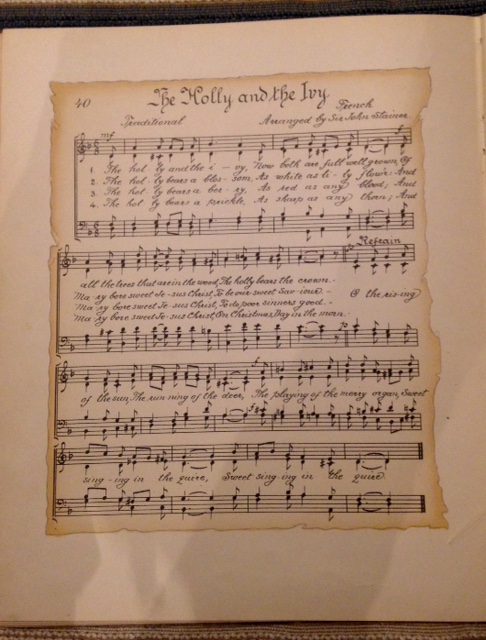
Good King Wenceslas and The Holly and the Ivy can be traced directly back to the middle ages, and are among the oldest musical compositions still sung regularly.
In older times, caroling children asked for (and were given) edible gifts such as dried fruit, eggs, nuts or sweets. By the 20th century, the edible gifts had been replaced my money. Caroling is also done by choirs, marching bands, groups trying to raise money for trips, projects, or charity, folk societies, neighbors and well-wishers.
Now caroling often includes secular as well as religious music. Such songs written in the United States range from Jingle Bells and Frosty the Snowman to O Little Town of Bethlehem to Away in a Manger. So gather round the old piano and celebrate the season with songs of your choice!







.jpg)