UBIQUITOUS BLOOD

Blood is so important that it has escaped the confines of the body and pops up everywhere, in symbolism, metaphors, and superstitions.

Fallacies About Blood

In many ancient cultures, where blood was seen as the essence of life—sacrificing blood (animal or human)—was believed to sustain the gods, the land, or the community. In ancient paganism, such sacrifices were offered to gods like Moloch, Aztec deities, or the Greek Fates to ensure fertility, harvests, or protection.

It was once believed that blood was the same as life, and as such, drinking blood was the equivalent of a transfusion today.

In other cultures, the heart was thought to be the blood-fountain and the core of personality, so this drinking of blood was regarded as soul transference.

Ma’at weighing the heart of the deceased against the Feather of Truth, determining a soul’s guilt or innocence in the Egyptian Book of the Dead

Cannibalism, as a tribal rite, was based on a similar belief, that the blood of another was his life and soul. The practice of drinking the blood of the bravest foes was to acquire their courage, cunning, and other distinctive traits.

Royalty and the super rich literally had blue blood. This was based on the fact that those who did not labor in the sun, and therefore weren’t tan, had veins that showed more prominently blue. (Indeed, some creatures have blue blood—e.g., horseshoe crabs—but humans aren’t among them.) Historically, Royal Blood meant that royalty were of divine or pure lineage, untouched by commoners. Bloodlines determined inheritance, legitimacy, and power.
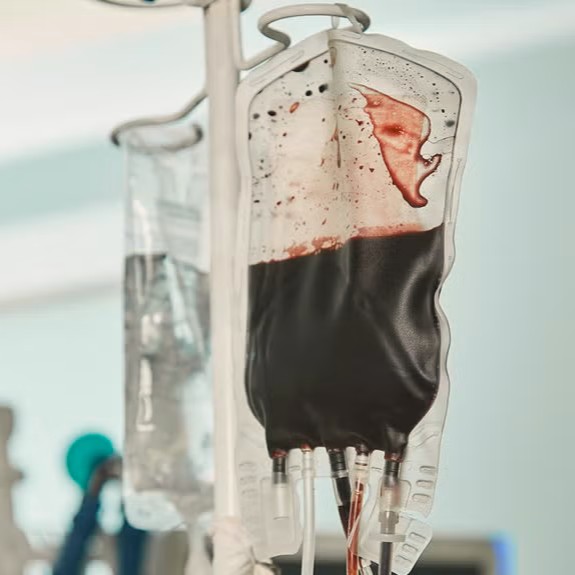
Transfusion bag

People of different races have different blood, and transfusions across ethnic groups are dangerous if not deadly.

In Japan, many people use blood type as a personality predictor, similar to how some Americans ascribe to star signs or Vietnamese believe in a birth year cycle.

A baby gets blood from the mother. In fact, the fetus creates its own blood entirely, in utero.

Bloodletting
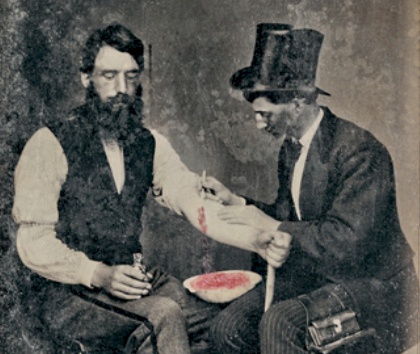
Bloodletting in the 1860s

As far back as the Ancient Egyptians, doctors have attempted to treat patients by adjusting fluids inside the body. In particular, medical theories held that sweating and bloodletting were effective treatments for everything from headaches to gout. Hippocrates believed menstruation was a spontaneous form of bloodletting. Talmudic, Ayurvedic, Chinese, and Islamic medical texts all contain detailed instructions of the practice.

Galen created very specific charts of the best locations to cut or place leeches to achieve specific health benefits, encouraging patients to take their “cure” into their own hands! Cutting the vein in the right hand might cure liver problems, while cutting the vein in the left hand could cure spleen trouble.

Diagram of where to bleed for specific health concerns

He also believed that the heart created blood and sent it to the organs and extremities, where it was used up. Having too much would cause it to stagnate, leading to illness. For centuries, doctors throughout Europe and the Middle East thought it purged toxins, balanced bodily chemistry, and boosted immunity.

Bloodletting remained a common medical practice through the 19th Century. Textbooks from 1923 still recommended treating patients with strategic bleeding.

It still shows up in our language. “Bloodletting” is now a euphemism for simmering tensions in a community erupting into violence.

Bloody Language

A subject so entwined with human history and sensibilities is bound to show up in our language.

Blood in Metaphors

Blood feud: People of one bloodline/clan are born enemies of another.

In cold blood: To do something cruel or violent deliberately and without emotion.
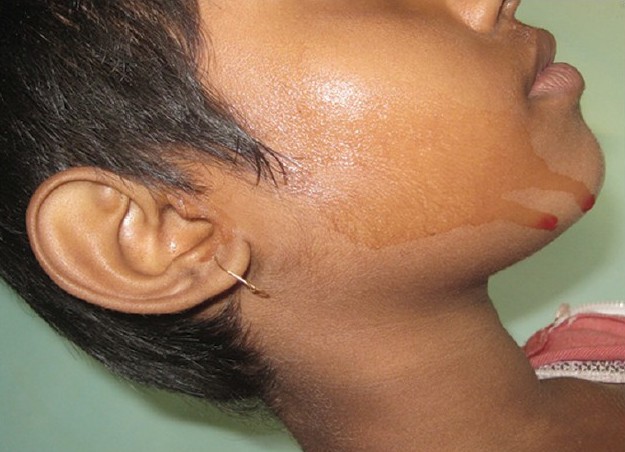
Hematohidrosis, a rare medical condition, causes a patient to sweat actual blood.

Blood, sweat, and tears: A lot of effort and hard work, often involving suffering.

Blood runs cold: To feel a sudden shock or horror.

Flesh and blood: Someone’s family or relatives; also used to describe human limitations or weaknesses.

Blood boils: To become extremely angry.

Bad blood: Strong feelings of hatred or anger between people.

New blood: New people joining a group or organization, bringing fresh ideas.
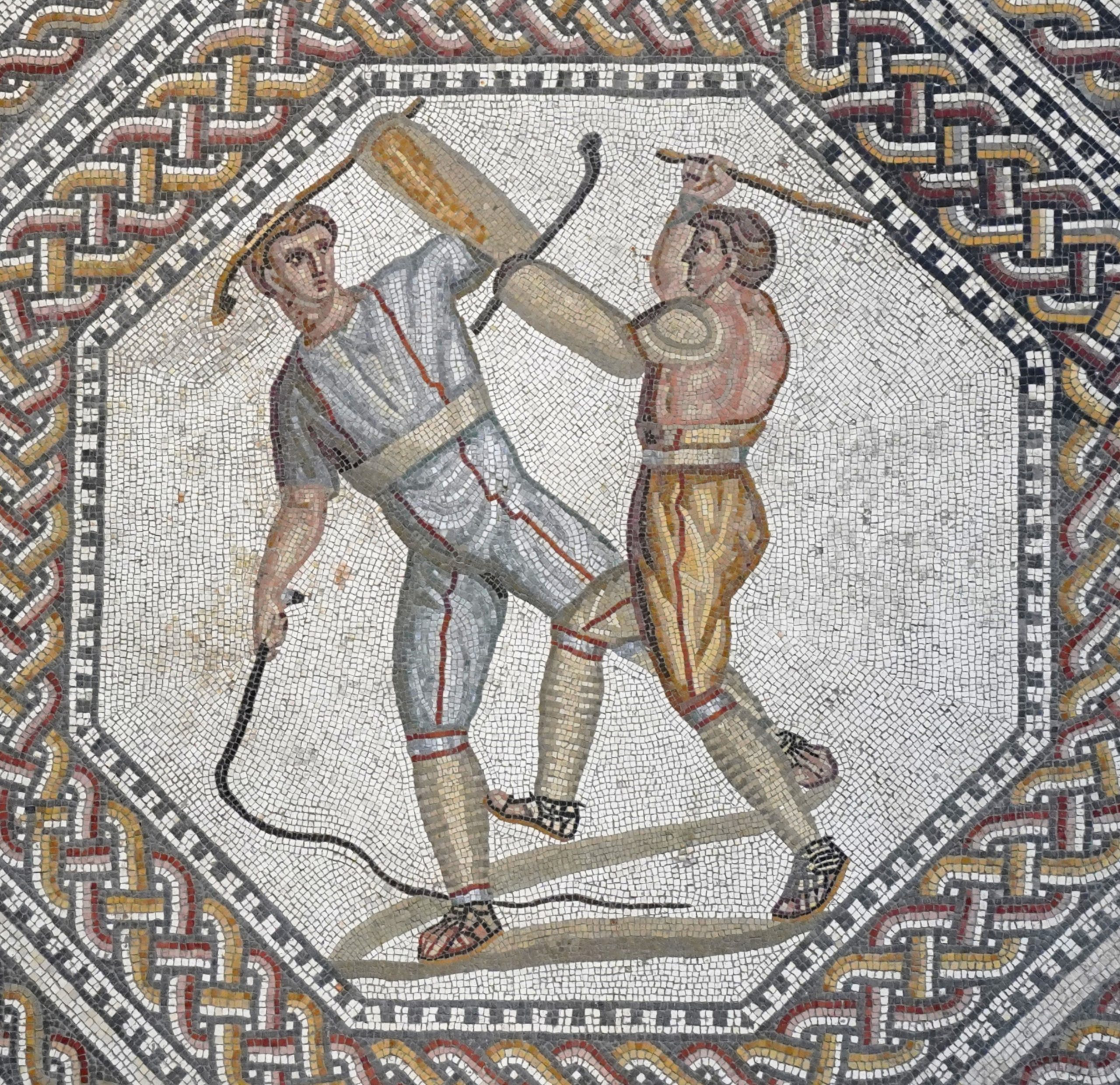
Roman gladiators from a Third Century mosaic

Blood sport: A sport involving the hunting or killing of animals, or a violent competition.

Blood money: Money earned through dishonest or violent means; also refers to money paid to a killer as compensation for a murder.

Bloodcurdling: Extremely frightening or shocking.

Blood brother: A very close friend; historically, mingling a few drops of blood from two people in a cup of wine and both drinking it sealed the bond. More recently, two people nick their thumbs or wrist veins and press them together to seal the bond. (“Brothers” could also be women, though this was much less common.)
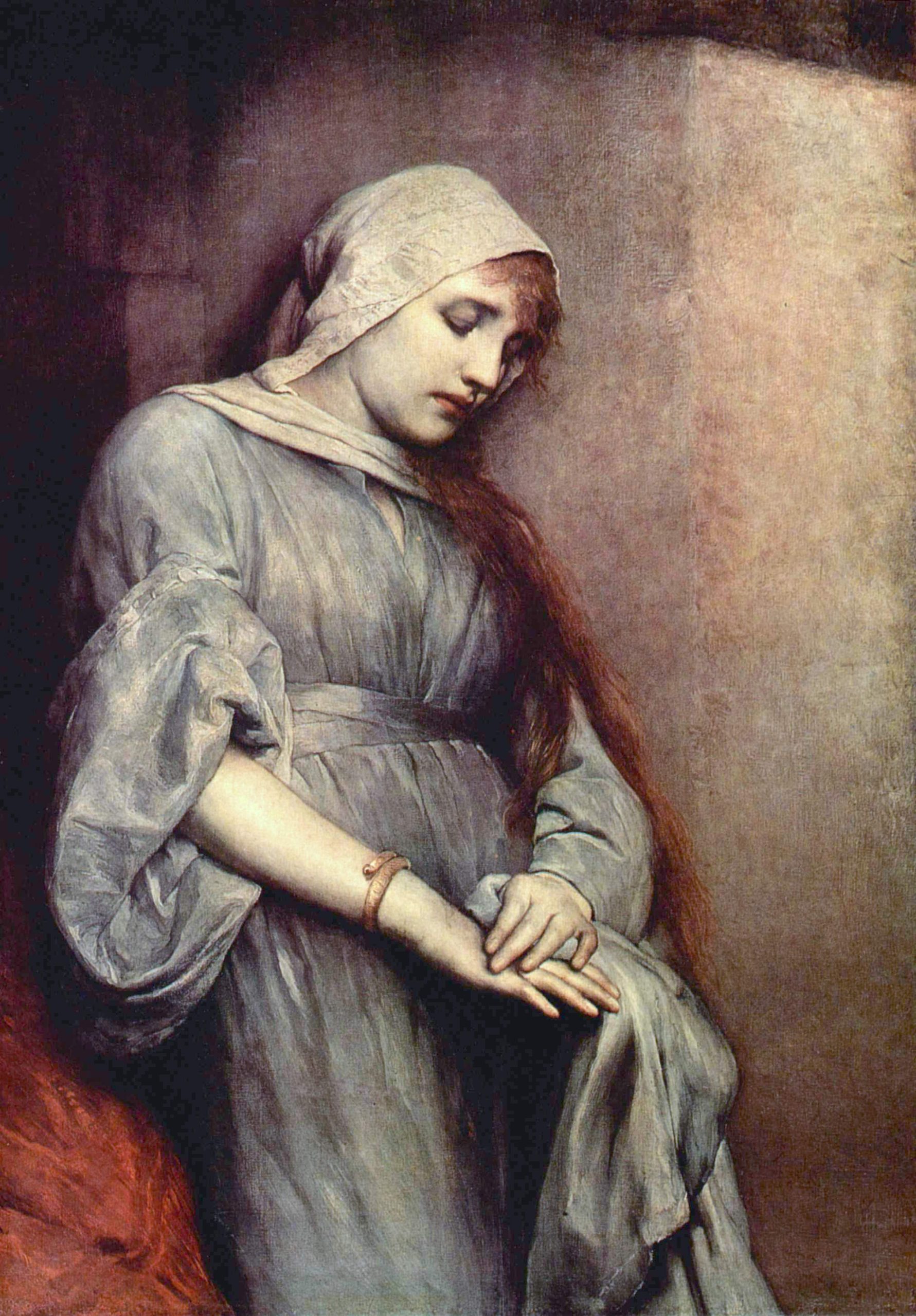
Lady Macbeth by Gabriel von Max

Blood on one’s hands (e.g., Lady Macbeth’s famous line, “Out, damned spot!”) symbolizes moral stain or unresolved guilt.

Bloodstained: Covered or marked with blood, often implying violence or guilt.

In one’s blood: innate, as of a skill or quality. The same as “XXX runs in the family.”

Blood is thicker than water: Family relationships are stronger than other relationships.

In some initiation rites (e.g., fraternities, secret societies, or rites of passage), blood may symbolize commitment, loyalty, or rebirth into a new social or spiritual state.

Bloody Proverbs

  • Blood is inherited and virtue is acquired.
  • None so keen at the hunting of wolves as the dog with wolf blood.
  • Who grudges his blood to a blade had better earn his living behind the plow.
  • You cannot get blood from a stone/turnip
  • Good blood will never lie.
  • Men’s skins have many colors, but human blood is always red.
  • Like blood, like means, and like age, make the happiest marriage.
  • Marrying in the blood is never good.
  • Noble and common blood is of the same color.
  • If blood is spilt on you before breakfast, you will shed blood before nightfall.

The human body contains about 5 liters (1.3 gallons) of blood, which circulates through the body 3 times every minute on average! It transports oxygen, nutrients, and hormones, fights infections, regulates body temperature, and removes waste products.

Bottom Line: Blood is so important that it’s everywhere!

BETTER KNOW YOUR BODY

Everybody has one. But how much do you really know about your body?

Skin

Let’s start with your largest and most visible organ: your skin. You probably aren’t precisely average, but these “average” data will give you an idea of how you compare.

World Body Painting Festival
Artist: Birgit Linke, Austria
  • If you are average, your skin weighs 6-9 or 7.5-22 pounds, depending on your source. According to the NIH Library of Medicine, skin makes up approximately 1/7 of your body weight.
  • Again, if you are average, you have approximately 21 square feet of skin.
  • Organ donation can include skin.
  • The average person has about 300 million skin cells. One square inch of skin has about 19 million cells.
  • The entire surface of your skin is replaced every month, which put another way means you have about 1,000 different skins in your life!
  • This skin renewal every 27-28 days involves sloughing off the old cells.
  • Your skin constantly sheds dead cells, about 30,000 to 40,000 cells every minute!
    • (That’s nearly 9 lbs. per year. On the low end, other sources say you slough off roughly 1.5 pounds of dead skin a year, equal to about 3 ½ cups of sugar.)
World Body Painting Festival
Artist: Stefan Stuppnig
  • Dead skin comprises about a billion tons of dust in the earth’s atmosphere.
  • Some sources estimate that more than half of household dust is actually dead skin, others say 70%, but much depends on number of people, pets, etc.
  • Scar tissue is different from normal skin because it lacks hair and sweat glands.
  • The color of human skin is determined by the level of pigment melanin that the body produces. Those with small amounts of melanin have light skin while those with large amounts have dark skin.
  • Genital skin is darker than other skin: nipples, anus, and genitals are more sensitive to sex hormones acting on melanocytes. The contrast increases during puberty and pregnancy.
  • Your skin has at least five different types of receptors that respond to pain and touch.
  • The loose skin on your elbow, known scientifically as olecranal skin or colloquially as the weenus, is basically nature’s Silly Puddy because there are fewer sensory neurons located there. That means you can keep kneading it all day long, and as hard as you want.

When it comes to skin, we tend to notice attractiveness, color, roughness, and wrinkles. But skin is functional as well as ornamental. It keeps everything on the inside from coming out. In addition, it also helps regulate temperature, provides touch and sensation, allows us to move without restriction (not too tight or too loose), heals and regenerates constantly, and much more.

Blood and Heart

World Body Painting Festival
Artist: Aina Vela
  • Your skin contains more than 11 miles of blood vessels.
  • Your blood makes up about eight percent of your body weight.
  • Laid end to end, an adult’s blood vessels could circle Earth’s equator four times!
  • This includes veins, arteries, and communicating little capillaries that move between both.
  • Pus is a build-up of white blood cells.
  • The human heart beats more than three billion times in an average lifespan.
  • Humans are the only species known to blush.
  • Your heart beats around 100000 times a day, 36500000 times a year and over a billion times if you live beyond 30.
  • Inside your bones are tiny tubes filled with blood vessels called osteons. They are to bones what rings are to trees. The percentage of large osteons increases with age.
  • If you live to age 70, your heart will have beat around 2.5 billion times!

Sweat

World Body Painting Festival
Artist: Ficek Martin
  • The body has 2.5 million sweat pores.
  • A single square inch of skin has up to 300 sweat glands.
  • Earwax is actually a type of sweat!
  • There are two different types of sweat glands.
    • Eccrine glands secrete salty water when body temperature gets too high.
    • Apocrine glands in the armpits (and a few other areas) secrete an oily, opaque substance that gains its characteristic scent from the bacteria in the area.
  • Sweat caused by mental or emotional distress is released by apocrine glands.
  • Your body needs time to adapt its sweat production in high temperatures, allowing you to produce sweat more quickly and with less salt and potassium.
  • When you’re too hot—or you lose your cool—your nerves send signals to open millions of glands, allowing sweat to flow. It pools by your armpits, palms, feet, head, and genitals.
  • Germs love to swim, so they thrive in sweat. Sweat on its own doesn’t smell bad. It’s the bacteria that mix with it.

Body Products

  • Your mouth produces about one-two liters of saliva each day!
  • Babies don’t shed tears until they’re at least one month old.
  • What we eat directly effects urine and feces. For example, you might notice red or pink after bingeing on beets. Or changes in your urine eating asparagus.
    • Note: Although asparagus affects the chemistry of everyone’s urine, some people are able to smell it and others aren’t—whether their own or someone else’s.
  • You produce about 40,000 liters of spit in your lifetime. Or to put it another way, enough spit to fill around five hundred bathtubs.
  • The average nose produces about a cupful of nasal mucus every day.
  • On average, you fart enough in one day to fill a party balloon.
  • We urinate enough every month to fill a bath!
  • Every second, you produce 25 million cells.

Brain and Nervous System

World Body Painting Festival
Artist: Lynn Schockmel, Luxembourg
  • Your brain is the fattest organ in the body, approximately 60%. It needs essential fatty acids to perform adequately.
  • The brain uses over a quarter of the oxygen used by the human body.
  • Your brain is sometimes more active when you’re asleep than when you’re awake.
  • Humans have a stage of sleep that features rapid eye movement (REM). REM sleep makes up around 25% of total sleep time and is often when you have your most vivid dreams.
  • Information zooms along nerves at about 400k mph!
  • Everyone is familiar with forgetting, but additionally, our brain re-writes memories each time we think of them, slowly altering or twisting them over time.
  • Some of the nerves in your skin are connected to muscles instead of the brain, sending signals (through the spinal cord) to react more quickly to heat, pain, etc.

Muscles

World Body Painting Festival
Artist: Cat Finlayson, UK
  • The word “muscle” comes from Latin term (musculus) meaning “little mouse“, which is what Ancient Romans thought flexed bicep muscles resembled.
  • Your heart is the only muscle that doesn’t get tired.
  • Gluteus maximus is the Latin name for the largest muscle in your body, your behind. You have two of them, one for each cheek. These powerful muscles serve as a cushion when you sit down, but when flexed tight, they keep you upright.
  • Few muscles are as hard-working as the tongue. By day, it twists to form the sounds you speak and pushes around the food you eat. While you sleep, your tongue moves saliva down your throat. 
  • Dentist Stuart Froum coined the term “curious tongue” to describe the reflex most people have to move their tongue to investigate foreign objects in the mouth, including dental drills.
  • The strongest muscle in the human body is the jaw (masseter).
  • A healthy jaw can close teeth with a force of up to 200 pounds.

Eyes

Artist: Hiraku Cho
  • Your eyes can get sunburned. The symptoms include headache, eye pain and redness, tearing, blurred vision, twitching, and feeling gritty. Sunglasses can prevent sunburn, and symptoms typically resolve themselves after 48 hours.
  • Your eye is your fastest muscle. The orbicularis oculi is capable of contracting in less than 1/100th of a second.
  • A blink typically can last 100-150 milliseconds.
  • Infants blink only once or twice a minute while adults average between 10 and 20.
  • Women blink 19 times per minute compared to 11 per minute for men. This may relate to estrogen levels, which can make the cornea more elastic, changing how light waves travel through the eye.
    • That’s over ten million times a year!
  • You blink more when talking and less when you are reading. This is why you get tired eyes when reading.
  • Only two percent of the population have green eyes. The largest concentration of green-eyed peoples is in Ireland, Scotland, and Northern Europe.
    • All races (Asian, African, Caucasian, Pacific Islanders, Arabic, Hispanic, and the indigenous peoples of the Americas) can have green eyes.
  • All babies are born with blue or brown eyes. Green eyes can take between six months and three years to appear in children.
  • By three months, our eyes are the same size that they will ever be as the corneas have reached their full width. Human eyes grow rapidly in the womb and for the first three months after birth.

Noses

World Body Painting Festival
Artist: Vlasova Yulia
  • Our bodies give one nostril a break while the other is active – we just don’t know we do it. We naturally tend to alternate breathing from one nostril then the other, which helps keep the air we breathe moist so as not to irritate our lungs.
  • Noses and ears do not continue to grow during adulthood. They do change shape, however, due to skin changes and gravity.
  • Scientists estimate that the nose can recognize a trillion different scents!
  • Identical twins smell the same. No surprise there!
  • Researchers at Rockefeller University estimated that humans can detect at least a trillion distinct smells.
  • In general, females are more sensitive to odors than males.
  • Your sense of smell is around 10000 times more sensitive than your sense of taste.

GI Tract

  • As well as having unique fingerprints, humans also have unique tongue prints.
  • It takes the body around 12 hours to completely digest eaten food.
  • When meds are to be taken “on an empty stomach” that means an hour before or two hours after eating.
  • You can’t breathe and swallow simultaneously (though I bet you’ve accidentally tried at some point in your life, likely with painful results).
  • On average, your intestines are 25 feet long from end to end. Your small intestine is over 20 feet. And while your large intestine is wider around, it’s only about 5 feet in length.
  • Your intestines are always moving, a continuous wavy motion called peristalsis. Or when vomiting, reverse-peristalsis.
  • Stomach acid can melt metal—at least certain metals, such as zinc. Digestive juices in the gut contain hydrochloric acid. They rank just below battery acid on the pH scale.

Who Else is in Your Body?

  • Your skin is home to more than 1,000 species of bacteria.
  • Your face is host to bugs too tiny to see. Your hairline, eye sockets, and lashes are favorite hiding places. If they get out of control, they can cause skin problems or eye infections.
  • 200 to 500 million different species of call your intestines home and play a crucial role in breaking down and digesting everything you eat.
  • About 2,400 different germs call the belly button home.
  • The average person has 67 different species of bacteria in their belly button.

Your Asymmetrical Body

  • The two sides of your face are not alike. If you take a photo of your face and divide it down the middle, then replicate each half, the faces look different enough for people to judge one face better looking than the other!
  • One side of your body is bigger than the other, with bigger hand and foot.
  • Your left lung is about 10 percent smaller than your right one.
  • It is possible to be “flipped.” Patients with dextrocardia have their heart on the right side of the body and the left lung is slightly larger. Depending on the patient, the liver, appendix, stomach, etc. may also be on the opposite side of the body.

Aging

Every new cell is reproduced from the template of our DNA. Therefore, it’s not surprising that this DNA template gets worn away and errors occur as we age.

But the aging body is beyond the scope here!

Bits and Pieces

World Body Painting Festival
Artist: Yulia Vlasova, Russia
  • All humans share about 99.9% of our DNA with other humans. For comparison, we share 98% with pigs, and 60% with bananas!
  • Adult lungs have a surface area of around 70 square meters!
  • Human teeth are just as strong as shark teeth.
  • Human teeth are almost as hard as opal. Diamonds have a hardness of 10,teeth are at 5.
  • You are about 1cm taller in the morning when you first get up than when you go to bed. This is because during the day the soft cartilage between your bones gets squashed and compressed.
  • You are also lighter when you first get up. During sleep, you exhale water vapor and tiny amounts of carbon as a byproduct of digestion.
  • Some penises “grow” more than 4 centimeters when aroused. I found nothing about any relationship between this and any aspect of sexual functioning.
  • Vaginas range from 2.7 to 3.1 inches. When aroused, the depth ranges from 4.3 to 4.7 inches.
  • Men are more sensitive to caffeine; women are more sensitive to alcohol.
  • Your fingernails grow three times faster than toenails, explained by the hands having more blood pumping through them. In colder climates, nails grow more slowly.
  • The smallest bone found in the human body is located in the middle ear. The stapes (or stirrup) bone is only 2.8 millimeters long.
  • Spread across their lifetime, most people spend an average of one whole year sitting on the toilet.

Bottom Line: Know your body well as a path to taking good care of it!