A mandala (emphasis on the first syllable) represents the universe, and has symbolic and ritual importance in Hinduism and Buddhism. Hinduism is an Indian and Southeast Asian religion and dharma (way of life). Buddhism is a practice, like yoga, and can be practiced by people of any religion.
Mandalas may be used to focus attention, as a spiritual guidance tool, for establishing a sacred space, and as an aid to meditation and to induce a trance. The basic form is a square with four gates containing a circle with a center point.
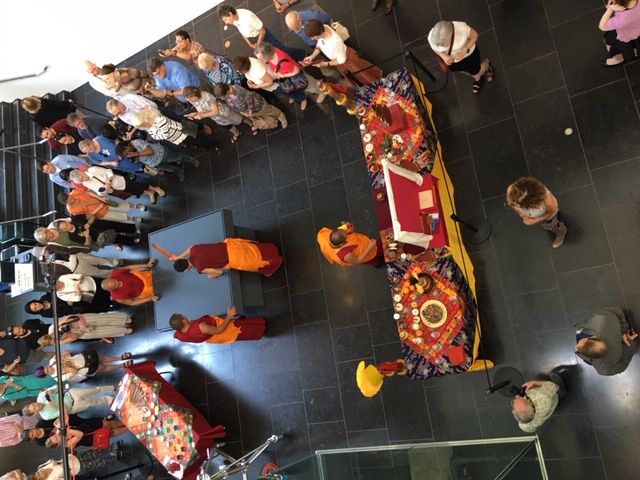
Vajrayana Buddhism has developed sand painting mandalas. And that brings us to the Virginia Museum of Fine Arts, which has a special exhibit “Awaken: A Tibetan Journey Toward Enlightenment” open now. According to the VMFA, “From May 2 through May 5, a group of Tibetan Buddhist monks from Drepung Loseling Monastery will create a sand mandala near the exhibition’s entrance, which—in accordance with their beliefs and practice—they will dismantle in a return visit on Aug. 3. Their visit is part of the Mystical Arts of Tibet World Tour that has traveled for more than 25 years and is endorsed by His Holiness the Dalai Lama.”
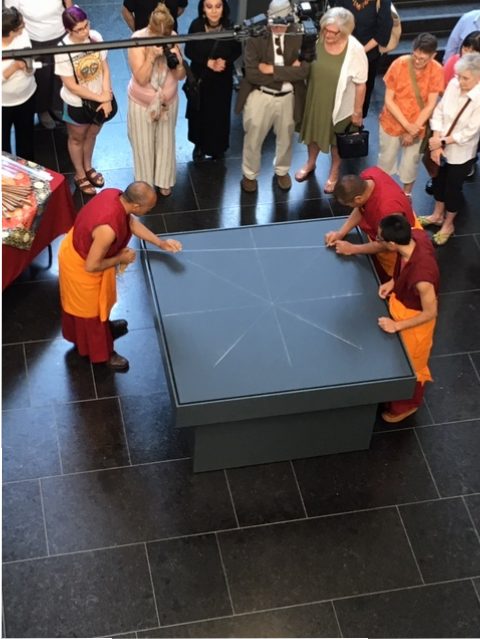
This week, I saw the Tibetan Buddhist Monks beginning that sand painting mandala. I could stay only little while, long enough to watch as they used a protractor to mark reference points on the circle.
They chalked thread or thin rope which two monks positioned across the circle. A third monk then picked up the center of the thread and dropped it, leaving a faint white chalk line.
No doubt by today, May 5, the mandala will be an elaborate and beautiful work of art. I intend to see it completed. I heard that when it is done, they will cover it on glass to preserve it during its time on view. And I will appreciate it all the more because, in accordance with their beliefs and practice, they will dismantle it on Aug. 3. I also heard that it will end in the James River—but that may be just gossip.
This sand painting is only a small part of the exhibit, which occupies ten spaces. The exhibit is on view April 27 through August 16.
Prejudice is an unjustified or incorrect attitude (usually negative) towards an individual based solely on his/her membership in a social group. In my opinion, prejudice is relatively benign for the target person if the prejudiced person does not act on the negative attitude. Unfortunately, this is seldom the case.
Discrimination is an action or behavior (including verbal)—usually negative—towards an individual or group of people on the basis of the prejudice. This is where the bad happens. Employment opportunities foreclosed. Inequality in lending practices. Lack of access to educational opportunities. Denial of goods or services (e.g., refusing to make a wedding cake for the wedding of a gay couple). Hate crimes.
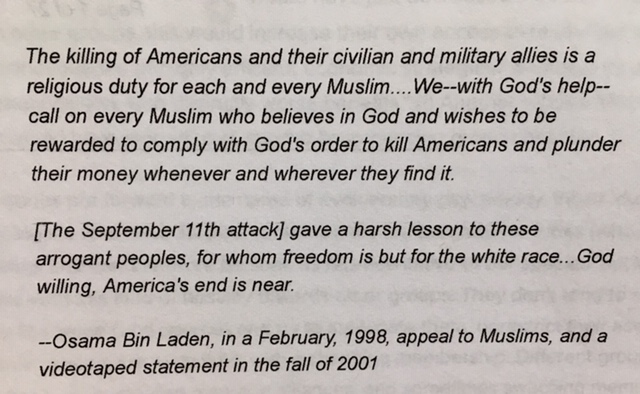
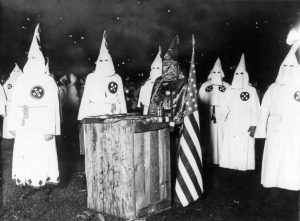
A classic example of prejudice leading to negative behavior:
So, one big question for you as a writer is what your character does as a reflection of his/her prejudice.
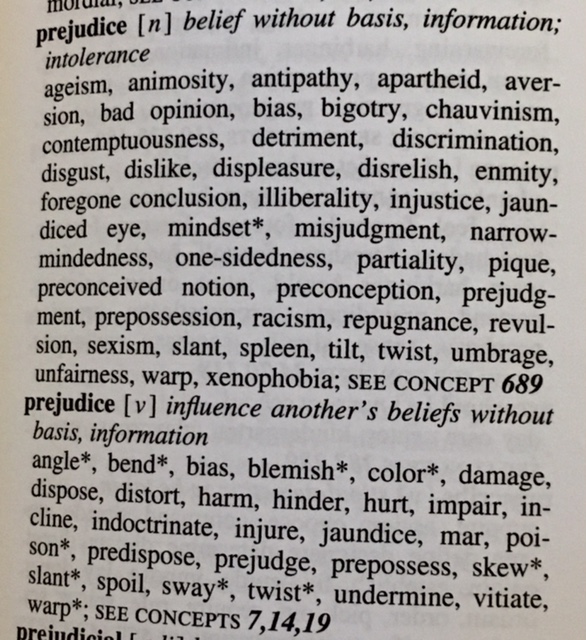
Although prejudice is an umbrella term for all sorts of -isms (as seen in the image above) it is also a subset of attitudes. And prejudice includes all three components of an attitude: cognitive, behavioral, and affective—how one thinks, behaves, and feels about a person, object, or act.
But before you can write realistically about a prejudiced character, you need to decide what function the prejudice serves for this character.
Cognitive adjustive: Lacking other information, one accepts stereotypes and/or prejudiced views as a way of knowing how to think and behave with a stranger.
Social normative: Holding attitudes—including prejudice—that allow the person to fit into a group or social setting. This might be family, gang, town, workplace, social class—any group the person wants entry to.
[Source: Brookings]
[Source: Creative Commons]
Ego-defensive: The person is basically insecure and adopts a prejudice to bolster feelings of self-worth. If a person has perceived lacks or failures, one way to feel better about oneself is to develop negative attitudes toward a whole group of people who, by the nature of who they are, can be viewed as inferior.
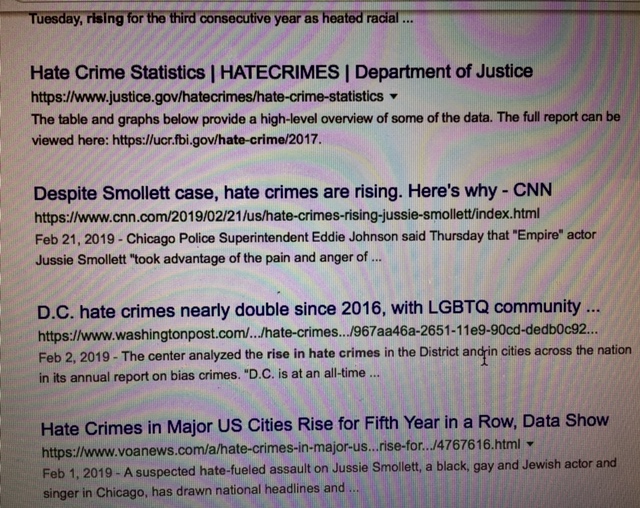
So, do you want your character to change? Depending on the function served, prejudice may be more or less entrenched. If it is based on lack of information, education and factual data will result in attitude change. Sometimes it’s as simple as getting to know members of the group. If it is based on group membership or conformity, changing reference groups will lead to attitude change. For example, moving to a different part of the country, changing schools or jobs, marrying into a family with differing attitudes, etc. The ego-defensive function is the most difficult to change. A person might suppress expression of deeply held biases when they are socially unacceptable (i.e., politically incorrect) but allow them expression when the atmosphere is right. Hate speech, hate crimes, and the rise of white supremacist groups are examples easily tracked online.
The ego-defensive function is highly robust. Prejudice serving this function is immune to factual evidence to the contrary, simply not believing the data. If, somehow, the facts cannot be denied, then one or more other groups might become targets of his/her prejudice. Eliminating prejudice for such people often involves psychotherapy because the cause is rooted in self-esteem, self-concept, and other deep psychological needs.
Often prejudice is negatively related to the mental health of the prejudiced person. For example, racism is a symptom of lack of psychological integration, self-esteem, and inner security. Similarly, sexism is unhealthy. Psychologists looked at 10 years of data from nearly 20,000 men and found that those who value having power over women and who endorse playboy-type behavior, and who hold traditional notions of masculinity (such as self-reliance), were more likely to experience depression, stress, body image issues, substance abuse, and negative social functioning. So if your character’s prejudice is racism or sexism, consider giving him/her some of these other characteristics as well.
Last but not least, consider how your character’s prejudice might bring him/her into conflict with others.
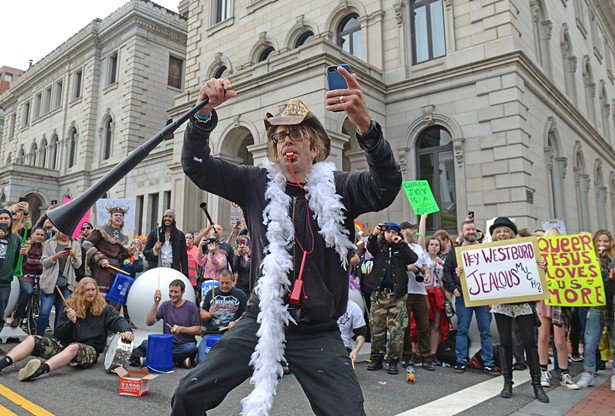
“Costume-clad kazoo players and drummers jubilantly respond to the Westboro Baptist Church.” [Source: Style Weekly]
Bottom line: Prejudice is a rich resource for writing your characters!