Hog Heaven

hog heaven
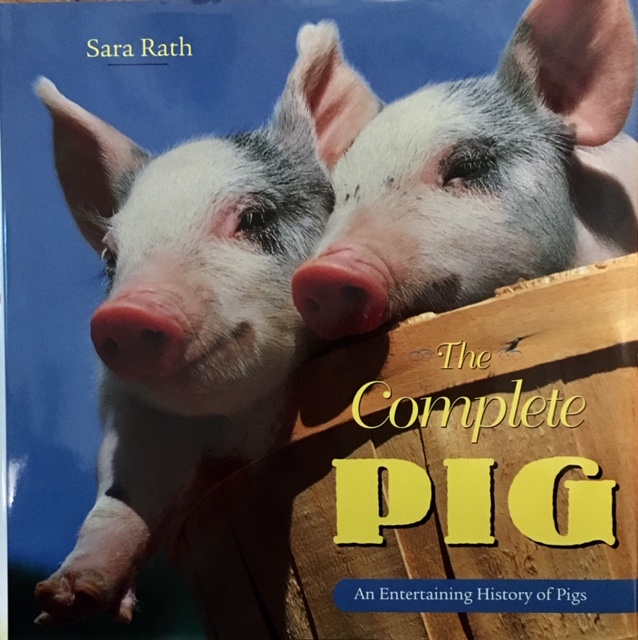
You may know from previous blog and FB posts that I’m enrolled in a class on nature writing. As a result, I’m even more aware of nature around me—of plants, birds, and squirrels in particular. But I’ve also been reading more about nature—particularly plants and animals, but I may move on to weather or geology at some point. But tonight, let’s talk pigs.
pigs
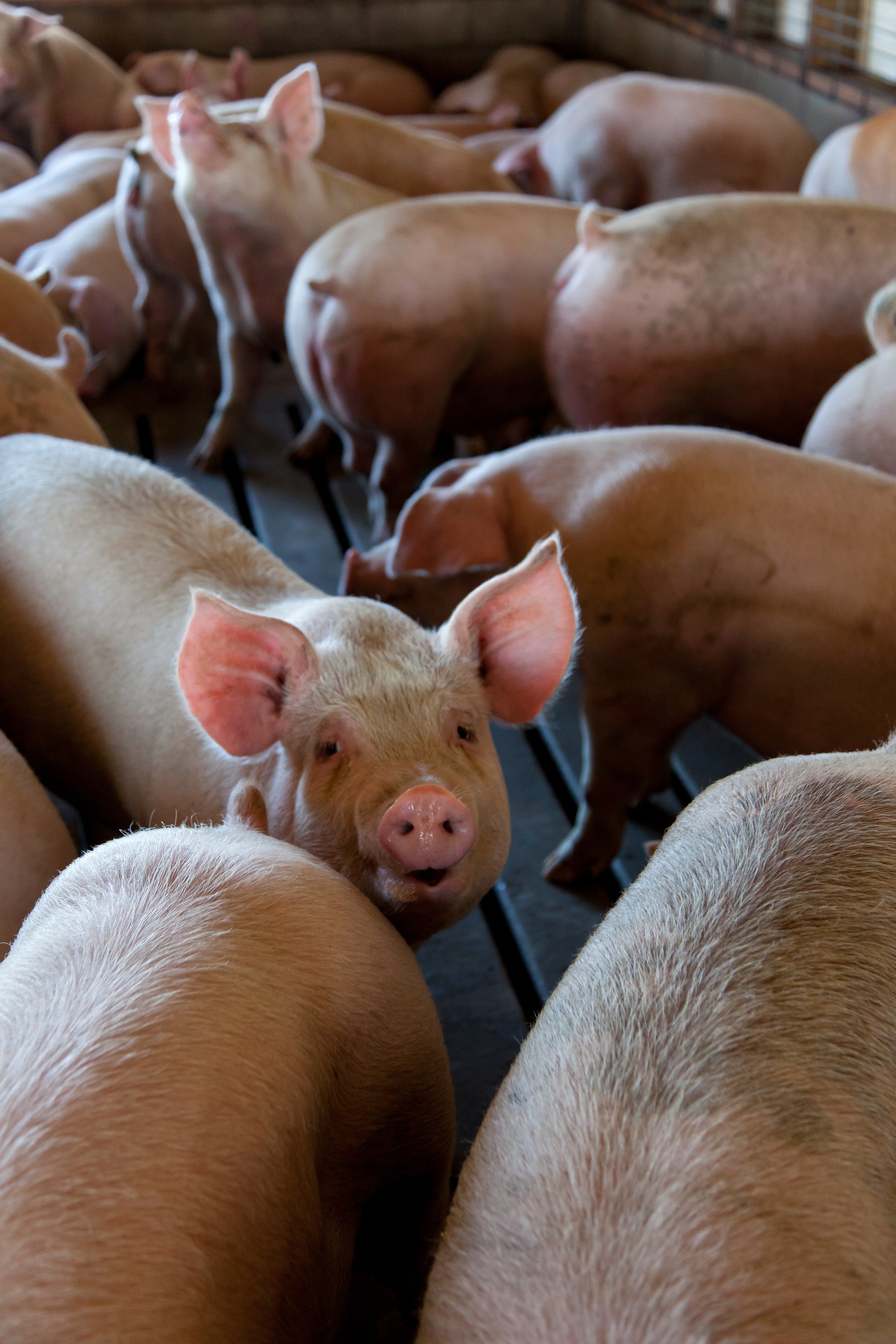
I grew up in farm country, with friends in 4-H who took their project pigs to the county fair, and uncles who butchered hogs on their farms. But most of us grew up hearing pig doggerel:


To market, to market
To buy a fat pig.
Home again, home again
Jiggedy jig.
To market to market
To buy a fat hog.
Home again, home again,
Jiggedy jog.
this little piggy
[Source: Pinterest]
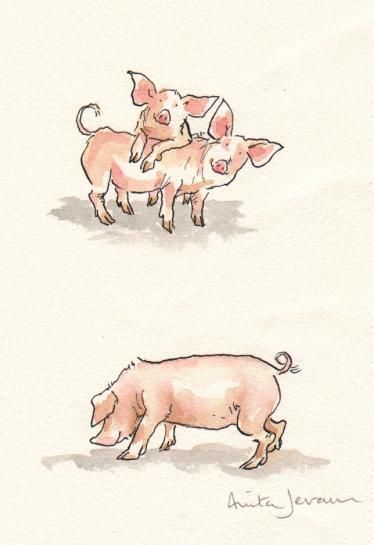
This little piggy went to market.
This little piggy stayed home.
This little piggy ate roast beef.
This little piggy had none.
And this little piggy went wee, wee, wee
All the way home.
three little pigs
[Source: South London Press]
Virtually everyone knows the story of “The Three Little Pigs.” If not that classic, there is always Porky Pig, and even more recently, Miss Piggy—who is cited as saying, “Never eat more than you can lift.”


Pigs have been all things to all people throughout history.


From the 11th through 13th centuries, the sow and the boar were symbols of all sorts of vices in the Bestiaries, collections of fables involving animals meant to provide morality themes for sermons, or personal reflection. Pigs in 16th century art often represented sins of the flesh.


Pigs as unclean: both Islam and traditional Judaism forbid eating pork. Hindus eat no pork, while Sikhs eat very little pork.


The contradictory roles of pigs in Greek mythology is beautifully illustrated by the legend that a sow was supposed to have suckled Zeus and a wild boar killed him. In ancient Egypt a pig represented the spirit of Osiris when crops were planted and the spirit of Seth when they were harvested. Nevertheless, they were considered unclean, and drinking pig milk was thought to cause leprosy. Tantric Buddhists worship Marici the Diamond Sow. The Kaulong section of Papua New Guinea is a pig culture—which is fascinating, and too much to go into here, but there is a saying there: “Pigs are our hearts.”
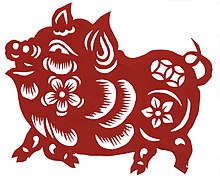
 

chinese zodiac pig
On the positive side: 2019 is the year of the pig in the Chinese zodiac. It comes around every twelve years. In 2007, it was the Year of the Golden Pig, especially auspicious because a Golden Pig year comes only once in every sixty years. The personality of Pigs is supposed to be kind and understanding, an able peacemaker. Pigs are excellent conversationalists, truthful and to the point. A Pig believes in justice and law and order, rejects all falsehood or hypocrisy.


Pigs for sport.
  • Greezed pig contests
  • Pig races at the Michigan Spree Festival
Random facts: 
  • Pigs are the most ancient of nonruminant mammals, existing forty million years ago—long before humans.
  • Pigs exist in one form or another in every part of the world.
  • In three months, three weeks, and three days, a sow can produce a litter of eight piglets. With competent treatment, they can be ready for market in six months.
  • Toothbrushes were invented in China and originally used boar bristles; today, industrial and consumer products are practically limitless, from plywood adhesive and dye to glue and bone china.
  • Beyond bacon: because of similarities to humans, pig heart valves, insulin, and porcine bur dressings. These are just examples of pharmaceutical uses, which rank second only to meat in importance.
  • You can’t sweat like a pig because pigs don’t sweat.
  • Pigs put on one pound of weight for every three pounds of feed they consume.
  • If there is an option, pigs do not wallow in their own waste.
  • Pigs can be housebroken.
Pigs in phrase and fable:
  • don’t cast pearls before swine
  • don’t buy a pig in a poke
  • can’t make a silk purse from a swine’s ear
  • graceful as a hog on ice
  • hogging the (x)
  • eat like a pig
  • eating high on the hog
  • living high on the hog
  • sweat like a pig (see above)
  • pig out
  • going whole hog
  • going hog wild
  • looks like a marzipan pig (i.e., prosperous)
  • fat as a pig
  • happy as a hog in shit
  • in a pig’s eye
  • piggy bank
  • piggyback
  • hogging the road
  • pigs get fat and hogs get slaughtered
  • being a porker
Bottom line: Pigs are ubiquitous. Is there a place for pigs in your writing?
 

Body Awareness

 
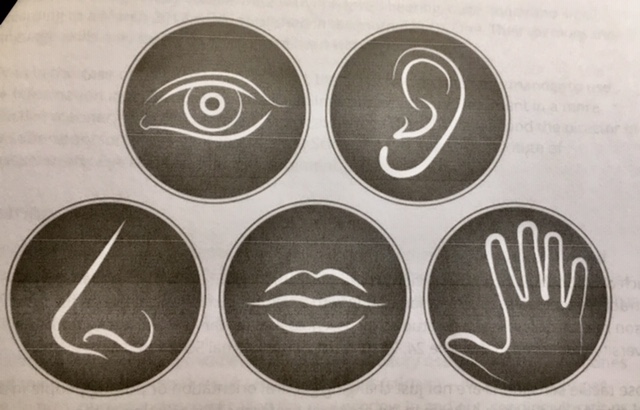
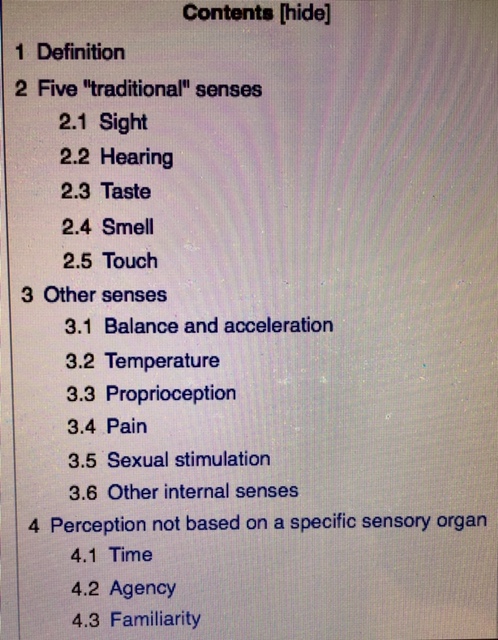
When writers write human sensations, they typically rely on the basic five: sight (vision), hearing (audition), taste (gustation), smell (olfaction), and touch (somatosensation). Everyone since Aristotle has recognized these. But relying on these is over-simplification.


In fact, humans have a multitude of sensors. The ability to detect other stimuli beyond those governed by these most broadly recognized senses also exists, and these sensory modalities include temperature (thermoception), kinesthetic sense (proprioception), pain (nociception), balance (equilibrioception), vibration (mechanoreception), and various internal stimuli (e.g. the different chemoreceptors for detecting salt and carbon dioxideconcentrations in the blood, or sense of hunger and sense of thirst).
What constitutes a sense is a matter of debate, leading to difficulties in defining what exactly a distinct sense is, and where the borders lie between responses to related stimuli. Today, a conservative list of senses numbers 10 and the generally accepted list includes 21. The radical list identifies at least 33.
 
But as writers, we don’t have to worry about exact numbers and labels. We just need to develop a keener body awareness for our characters.
 
 
One of my personal favorites is proprioception, the sense that gives you the ability to tell where your body parts are in relation to other body parts and the environment. Being able to close your eyes and touch your nose is one example—a skill that is impaired when drunk, BTW.
 
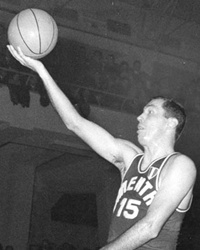
I first really though about this sense when I read what John McPhee said about Bill Bradley, back in the day when Bill Bradley was a basketball superstar. McPhee was particularly impressed that Bradley, back to the basket, could look him in the eye, hold a conversation, and toss a basketball over his shoulder and make the shot.
 
 
Bradley: “When you have played basketball for a while, you don’t need to look at the basket when you are in close like this….You develop a sense of where you are.”
 
Any character who is athletic would have a highly developed sense of body awareness. The opposite of Bill Bradley is the character who is forever bumping her/his head, tripping, knocking into things, etc.
 
Choose any sense and have a character who is characterized by an extreme of that sense. For example, tea, wine, or coffee tasters; acrobats; inability to feel pain or temperature; etc.
 
Numerous studies have shown that people do have the ability to detect accurately the passage of time, without counting or anything like that: on average, 18 to 24 year olds could tell when 3 minutes were up within a 3 second margin. And perhaps more interesting, our sense of time slows down with age, so that 60-80 year olds, on average, thought that 3 minutes had passed at around 3 minutes and 40 seconds! Again, this might be more useful for people on either extreme from the average. FYI, people with Parkinson’s or ADD have very poor sense of time passage compared to “normal” people.
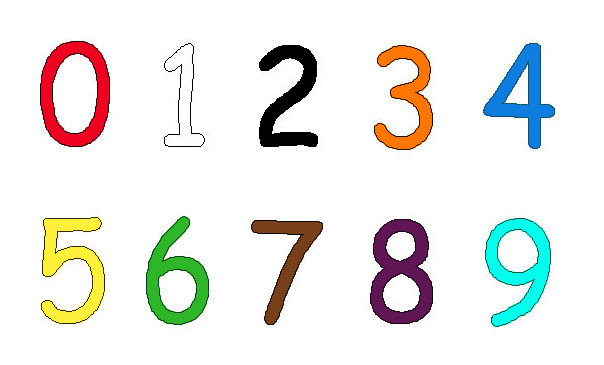
numbers in color
Synesthesia is, essentially, when our sensory wires get crossed. Such people hear or taste color, for example. Although some people experience this naturally, it is more common under the influence of hallucinogens.


BOTTOM LINE: Do a little reading online about human senses to develop awareness of how these can enhance your writing!
 

When Your Character is Prejudiced

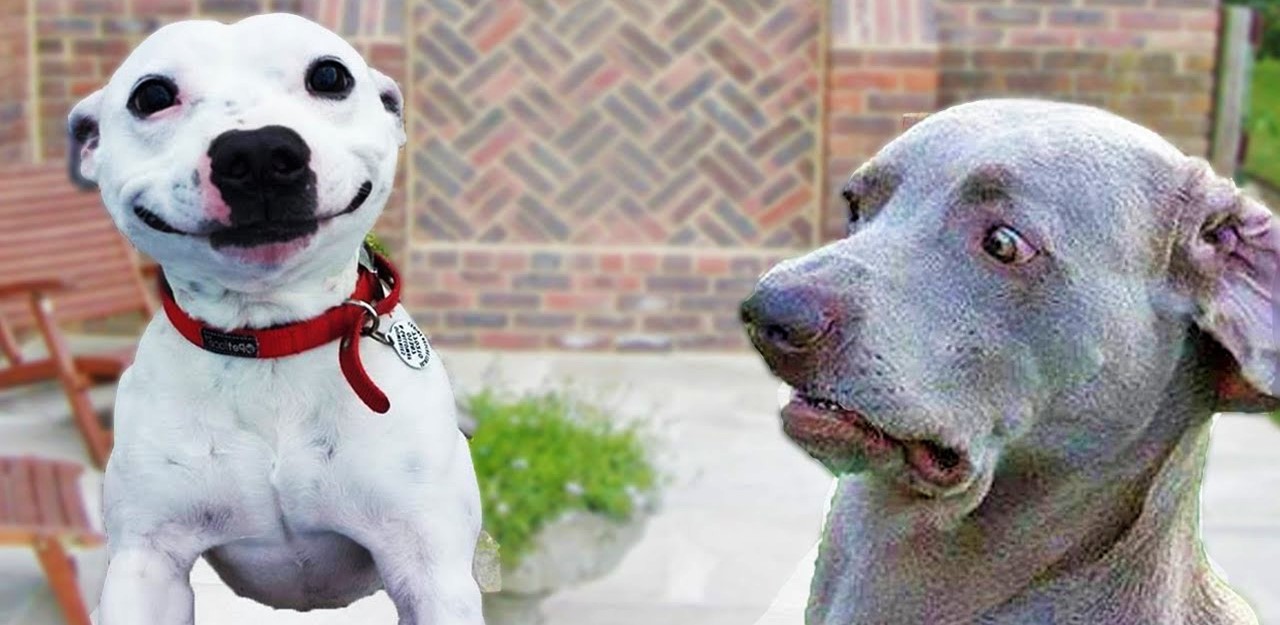
character prejudiced
Prejudice is an unjustified or incorrect attitude (usually negative) towards an individual based solely on his/her membership in a social group. In my opinion, prejudice is relatively benign for the target person if the prejudiced person does not act on the negative attitude. Unfortunately, this is seldom the case.


Discrimination is an action or behavior (including verbal)—usually negative—towards an individual or group of people on the basis of the prejudice. This is where the bad happens. Employment opportunities foreclosed. Inequality in lending practices. Lack of access to educational opportunities. Denial of goods or services (e.g., refusing to make a wedding cake for the wedding of a gay couple). Hate crimes.


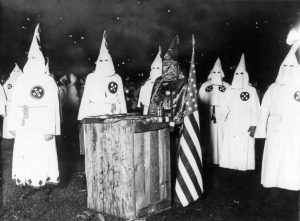
A classic example of prejudice leading to negative behavior:


character prejudiced
So, one big question for you as a writer is what your character does as a reflection of his/her prejudice.
 
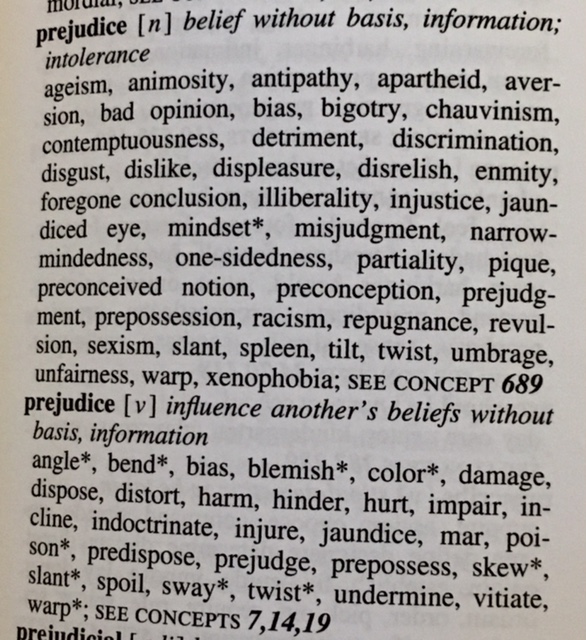
Although prejudice is an umbrella term for all sorts of -isms (as seen in the image above) it is also a subset of attitudes. And prejudice includes all three components of an attitude: cognitive, behavioral, and affective—how one thinks, behaves, and feels about a person, object, or act.


But before you can write realistically about a prejudiced character, you need to decide what function the prejudice serves for this character.
 
Cognitive adjustive: Lacking other information, one accepts stereotypes and/or prejudiced views as a way of knowing how to think and behave with a stranger.


Social normative: Holding attitudes—including prejudice—that allow the person to fit into a group or social setting. This might be family, gang, town, workplace, social class—any group the person wants entry to.


Ego-defensive: The person is basically insecure and adopts a prejudice to bolster feelings of self-worth. If a person has perceived lacks or failures, one way to feel better about oneself is to develop negative attitudes toward a whole group of people who, by the nature of who they are, can be viewed as inferior.


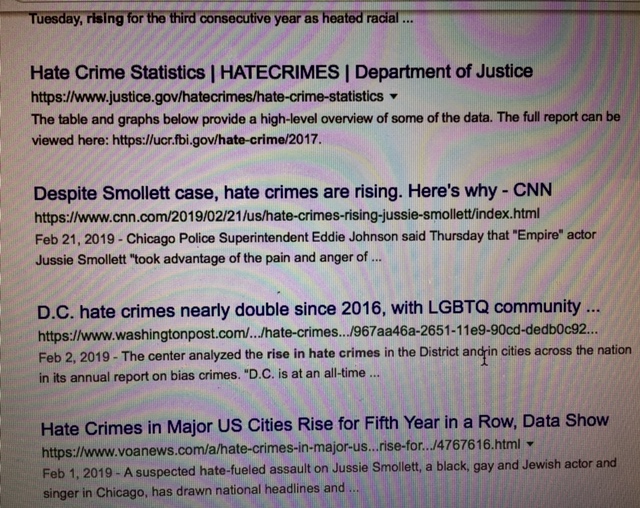
So, do you want your character to change? Depending on the function served, prejudice may be more or less entrenched. If it is based on lack of information, education and factual data will result in attitude change. Sometimes it’s as simple as getting to know members of the group. If it is based on group membership or conformity, changing reference groups will lead to attitude change. For example, moving to a different part of the country, changing schools or jobs, marrying into a family with differing attitudes, etc. The ego-defensive function is the most difficult to change. A person might suppress expression of deeply held biases when they are socially unacceptable (i.e., politically incorrect) but allow them expression when the atmosphere is right. Hate speech, hate crimes, and the rise of white supremacist groups are examples easily tracked online.


character prejudiced
The ego-defensive function is highly robust. Prejudice serving this function is immune to factual evidence to the contrary, simply not believing the data. If, somehow, the facts cannot be denied, then one or more other groups might become targets of his/her prejudice. Eliminating prejudice for such people often involves psychotherapy because the cause is rooted in self-esteem, self-concept, and other deep psychological needs.


Often prejudice is negatively related to the mental health of the prejudiced person. For example, racism is a symptom of lack of psychological integration, self-esteem, and inner security. Similarly, sexism is unhealthy. Psychologists looked at 10 years of data from nearly 20,000 men and found that those who value having power over women and who endorse playboy-type behavior, and who hold traditional notions of masculinity (such as self-reliance), were more likely to experience depression, stress, body image issues, substance abuse, and negative social functioning. So if your character’s prejudice is racism or sexism, consider giving him/her some of these other characteristics as well.
 
Last but not least, consider how your character’s prejudice might bring him/her into conflict with others.
 
westboro rally richmond
“Costume-clad kazoo players and drummers jubilantly respond to the Westboro Baptist Church.” [Source: Style Weekly]
 
Bottom line: Prejudice is a rich resource for writing your characters!