Volunteering is a positive thing, as nearly everyone agrees. A volunteer benefits not just their community but reaps a range of benefits mentally, professionally, and personally.
Maureen Sullivan and Shirley Conn, American Women’s Voluntary Services (F. Palumbo, 1941)
Words associated with volunteering include:
Passionate
Reliable
Team player
Patient
Creative
Energetic
Positive
Willing to help
Compassionate
Organized
Why to Volunteer
So, if you volunteer, you are likely to enhance your image. But if your image is “fine,“ why bother? There are many more substantive reasons for people—even selfish people—to volunteer.
Social scientist have studied the phenomenon of volunteering for years, and the benefits are clearly documented for physical benefits, a range of mental and emotional positives as well as a sense of self-worth, and social networking.
Dr. Eric Kim, psychologist, has studied the connection between psychological well-being and physical health. One study, published in the American Journal of Preventive Medicine, followed people who volunteered at least two hours per week over a period of four years. According to Kim, “Our minds and bodies are rewarded when we give to others.” Study participants showed less chance of early death and also reduced “physical functioning limitations.”
Developing confidence: discovering hidden talents that may change the volunteer’s view of their own self-worth.
Learning new/valuable skills: opportunity to develop transferable skills applicable to any position, such as interpersonal communication, time management, leadership, delegation, communication, leadership and problem-solving.
Networking: volunteer work can demonstrate to those who may be in a position to recommend you to others or hire you for a paid position based on the kind of person you are (e.g. how you work with others, how you approach tasks, how you take initiative, how you manage your time).
Targeted volunteering gives you the opportunity to develop meaningful connections with professionals in your field of interest.
Career exploration: volunteering is also a great way to explore different career opportunities by engaging with professionals in a variety of fields to better understand your interests, likes and dislikes and determine which fields you might want to pursue further.
Other professional benefits:
Gaining professional experience
Expand your resume
Career advancement
Develop social skills
Mental Health Benefits
Mental health professionals agree that focusing on a cause outside of yourself has many benefits for mental health and well-being.
Interrupts tension-producing patterns.
Increase happiness: reduce stress, combat depression, anxiety and loneliness by releasing dopamine.
Moods and emotions, like optimism, joy, and control over one’s fate, strengthen the immune system.
Physical health (by encouraging more physical activity)
Gratification of giving back
Meet new people/make new friends
Finding purpose
And bring fun into your life!
Benefits to Your Community
Community cohesion: assisting in uniting people from diverse backgrounds to work toward a common goal and building camaraderie through teamwork.
Personal growth and fulfillment: through working with local non-profit agencies, learn about the functions and operations of our government, gain knowledge of local resources available to solve community needs.
Saving resources: volunteering provides valuable community services so more money can be spent on local improvements. The estimated value of a volunteer’s time in California is $26.87 per hour based on the Corporation for National & Community Service.
Cons of Volunteering
The constraints on time, funding, or manpower can make it tough for volunteers to hit their goals or create a significant impact. Such failures can cause the volunteers to lose faith in the cause or in the benefits of volunteering altogether.
In addition, you may also encounter resistance. Introducing new ideas or initiatives can face pushback, both from within the organization and the community.
Bottom Line: Weighing the pros and cons, even selfish self-interest supports volunteering.
The relationship between clothing and psychology has been studied for decades. The major point overall is that the relationship between clothing and psychology is bidirectional. Not only do our clothing choices reflect our identity, but they can also influence our thoughts and feelings.
Clothes can be a way to express ourselves without saying a word. As a form of nonverbal communication, clothes can reveal our inner emotional states to others—or hide them.
Mood
On a given day, clothes may be a reflection of one’s mood OR a projection of the mood we want people to think we are feeling. For example, someone who wears bright colors may be feeling outgoing and confident, or want to appear that way. Someone who chooses black may be reserved and serious, or want to seem so. Also, over centuries, dark and dull colors were the colors of mourning, sometimes required more than felt.
On days when we feel happy and positive, we tend to gravitate towards bright colors and playful patterns. Conversely, during times of sadness or anxiety, we may find ourselves reaching for comfortable and cozy clothing in neutral tones. Our clothing can become a reflection of how we are feeling.
Nostalgia
Certain clothing items can evoke nostalgia. As humans, we have an innate ability to attach emotions and memories to objects, including clothing that holds sentimental value or reminds us of a specific time or place in our lives. By definition, nostalgia means thinking of past happy moments filled with joy and warmth.
One reason certain clothing items hold strong nostalgic value is because they were worn during significant events or milestones in our lives. For example, a wedding dress, or a graduation gown that brings back memories of hard work and achievement.
The opposite is also true: some items of clothing or jewelry may bring back powerful memories of loss or grief.
Comfort
Physical comfort is essential for our overall well-being. When we wear comfortable clothing, we feel relaxed and at ease. It allows us to move freely, without restrictions or discomfort. Comfortable clothes can also boost our confidence as we don’t have to constantly adjust or worry about how we look. This sense of ease can positively impact our mood by reducing stress and anxiety levels.
Self-Perception
The clothes we wear can also influence how we feel about ourselves. Studies have shown that people tend to feel more confident when dressed more formally than when dressed more casually. When we feel confident and put together, it can positively affect our mindset and give us a sense of power and control. The explanation posited is that dressing in professional attire signals importance and authority, which can boost one’s self-esteem. This phenomenon, known as “enclothed cognition,” highlights the powerful impact clothing can have on our psychological state.
The saying “dress for the job you want, not the job you have” holds true in many professional settings. When we dress professionally, we are projecting an image of competence, credibility, and authority. Participants in a study paid closer attention and made fewer mistakes on a test when they wore white lab coats. Women in another study performed either worse or more variably on both athletic and cognitivetasks when required to wear clothing that draws attention to their bodies. This not only affects how others perceive us but also how they respond to us, as a competent authority—further boosting self-esteem and confidence.
Reflective and Affective Color
Color can both affect our emotions and reflect them. For instance, red is associated with passion and energy while blue represents calmness and stability. Our brains associate green with nature, growth, balance, and harmony while yellow represents happiness and optimism. These associations can shape how others perceive us based on the color of clothing we choose to wear.
The colors we choose to wear have a significant impact on our mood and behavior. This is because colors can evoke different emotions and feelings, making us feel happy, calm, energized, or even anxious. The psychology of color has been studied extensively, with research showing that certain hues can trigger specific reactions in the brain.
Personality for Color Preferences
Color preferences are related to personality traits.
Juliet Ju and Jung Hee Ha researched the relationships between personality and color preferences in 2022. Their research reveals a positive correlation between agreeableness and preference for yellow, light blue, and white, and a negative correlation between agreeableness and a preference for red. In addition, they found a positive correlation between conscientiousness and a preference for light blue and dark blue, and a negative correlation between conscientiousness and a preference for red.
Meanwhile, emotional stability was positively correlated with a preference for light blue, dark blue, and white, and negatively correlated with red and yellow. Finally, openness to new experiences was positively correlated with a preference for bright blue and white, and negatively correlated with a preference for orange.
This research found that color preferences significantly predicted all personality traits except extraversion. Agreeableness was significantly predicted by yellow, light blue, and white preferences. They found that the preference for light blue significantly predicted conscientiousness. Emotional stability was significantly predicted by red and light blue preferences. Openness to new experiences was predicted by green, purple, and white preferences.
Good to know if you are trying to manipulate the impression you are making!
Red is associated with passion, love, and power. It is a bold and intense color that can increase heart rate and blood pressure, making us feel more alert and energized. Wearing red clothing can also make us appear more confident and attractive. On the other hand, too much red can also lead to feelings of anger or aggression.
Blueis known for its calming effect on the mind and body. It is often associated with trust, stability, and intelligence. Studies have shown that wearing blue clothing can lower blood pressure and heart rate while promoting relaxation. This makes it an ideal color to wear during stressful situations or when you need to remain focused. FYI, overall blue is America’s favorite color.
Yellowis a bright and cheerful color that symbolizes happiness, optimism, and creativity. It has been found to stimulate mental activity and boost energy levels. Wearing yellow clothing can help improve your mood on days when you are feeling down or unmotivated.
Greenrepresents nature, growth, balance, and harmony. It has a calming effect on the eyes as it reflects most light wavelengths evenly. Wearing green clothing can promote feelings of tranquility while reducing anxiety levels.
Impact of Clothing Patterns
A study by George K Stylios, Meixuan Chen indicated that patterns on clothing also affect the mood and behavior of the wearer and the observer. In particular, repeating patterns increase theta brain waves, indicating people take more pleasure in these compared to non-repeating ones. People were also more excited by strong, intense patterns than weak or subtle ones.
So, if you want to attract attention, opt for an intense, repeating pattern. If you’re going for a calming but pleasant effect, wear something with a subtly repeating pattern. Clothing without any patterns tends to have less effect on the brain of the observer, which may be helpful for someone who wishes to be unobtrusive. Wearing an intense, non-repeating pattern will have a very strong, edgy effect.
Values and Beliefs
Values and beliefs can be revealed by clothing. A t-shirt or hat with a slogan will make an immediate statement about the wearer’s beliefs, but other signs may not be as obvious. For example, someone who wears clothing made from sustainable, eco-friendly materials might signal their commitment to environmental causes, while someone who chooses to wear clothing from a particular cultural tradition might be expressing their connection to that culture. In this way, the clothes we wear can serve as a visual representation of our beliefs and values.
Identity Reinforcement
We often choose clothing that reinforces our existing self-concept. If you see yourself as a creative individual, you might gravitate toward unique and artistic fashion choices. On the other hand, if you identify as a professional, your wardrobe may consist of business attire that reflects your dedication to your career.
Social Identity
We tend to dress in ways that align with the social groups we belong to or aspire to be part of. Subcultures, such as punk, goth, or hip-hop, often have distinct fashion styles associated with them. By adopting clothing related to a particular subculture, individuals signal their membership and allegiance to that group. It’s a way of saying, “I belong here.”
None of This is Infallible
It is important to recognize that clothing choice cannot definitively reveal a person’s personality. All of the points covered in this blog are based on group data, and individuals vary a great deal. So, while clothing can provide some clues, it cannot accurately define a person’s personality. Remember that quite a lot of personal fashion is determined by elements outside the wearer’s control!
Bottom Line: Clothing is more than just a practical necessity. Understanding the psychology behind our clothing choices can lead to greater self-awareness and a more intentional approach to the messages we convey through our attire. So the next time you stand in front of your closet, remember that your clothing choices are more than just fabric and threads; they reflect who you are and who you aspire to be.
There’s no denying that clothes are important. They are (arguably) the first thing people see when they see you—front, back, or sideways. People may infer a lot from your clothes, everything from socio-economic class to what you like. Are they accurate?
Sometimes. In my opinion, there are multiple factors that determine what one wears at any given time. Our clothing choices are not static; rather, they adapt to different circumstances. The way you dress for a job interview will likely differ from how you dress for a casual weekend with friends. Adaptability reflects our ability to navigate social situations effectively. We use clothing as a tool to project the desired image.
Factors Outside Yourself That Affect Clothing Choices
Socio-Economic Standing
As a child, I wore whatever my mother made for me, plus hand-me-downs from older cousins. Although places such as resale stores, Goodwill, and Ashland Christian Emergency Services may provide access to clothes one might not be able to afford otherwise, perfect tailoring, high fashion, and accessories such as fur just aren’t available to most working class/blue- or pink-collar people.
Accessibility
Related to socio-economic standing is the issue of what clothes a person is able to obtain and wear. Wealthy people can afford to have clothes tailored or even custom-made to fit, but everyone else is generally limited to what is available on the rack. Even trying to make or alter your own clothes requires skill, time, and materials. People with measurements outside the average often have to settle for what fits rather than what they like.
Though they have improved a bit in recent years, many clothing lines that cater to plus-size women still offer only dark colors, floral prints, boxy silhouettes, and outdated trends. Additionally, many brands simply scale up clothing designed for thinner bodies, making clothes that don’t fit at the shoulders and hips or don’t bend properly at the knees and elbows.
Exceptionally tall or short fashionistas face similar problems when trying to choose clothing. A friend who is very tall hates tunic style tops but often can’t find anything else long enough for her torso. Her equally tall husband generally settles for shirts too large in the shoulders because those are the only ones that don’t bare his navel. Another friend has to shop for footwear exclusively in the children’s section because those are the only shoes small enough for her feet.
Work
Although the line has blurred since the COVID restrictions made work-from-home and on-line-commuting common, most people can still look at their closets/dressers and identify which clothes are specifically for work—at least for Zoom meetings!
The most obvious work place attire is seen where uniforms are required: members of the military, nurses, fast-food workers, flight attendants, athletic teams, and the like.
But beyond such obvious uniforms, think about what you expect to see on a funeral director; priest, minister, rabbi, or mullah; fashion designer; orchestra member; member of Congress, etc. Although these (and many other) professions do not have a single uniform per se, nevertheless informal or even formal dress codes apply. At one time, when part of my job included overseeing secretarial and clerical staff who met the public, I told the employees (all female at the time) no cleavage, no pits, no crotch, and no jeans on the job.
Astronauts must wear clothing to keep them safe aboard a rocket ship or in the cold vacuum of space.
Some jobs require specific clothing styles for safety or convenience. Locksmiths need to wear shoes with steel toe caps and no laces where shards of metal could work their way inside. General contractors often wear cargo pants and utility belts with plenty of pockets to hold tools and materials. Anyone working in a kitchen is going to prefer shirts with closely fitting sleeves. People with particularly messy workplaces, such as auto mechanics and crime scene cleaners, may opt to wear a full-body coverall at work to protect their regular clothing.
Dress for Success
As jobs change, so does one’s clothing. As a college professor I wore tweeds, wool, boots, and almost no jewelry. For over ten years as an executive in association management and academic administration, I wore skirted banker suits, pearls, a moderate amount of gold jewelry, and two-inch heels with matching handbags and briefcase.
In late1970s and early ‘80s, John T. Molloy published many Dress for Success books. I suspect that his advice is outdated: today, I met with a female bank manager who wore slacks and a cable-knit sweater.
Still, the concept remains the same. Although the specifics vary, dressing for success is still a real thing. Proverbial wisdom says, “Dress for the job you want, not the job you have.” And then there is this hint of who is striving: you can tell who’s on the way up by whose shoes are shined.
In Retirement/At Leisure
This is where one is likely to get the clearest insight into personal clothing preferences.
No longer dressing for paid work, I wear flat black shoes, comfortable pants, casual tops, and lots of silver jewelry (usually earrings, necklace, bracelet, watch, and multiple rings on each hand). Even so, I’m a little more formal for symphony, opera, or theater. Society still has expectations about what people ought to wear. Regardless of work status, what one wears to a worship service is very likely different from what one wears to a ballgame. (All of the following factors still apply.)
Geographic Location/ Weather/ Season
Not to belabor the point: what is necessary in upstate New York in winter isn’t appropriate in South Carolina, and what is worn in South Carolina is likely inadequate in upstate New York. And all of America tends to dress more casually than the rest of the world.
Just look at traditional national costumes from countries with varying climates and compare that with what is considered socially acceptable now. Along with lightweight fabrics, society is more likely to accept bared shoulders, shorts, open-toed shoes in hot, humid climates. Going to work in a sleeveless shirt and shorts would likely cause raised eyebrows in Norway. Wearing a fur-lined parka to the beach in Thailand might cause heat stroke!
Ceremonies and Celebrations
Think funeral, wedding, employee party, anniversary, baby shower, Halloween party… Again, this is pretty obvious, although it differs over time and by peer group—and personal preference!
In September of the same year, I attended the weddings of my oldest and youngest daughters. For numerous reasons, including geography, I wasn’t involved in the planning of either event. My husband and I gave each daughter a check (for the same amount of money) and said, “Do what you will.”
The older daughter’s wedding was held in an historic meeting house in New England and involved a white dress and veil, 6 attendants in matching dresses, a sit-down reception, and dancing. I wore a dress suitable for the mother of the bride.
The younger daughter was married in the back yard of the house where she and her soon-to-be-husband were living, with baskets of flowers nailed to railroad ties. He wore a tailored green silk suit and shirt; she wore a white, spaghetti-strap mini-dress, a circle of daisies in her hair, and platform sandals. The reception was an outdoor barbecue. The guests sported leather, chains, denim, and tattoos. I wore casual pants and top.
Note: people who dress to the expected norms tell us much less about themselves than the rebels who defy expectations.
Clothes for Functionality
Sometimes, fashion is the result of function, clothing and accessories that allow the body to move and perform in ways otherwise impossible. Think of a soccer player’s cleats or a fly fisher with a many-pocketed vest and rubber boots.
Medically Adapted Clothes
Some people choose clothes for medical reasons rather than fashionable ones, though the two can sometimes be combined. People who use mobility devices like wheelchairs or crutches might choose clothing that drapes nicely when seated or has no chance of tangling. Those who have attached medical devices, such as chemotherapy ports, insulin pumps, or colostomy bags can buy or adapt clothing that allows easier access these devices. Compression tights can help with circulation issues. Nursing mothers are likely to wear shirts, dresses, and bras designed to allow feeding access.
Eyeglasses straddle the line between accessories and medical devices. Though more than 4 billion people worldwide rely on corrective lenses, it is usually possible to choose frames of a shape, size, and color that reflects one’s personal style preferences.
People with sensitive skin and those who spend a lot of time outside have an increasing range of options for sun protection. Long-sleeved swimsuits and UV protective workout clothes share shelf space with wide-brimmed hats, sunglasses, and sunblock creams.
Hobby Clothes
The clothes you wear for your hobbies are likely very different from those you’d wear to work or an evening out with friends. If those hobbies are active ones, you may choose clothing that makes it easier to enjoy those hobbies.
A gardener wears gloves and sturdy pants for protection rather than fashion. A skier’s suit provides insulation but still allows movement. Leotards, running shorts, rock-climbing gloves, line-dancing shoes, and sweat bands all allow the wearer to move in comfort while enjoying their hobbies.
Clothesthat Enhance
Wearing a dragon’s wings allows small children to take flight, as everyone knows.
And then there are clothes that allow the wearer to surpass their previous athletic or artistic performance. A ballet dancer wears pointe shoes not for the sake of fashion but because they redistribute weight and support her foot while balancing on the tips of her toes. Weight lifters wear friction gloves and intra-abdominal pressure belts, allowing them to lift heavier loads without injury. A marathon runner and a hurdler will choose very different shoes for competition, as shoe designs can provide athletes with different advantages.
Competitive swimmers faced controversy at the 2008 Olympics for wearing Speedo’s LZR Racer suits. These suits provided swimmers with extra buoyancy, reduced drag, and muscle compression. Ultimately, competitive swimming advisory boards banned these suits, claiming they were the equivalent of “technological doping” for athletes.
Artistic Performance
Belly dancers typically perform in costumes that accent their hips.
Performance clothes often mix fashion with functionality, chosen not just for the way they look but for how they enhance the wearer’s movements. A Chinese long-sleeve dancer wears a costume with sleeves extended far past her fingertips to highlight the graceful movements of her hands and arms. Tap dancers and Irish dancers might choose sparkly socks and shoe buckles to draw attention to their fancy footwork. A harpist or flautist might wear sleeves that flutter attractively when they play their instrument.
When Clothes Get Truly Personal
Overall, despite external expectations, clothes can still be a form of self-expression.
Style Choices
Whether you opt for a bohemian maxi dress, a tailored suit, or a vintage band t-shirt, your clothing sends a message about who you are and what you stand for. According to the fashion industry, there are several basic style choices in American clothing, including the following.
Classic/ Traditional
Gabrielle Union
If you would describe your style as classic or traditional, you choose plain fabrics, or maybe a discreet pinstripe at most. You like clean and crisp fabrics that have some structure. You are drawn to timeless fashion, preferring to invest in quality fabrics and timeless styles rather than jumping on trends. A person with a classic style typically has a rather formal wardrobe and always look polished and put together. Matching and co-ordinated looks are your preference over those that incorporate bold colors and prints. Your jewelry and accessory choices are not overbearing; they compliment your outfits without being the focal point.
Natural/ Relaxed
Tilda Swinton
Feeling comfortable in your clothes is most important to you, and your easygoing nature tends towards more casual outfits. Simple lines and designs are your preferred choices over anything too detailed or fussy. In keeping with this carefree attitude, you tend to buy easy care, wash and wear garments. You prefer fabrics such as denim, cotton jersey, and lightweight knits. Your jewelry choices reflect your minimal look, and you tend to wear basic and durable accessories. Your footwear also is chosen for comfort. You are not a pattern lover, but choose a stripe or check and sometimes a tweed. You like some texture and also are attracted to the colors of nature. Lots of denim, khaki, and button-front styling.
Gamine—a smaller/shorter version of sporty/natural. The gamin woman looks great in pixie hairstyles and sporty/natural clothing styles.
Dramatic/ Edgy
Lupita Nyong’o
If you have a dramatic streak, you will like brighter colors, big bold patterns, or high contrast patterns, perhaps fabrics with shine or a more structural appearance. You may also like animal prints, large and spectacular accessories. Wearing the latest fashion takes precedence over comfort, and you are willing to give most new trends a go. This means your wardrobe consists of many different styles and one-off pieces ready to make a statement. Your look is striking and well-thought-out. Details such a lip color and eye-catching shoes provide the finishing touch to your look. Jewelry and accessories in shiny metal finishes or bold one-of-a-kind wearable art pieces compliment your statement-making looks.
Artistic/ Creative
Josephine Baker
If you have a creative personality you may like patterns that are more about ‘wearable art’, abstract prints, or mixtures of prints and patterns all in one garment. Your way of dressing is innovative and individualistic, and you aren’t overly influenced by current trends or traditional rules. You use your clothing choices to reflect your personality and put together unique and interesting outfits with items purchased from varied sources. Different colors, textures, and prints fill your wardrobe, and your jewelry collection is bold while your footwear and accessories are usually statement-making.
Romantic/ Feminine
Zoe Saldaña
Women with this style prefer floral prints, or nature inspired ones (such as butterflies, or plants). If your style leans toward the feminine and romantic, you will choose soft, floaty fabrics that drape over your body. You may like sequins and beading detail on clothes. You have a soft appearance and generally prefer flowing silhouettes and muted colors. Your clothing choices are pretty, and include details such as bows, ruffles, pleats, and lace. Even with simpler styles, you will most likely choose them in pastel colors or with decorative details. Your footwear and accessory choices are delicate and minimal with fine necklaces and ballet flats among your staples.
If you think of yourself as Romantic, you like dressing with lots of fullness and softness. You choose large plaids, large printed designs on fabrics, and large details (Women like large ruffles, lace and bows; men like baggy pants and full cut shirts & sweaters).
“Timeline of Spring Fashions” by a-little-bit-lexical
Your style is much more than clothes or accessories. It includes all the little things that you do to make yourself look and feel good, from hair style and makeup to nail care and grooming.
Bottom Line: Be aware of what you wear. Within situational contexts such as those discussed above, clothes can reflect your personality AND how you want to be perceived. They may reflect social status, current activity, as well as your current mood or mindset.
A friend recently told me that the horror villains we fear are subconscious stand-ins for things we’re afraid of in real life. Vampires stand for a fear of change; zombies for a fear of crowds or strangers.
Fear of clowns is a sign you’re a normal, well-adjusted, perfectly rational person.
Inquiring minds want to know! I started with vampires—and I never got past vampires!
When I went online to learn what it means if we fear vampires, what popped up was an article by Ralph Blumenthal, “A Fear of Vampires Can Mask a Fear of Something Much Worse.” He was writing in 2002 about villagers in Malawi believing that the government was colluding with vampires to collect human blood in exchange for food.
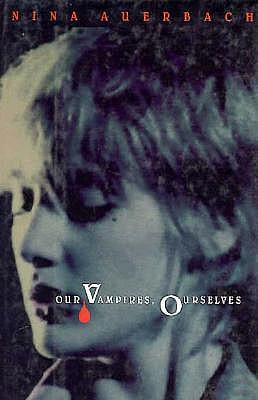
At the time, Malawi was in the grip of starvation, a severe AIDS epidemic, and political upheaval. He cited Nina Auerbach, author of Our Vampires, Ourselves, to the effect that stories of the undead embody power ”and our fears of power.”
In nearly every culture in the world, there is a legend of some variation of vampire-like creatures—the dead who reanimate and come back to feed on the living. And there is general agreement that the roots of vampire legends are in the misunderstanding of how bodies decompose and of how certain diseases spread.
In an October 26, 2016 article in National Geographic titled “The Bloody Truth About Vampires,” Becky Little wrote, “As a corpse’s skin shrinks, its teeth and fingernails can appear to have grown longer. And as internal organs break down, a dark ‘purge fluid’ can leak out of the nose and mouth. People unfamiliar with this process would interpret this fluid to be blood and suspect that the corpse had been drinking it from the living.”
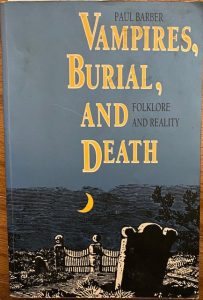
Paul Barber, author of Vampires, Burial, and Death: Folklore and Reality, made several telling points in the introduction to his book. One is that there is little similarity between the vampires of folklore and the vampires of fiction.
The Modern Vampire
Modern images of vampires are pretty stereotyped: fangs that bite the necks of victims; drinking human blood; can’t see themselves in mirrors; can be warded off with garlic, killed with a stake (or silver nail) through the heart; are aristocrats who live in castles and may be sexy. This image was popularized by Bela Lugosi’s portrayal of Count Dracula in the 1931 film adaptation of the Broadway show of the same name. Unlike Bram Stoker’s description of the monster in the 1897 novel Dracula as a repulsive old man with huge eyebrows and bat-like ears, Lugosi showed audiences a mysteriously elegant gentleman in evening dress.
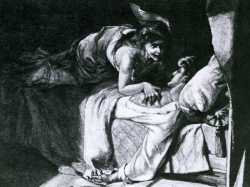
The 1922 film Nosferatu (on left), though an unlicensed adaptation, portrayed the vampire as described in Stoker’s novel.
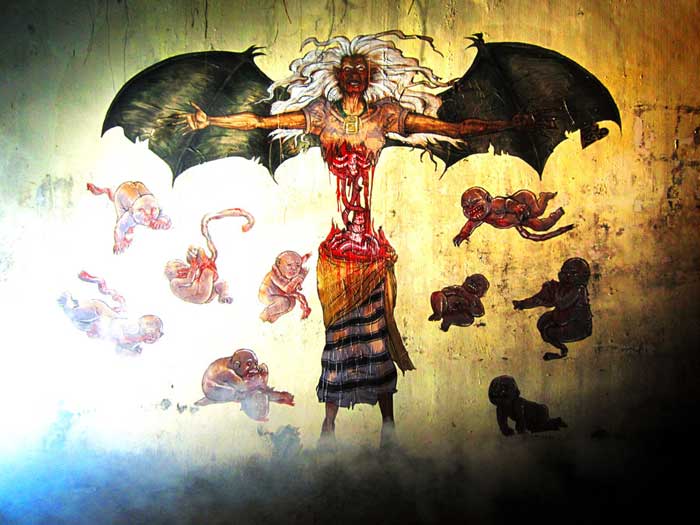
Polish strzyga
In European folklore, vampires typically wore shrouds, and were often described as bloated, with a ruddy or dark countenance. Specific descriptions varied among regions: sometimes male, sometimes female, might have long fingernails, a stubby beard, the mouth and left eye open, a permanently hateful stare, red eyes, no eyes, etc. Fangs were not always a prominent feature, and blood was generally sucked from bites on the chest near the heart rather than the throat.
But perhaps the most important theme of Barber’s book is that, lacking a scientific background in physiology, pathology, or immunization, the common response of ancient societies was to blame death and disease on the dead. To that end, the interpretations they came up with—while wrong from today’s perspective—nevertheless were usually coherent, covered all the data, and provided the rationale for some common practices that seemed to be otherwise inexplicable.
He’s the color of a rotting corpse, but cloth fangs are pretty harmless.
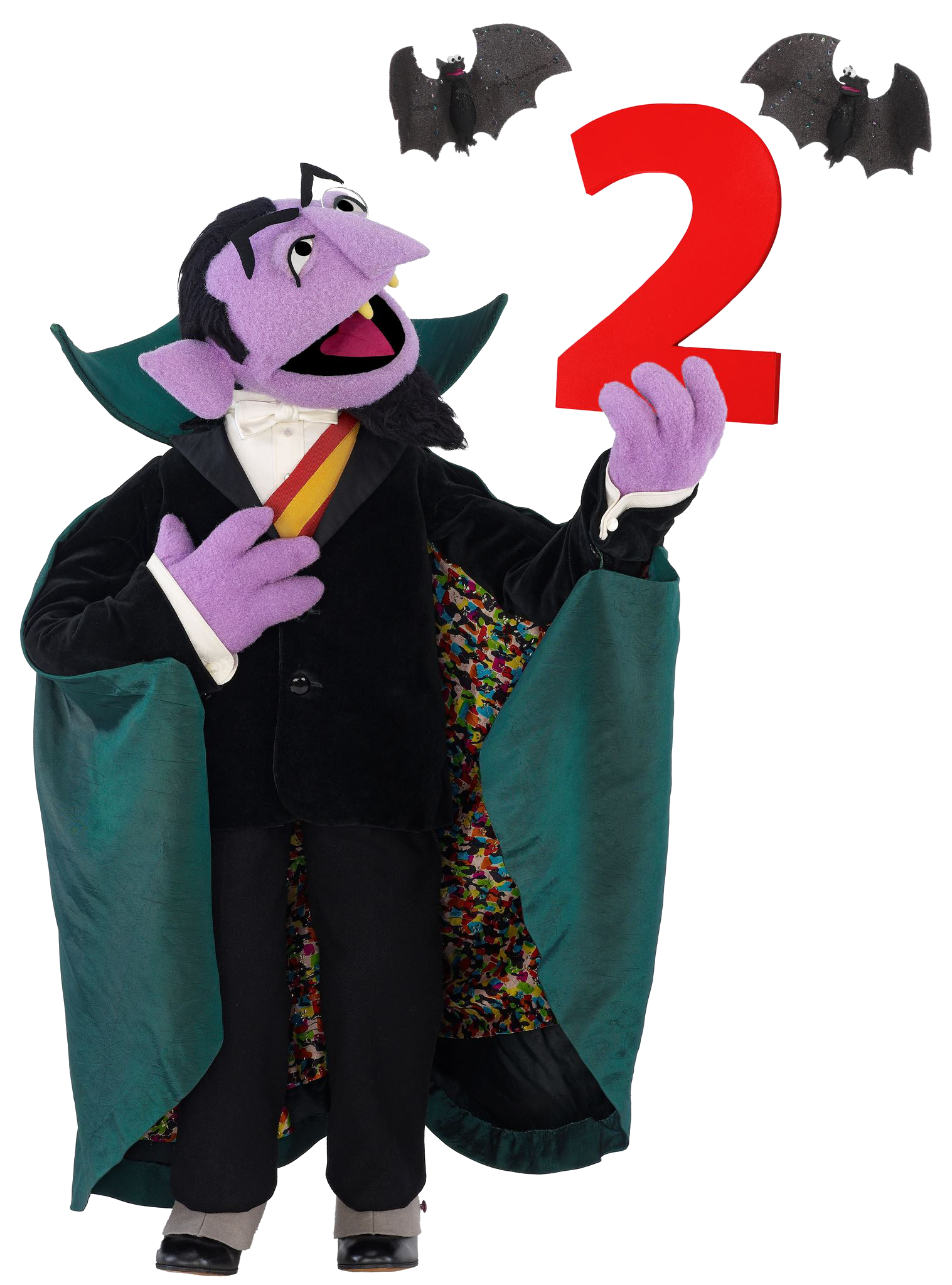
Should you ever be pursued by a vampire, fling a handful of rice, millet, or other small grain in its path. The vampire will be compelled to stop to count every grain, giving you time to escape. I found no information on how vampires came to be associated with arithmomania, but it endures: remember The Count von Count on Sesame Street?
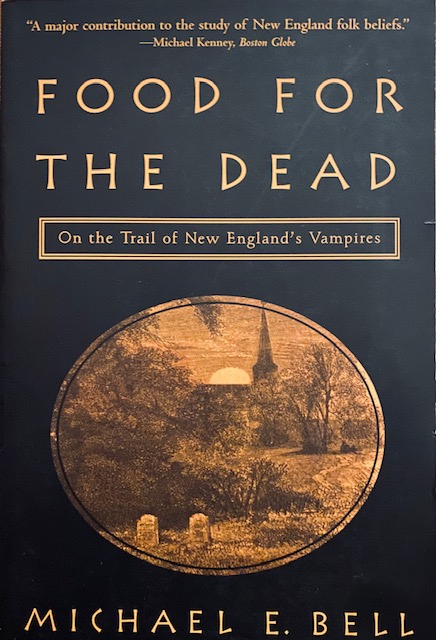
At this point, I realize that getting into methods of identifying vampires, protecting against vampires, ways to destroy vampires, and cross-cultural variations on vampirism is way beyond the scope of this blog. Instead, I refer you to books such as this:
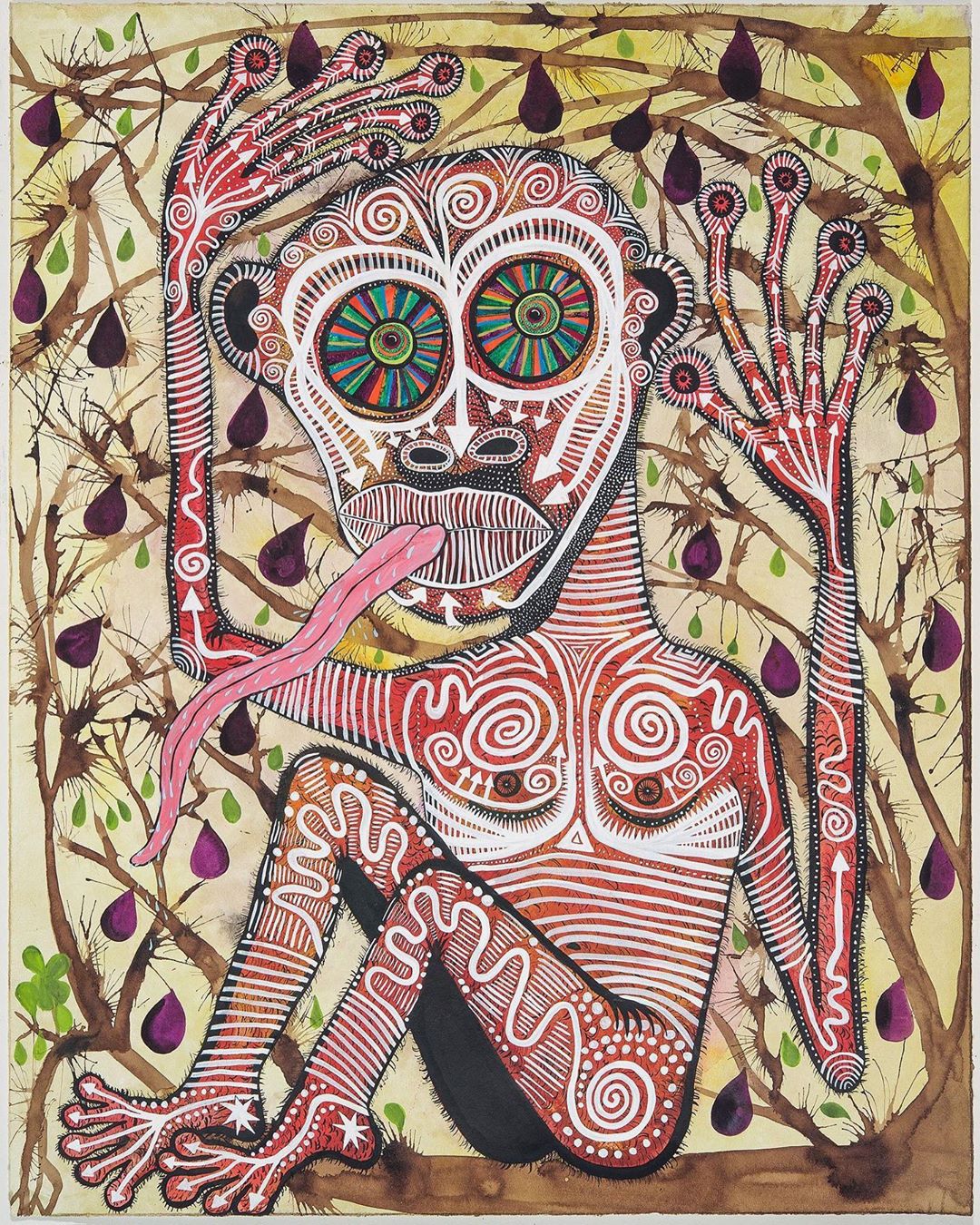
The yara-ma-yha-who in Australia drains a victim of almost all blood before swallowing and regurgitating the body, which then becomes a copy of its killer.
Seeing a vampire in your dream symbolizes an aspect of your personality that is parasitic or selfishly feeds off others.
Alternatively, a vampire may reflect feelings about people you believe want to pull you down to their level or convert you to thinking negatively in a way similar to theirs.
To dream of being a vampire represents a selfish need to feed off others.
To dream of being bitten by a vampire represents feelings about other people using you or feeding off you and being unable to stop it.
Vampires may be a sign of dependence, problems with addiction, social pressure, or ambivalence.
A dream vampire might be telling you that you need to start being more independent and relying less on others’ resources or accomplishments.
To dream of killing vampires represents overcoming dependence on others.
Repeated dreams of vampires hovering over your shoulder and correcting your spelling or suggesting topics for research and expansion is almost certainly a sign that you are writing a blog entry about vampires.
Bottom line for writers:consider whether a vampire is a fit metaphor for your character.
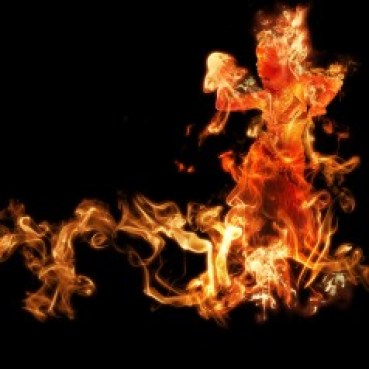
The soucouyant appears in the Caribbean by day as a harmless old woman, but she sheds her skin at night to hunt as a ball of fire.
What is insulting varies from person to person. One person’s joke is another person’s wound. And insults vary by subculture. What I’ve collected here are words and phrases from across the web that at least some people consider insulting. I’ve not included insults that seem to be tied to specific subgroups, such as shiksa. There are too many of them and this is just an (extensive) sample. I’m neither condoning nor condemning the use of any of these!
Insults to One’s Intellect or Cognitive Skills
“I’ll explain, and I’ll use small words, so you’ll be sure to understand.” ~Wesley, The Princess Bride (1987)
Dumb as a rock/post/bag of turnips/hammers
Addleheaded
Airhead
Bubblehead
I don’t have the time or the crayons to explain it to you.
Biscuit not done in the middle.
One card short of a full deck
Not playing with a full deck
Not the brightest bulb in the pack.
The communication skills of an alarm clock.
Bad luck when it comes to thinking.
The same sense of direction as Christopher Columbus.
If you had another half a brain you’d be a halfwit.
Sharp as a [rubber] ball.
Stupidity is not a crime. [You’re] free to go.
“To call you stupid would be an insult to stupid people. I’ve known sheep that could outwit you. I’ve worn dresses with higher IQs. But you think you’re an intellectual, don’t you, ape?” ~Wanda, A Fish Called Wanda (1988)
“If your brains were dynamite, there wouldn’t be enough to blow your hat off.” ~Kurt Vonnegut Jr.
Congratulations on being the top of the bell curve.
You are the human equivalent of a participation trophy.
Suffering from delusions of adequacy.
The attention span of an ice cream in July.
A battle of wits with someone who is unarmed.
It appears that your brain cells are not holding hands right now.
I smell something burning. Are you trying to think again?
Better to keep your mouth shut and be thought a fool than to open it and remove all doubt.
You changed your mind? Here’s hoping this one works better.
It’s great that you don’t let education get in the way of your ignorance.
No need to fear success. You have nothing to worry about.
If [you] ever had a thought, it would die of loneliness.
You’d struggle to pour water out of a boot with instructions on the heel.
Who’s using the family brain cell at the moment?
Insults to One’s Character/Personality
“Why, you stuck-up, half-witted, scruffy-looking nerf herder.” ~Leia Organa, The Empire Strikes Back (1980)
I forgot the world revolves around you. My bad!
Nose so high in the air s/he sniffs clouds
If her/his lips are moving, s/he is lying.
A sharp tongue doesn’t indicate a keen mind.
I’d give you a nasty look, but you already have one.
f you were a spice, you’d be flour.
Useful as a lighthouse in a desert.
Useless as the “ueue” in “queue.”
Useful as a soup sandwich.
Just like a Russian doll—full of yourself.
Your face is just fine. It’s your personality that’s the issue.
Whatever is eating you must be suffering terribly.
All the tact of a bowling ball.
Did the middle of my sentence interrupt the beginning of yours?
It’s impossible to underestimate you.
You have the rest of your life to be a knucklehead. You can take today off.
“If they can make penicillin out of moldy bread, then they can sure make something out of you.” ~Muhammad Ali
You are proof that the universe has a sense of humor.
S/he has no off switch.
You should use glue instead of chapstick.
Is there an intermission to this drama?
Deep as a puddle in a parking lot.
A slightly tilted picture frame.
You really should come with a warning label.
A personality that’s a vibrant shade of beige.
As useful/helpful/necessary as a screen door on a submarine.
Such a conversation starter. It gets underway as soon as you leave.
Two-faced.
Crooked as a corkscrew.
So crooked he had to be screwed into his grave.
Charismatic as a wet sock.
Someone who takes more than 15 items through the express lane.
Your ambition outweighs your skills.
“You’re somewhere between a cockroach and that white stuff that accumulates at the corner of your mouth when you’re really thirsty.” ~Nic Cage, Con Air (1997)
Insults to One’s Person
“I never forget a face, but in your case I’ll make an exception!” ~Groucho Marx
Looks like the south side of a horse heading north.
A nose that could chop wood.
If you were fruit you’d be a perfect pear/apple.
Not the ugliest wo/man in the world—unless the other one has died
I’ve seen salads dressed better than you.
You have a face for radio.
If my dog was as ugly as you are, I’d shave his butt and walk him backward.
Can I have the name of your hair cutter? I need to know where not to go.
Whatever kind of look you were aiming for, you missed.
Two left feet.
Sweet as rhubarb.
Walleyed.
Face so ugly s/he should walk backward.
Nobody could be as dumb as you look.
My life may be a joke, but it’s not as funny as your outfit.
Wishing Someone Ill
May your life be as unpleasant as you are.
May you live in interesting times.
May your cheek always find the hot side of the pillow and the heel of your left sock always slip down inside your shoe.
Wishing you all the happiness you deserve—and not one ounce more.
May the chocolate chips in your cookies always turn out to be raisins.
May you have a sparsely attended funeral.
Insulting to Men
“His mother should have thrown him away and kept the stork!” ~Mae West
Bastard
Son-of-a-bitch
Thinks with his little head
You’re not one of the boys and you never will be
Angry white male
Mother f***er
Beta male
You’re just like your father
If you walked into a wall with an erection your nose would hit the wall first.
Bubba
Cock (slang)
Company man
Buffoon
Cuckold
“Your mother was a hamster, and your father smelt of elderberries!” ~French knights, Monty Python and the Holy Grail (1975)
“Perhaps I am rather drunk to-night, but I shall be sober to-morrow morning; but you’re a damned fool tonight, and you’ll be a damned fool to-morrow morning.” ~unnamed Parliamentarian, quoted by Augustus Hare
Fop
Your quiche is terrible!
Himbo
Dick
Incel
Master of the unsuccessful comb-over
Lothario
Lounge lizard
You are such a nice guy.
MAMIL (middle-aged man in lycra)
Manlet
Couldn’t get off a rabbit with that little dick.
Could wear a women’s bikini bottom, and nobody would look twice.
No sports car in the world could compensate for that tiny dick.
Need a magnifying glass to see his dick.
Does something that small really work?
Are you a pedophile? After all, you have a child size penis.
Looks like a eunuch.
“You are a sad strange little man, and you have my pity.” ~Buzz Lightyear, Toy Story (1995)
Do tiny dicks run in the family?
Leads with his zipper.
He has cotton balls
Mansplaining
Pantywaist
Manspreading
Manterrupting
Motherfucker
Bell end
Prick (slang)
Reply guy
White knight
I am searching for the bones of your father but cannot distinguish them from those of a slave. (said by Diogenes to Alexander the Great)
Insulting to Women
“The woman speaks eight languages and can’t say ‘no’ in any of them.” ~Dorothy Parker
Easy piece
Battle-axe (woman)
Bimbo
Cat lady
Cougar (slang)
Crone
Cunt (in some cultures, such as Australia, this is a common greeting among friends, rather than an insult)
Dyke (slang)
Fag hag
Female hysteria
Floozie
Gold digger
“You wanna see a bad facelift? Helen Danvers, two o’clock. She looks like she’s re-entering the Earth’s atmosphere.” ~Catherine Frazier, The Women (1939)
MRS degree
Bitch
Castrating bitch
Nasty woman
Nowhere girls
Puck bunny
Queen bee (sociology)
Radical chic
Shrew (stock character)
Slut
Cock teaser
Spinster
Suzy Homemaker
Termagant
“In order to avoid being called a flirt, she always yielded easily.” ~Charles Maurice de Talleyrand-Périgord
Trollop
Trophy wife
Twat
Virago
WAGs
Whore
Hoe
(Chest) flat as a pancake
Thunder thighs
Hag
Harpy
Lesbian until graduation
Moll
Generalized Insults
“If you won’t be a good example, then you’ll have to be a horrible warning.” ~Empress Catherine II of Russia
You are why the gene pool needs a lifeguard.
You’re a nonessential vitamin.
I have 90 billion nerves, and you’re on every single one of them.
I may not be perfect, but at least I am not you.
Yes, sometimes you’re an idiot. But don’t be sorry for who you are!
I like you. People say I have no taste, but I like you.
I don’t know where you were before we met, but I wish you were still there.
I’ll never forget the first time we met. But I’ll keep trying.
We were happily married for a month. Too bad it was our 10-year anniversary.
I admire the way you try so hard.
You’re entitled to your incorrect opinion.
You should have tried doing it the way I told you to in the the first place.
Well, at least you’re good-looking.
What the devil kind of knight are you, that can’t slay a hedgehog with your naked arse? (said by the Zaporozhian Cossacks to Sultan Mehmed IV)
“That trunk of humours, that bolting-hutch of beastliness, that swollen parcel of dropsies, that huge bombard of sack, that stuffed cloak-bag of guts, that roasted Manningtree ox with pudding in his belly, that reverend vice, that grey Iniquity, that father ruffian, that vanity in years?” ~William Shakespeare, (Henry IV Part 1 [Act 2, Scene 4])
Cockalorum– a boastful and self-important person; a strutting little fellow
Snollygoster– an unprincipled but shrewd person
Pillock– a very stupid or foolish person
Lickspittle– a fawning subordinate; a suck-up
Smellfungus– an excessively faultfinding person
Ninnyhammer– ninny; simpleton, fool
Mumpsimus– a stubborn person who insists on making an error in spite of being shown that it is wrong
Milksop– an unmanly man; a mollycoddle (a pampered or effeminate boy or man)
Hobbledehoy– an awkward, gawky young man
Pettifogger– shyster; a lawyer whose methods are underhanded or disreputable
Mooncalf– a foolish or absentminded person
Saltimbanco– a mountebank; a person who sells quack medicines from a platform
Smell-feast– one given to finding out and getting invited to good feasts
Bottom Line: Tempting as it might be to fling insults around, consider the possible—probable?— escalation. Relationships might suffer irreparable damage.
“I’d like Frank Shirley, my boss, right here tonight. I want to tell him what a cheap, lying, no-good, rotten, four-flushing, low-life, snake-licking, dirt-eating, inbred, overstuffed, ignorant, blood-sucking, dog-kissing, brainless, dickless, hopeless, heartless, fat-ass, bug-eyed, stiff-legged, spotty-lipped, worm-headed sack of monkey shit he is.” ~National Lampoon’s Christmas Vacation (1989)
And if you are a true traditionalist, you will be carving turnips rather than pumpkins for your jack o’lanterns!
Legendary Jack of the Lantern
Jack o’lanterns originated in the fens (marshes) of rural Ireland. In the early 1600’s, the legend began of Stingy Jack (aka, Jack the Smith, Drunk Jack, Flakey Jack, and other names, used interchangeably).
The most popular version of the tale involves Jack first tricking the Devil into changing into a coin, then trapping him in his transfigured state. Some longer versions of the story have Jack tricking the Devil three or four different times. Eventually, Jack offered the Devil out of the deal in exchange for not taking his soul for ten years.
Jack died before ten years had passed. The angels didn’t allow him into heaven because he was such a dishonest trickster. The Devil kept his promise not to take Jack’s soul, so he couldn’t go to hell, either. Instead, the Devil tossed Jack a lump of burning coal from hell so he could have a bit of light. Jack carved out a turnip and stuck the coal inside, creating a lantern. Hence, “Jack of the Lantern,” has roamed the Earth with it ever since.
Jack O’Lanterns at Samhain
Traditional Cornish Jack O’Lantern
Many people in Ireland and Great Britain also continued the Gaelic celebration of Samhain, including a ritual of going from house to house in search of food and drink. (Thus the origins of Trick or Treating). Many carved turnips, potatoes, and other root vegetables, adding coals or candles to create makeshift lanterns to light their way. Occasionally, people carved these with faces.
Those who made the lanterns with faces said they represent spirits or supernatural beings. Sometimes, they used jack o’lanterns to ward off evil spirits they might encounter while walking at night. Alternately, Halloween celebrants used them to frighten people.
Traditionally, the veil between the living and the dead was thinnest at Samhain, leaving people in danger of supernatural threat. Celebrants sometimes set jack o’lanterns on windowsills to keep harmful spirits out of the house.
Carving Jack O’Lanterns
A jack-o-lantern (or jack o’lantern) is any carved lantern, most commonly made from a pumpkin today. But instructions for carving less common jack o’lanterns are widely available online. Alternatives, other than turnips, include:
Melons
Red beets
Rutabagas
Eggplant
Potatoes
Sweet potatoes
Butternut squash
Acorn squash
Zucchini
Bell pepper
Grapefruit
Grapes
Apples (which can be dried, making shrunken heads)
On the last Thursday of October, children in South Somerset, England celebrate Punkie Night. They carve mangelwurzel roots into the shape of a lantern. In the words of one who has tried this, “It’s like trying to hollow out a block of wood with a spoon.” Children then dress in costumes and knock on neighbors’ doors to ask for a candle for their “punkie” — and threaten tricks if neighbors don’t comply!
According to legend, this tradition began in the 19th century when a group of [probably inebriated] men returning from a nearby village got lost in the foggy night. Their wives went out searching for their missing menfolk, carrying carved mangelwurzel lanterns to light the way. However, the men thought the approaching lights were the souls of unbaptized children and ran away, forever lost in the fog.
Jack O’Lanterns in America
European immigrants to America found a handy New World crop to celebrate Halloween, much larger and easier to carve than the root vegetables of home: winter squash, the most famous of which is a pumpkin.
If you prefer using pumpkins for your jack o’lanterns, consider a white one. New Moon Hybrid is perfectly uniform, 35-45 pounds, alpine white. Alternatively, grown for appearance and carve-ability rather than flavor, the Albino White Casper produces 12-15 pound pumpkins.
Bottom Line: Virtually any fruit or vegetable can be a jack o’lantern, especially if you allow painting as well as carving (although carving is necessary for a lighted lantern).
Evidence for bat-like flying mammals appears as far back as the Eocene Epoch, some 50 million years ago.
Bat Cultures
Bats have had a long time to become steeped in cultural superstitions and myths. For example:
Australian folklore: A bat represents a human incarnation, and killing one can shorten your life or result in a heavy fine.
Camatotz in Guatemala City
Maya religion: The Mayan bat god, Camazotz, appears as an anthropomorphized leaf-nosed bat in sculpture and stories. His name translates to “death bat” or “snatch bat”.
Buddhism: Some Buddhists believe a small bat perched on the right shoulder signifies good luck, longevity, and happiness.
Spiritual practices: Many practices associate the bat with themes of rebirth, intuition, and darkness. They are believed to guide people through difficult or frightening transitions.
Chinese culture: The Chinese word for bat (福 Fu) sounds like the Mandarin word for prosperity and luck. Because of this, many feng shui practitioners include bat symbols in their decor. Red envelopes of money presented to children at New Year traditionally include five bats in their design.
Polynesian religion: While fleeing from her husband, the goddess Leutogi’s brother sent his pet bat to rescue her. When she became the goddess of fertility and night, she showed her appreciation by adopting the bat as one of her totem animals.
Modern Western Culture
“Ariel on a Bat’s Back” (1804) by Henry Singleton
In Western cultures, such as ours, people often associate bats with bad luck, death, witchcraft, vampires, and darkness. Some Westerners believe that a bat flying into the house is a sign of death or that the occupants will soon leave. As someone who lived with bats in the attic—literally—for years, I can personally testify that neither of those things happened.
Some believe that hearing a bat call while flying in the early evening is a sign of bad luck. Despite many close encounters with bats, I’ve been extremely fortunate!
So, darkness, yes. Death and bad luck, no. As for witchcraft and vampires, keep reading.
The real skinny on bats is that they are an important species that impact our daily lives in ways we might not even realize. Bats play important roles in their ecosystems as natural pest controls, pollinators, and seed dispersers.
Bat Pest Control
Most bats (about 70%) consume insects, like mosquitos, helping to control insect populations that can carry human diseases, or beetles, which damage agricultural crops. Economists have estimated that the pest control provided by healthy bat populations is worth over $50 billion!
Hibernating Indiana bat
Most North American bats are insectivorous. Insect-eating bats capture their prey by foraging on the wing, catching flying insects from a perch, or collecting insects from plants. Some species of bat seize insects with their mouths. Others use their wings or tail membrane to trap prey. Bats disable large insects with a quick bite, then envelop the insect in a basket formed by its wings and tail, and carry the insect to a perch for eating. Bats have sharp teeth to chew their food into tiny, digestible pieces.
Each night, bats eat thousands of insects! Big brown bats fly at dusk, often using the same feeding ground each night. They fly in a nearly straight course 30 feet in the air, often emitting an audible chatter. One little brown bat can catch 600 mosquitoes or more an hour. The endangered Indiana bat, which weighs about three pennies, consumes up to half its bulk every evening. This insect-heavy diet helps both foresters and farmers.
Carnivorous bat species—which are more rare and eat small animals like fish, birds, mice and frogs—also act as a natural control on their prey’s populations.
Plant Helper
Golden-crowned fruit bat
Fruit bats and nectar bats are key players in helping local plants by dispersing seeds as they fly, which assists pollination. For example, the lesser long-nosed bat is the primary nighttime pollinator for the saguaro cactus in the Sonoran Desert, which spans from southern California and Arizona into northwest Mexico. Like a hummingbird, the lesser long-nosed bat can hover at flowers, using its 3-inch-long tongue — equal to its body length — to feed on nectar in desert environments.
Desert ecosystems rely on nectar-feeding bats to pollinate giant cacti, including the organ pipe as well as the saguaro of Arizona.
Without bats, say goodbye to bananas, avocados, and mangoes. Over 300 species of fruit depend on bats for pollination. Bats help spread seeds for nuts, figs, and cacao — the main ingredient in chocolate.
Bats Inspiring Medical Marvels
Illustration of bats’ echolocation
About 80 medicines come from plants that rely on bats for their survival. Research on bats has also led to advances in vaccines.
Donald Griffin, an American zoologist, coined the term echolocation in 1944. Griffin worked with Robert Galambos, a neuroscientist, to demonstrate the phenomenon and determine precisely how bats used echolocation. While bats are not blind, studying how bats use echolocation has helped scientists develop navigational aids for the blind.
Scientists have also been studying the secrets behind bats’ relative longevity. Biologists hope that understanding how the telomeres on strands of bat DNA protect cell growth may lead to breakthroughs in preventing or reversing aging and cancer growth in humans.
Vampire bats have a protein in their saliva that researchers have modeled to help stroke patients. Their anticoagulant property keeps the blood of prey flowing without clotting so the bat can eat its meal. This enzyme — named Draculin — has been found to break up blood clots in the brain that cause strokes in humans. The opposite of frightening, vampire bats are a fascinating and important species that are contributing to science.
Vampire Bats
Vampire bat (Desmodus rotundus) feeding on a pig
But what about bats feasting on human blood? Mostly just myth. First of all, only three bat species are blood-suckers—meaning 0.0025% of bats eat blood to survive—and they only suck the blood of other mammals and a few birds. These three vampire bat species live in Central and South America; none are native to the U.S.
The vampire bat feeds mainly on the blood of cattle, horses, and wild mammals such as deer and peccaries. The harm from such bites isn’t from blood loss, which is relatively small, but rather from the exposure of the livestock to secondary infections, parasites, and the transmission of viral-borne diseases.
Diphylla ecaudata, a bat native to northern Brazil, may have recently adapted to feeding on human blood. These bats, which primarily feed on several species of birds, have felt the effects of climate change making their preferred food source more difficult to find. When researchers tested the DNA of blood in these bats’ stomachs, they found cattle and human blood mixed with the expected birds. However, evidence points to D. ecaudata still relying primarily on their preferred birds for food.
Because the true vampire bat of Central and South America feeds on blood, a popular misconception has been to link it to the human vampire legend. The Eastern European tale of a vampire dates back to the Middle Ages. There are no vampire bats native to Europe or Asia. They weren’t even known to exist before the 1500’s, when explorers visited the New World and observed their unusual eating habits. Scientists named the bat for the legend rather than the legend originating with the bat!
Fascinating Animals
Besides being useful, bats are just plain interesting. This isn’t surprising, given that there are over 1,400 species of bats worldwide. Only rodents have a greater number of species. Bats are native to nearly every climate except extreme deserts and polar regions.
To reduce their energy needs, hibernating little brown bats can stop breathing for almost an hour.
The Honduran white bat, a snow-white bat with yellow nose and ears, cuts large leaves to make “tents” to protect its small colonies from drenching jungle rains.
The ancestors of the endangered Hawaiian hoary bat (‘Ope’ape’a) traveled over 3,600 kilometers from the Pacific Coast almost 10,000 years ago to become Hawaii’s state land mammal.
If you’ve seen one bat, you’ve seen one bat! Bats come in many colors, sizes, and shapes.
Spotted bat
The spotted bat, which lives in Texas, is black with a white patch on each shoulder and the rump.
Other bats have patterns so bright biologists call them butterfly bats.
Some bats, such as the Eastern red bat, have long angora-like fur varying in color from red to black and white.
The bumblebee bat of Thailand weighs less than a penny.
Some of the large bats known as flying foxes, such as those living in Indonesia, have wingspans up to 6 feet.
The eastern pipistrelle, which lives in most of the eastern United States, is also called the pygmy bat because of its small size. Its fur is yellowish brown, darker on the back. The back hairs are tricolor: gray at the base, then a band of yellow brown, and dark brown at the tip.
Flying foxes live only in tropical and subtropical areas including Australia and eat primarily fruit and nectar. Other species of bats are carnivorous, preying on fish, frogs, mice, and birds. As discussed above, the fabled vampire bat feeds on blood. All bats living in the United States and Canada eat insects, except 3 species of nectar-feeding bats living along the Texas-Arizona border.
Bats are Mammals!
Because they fly, many people think of bats as birds. Instead, bats share the characteristics of all mammals (hair, regulated body temperature, the ability to bear their young alive and nurse them). They make up a fifth of all mammal species on earth.
Big-eared Townsend bat
Bats are the only mammals to truly fly. Other “flying” mammals, such as the flying squirrel, only glide through the air for short distances. True flight requires a flight stroke, or flap of the wings, to thrust the animal through the air. Because of their unique wing structure, bats have great maneuverability — some say, even better than birds!
Bats may be small, but they’re fast little buggers. How fast a bat flies depends on the species, but some can reach speeds over 100 miles per hour according to new research.
Bat Life
Procreation
A baby bat is a pup, and a group of bats is a colony. In many species, the males and females roost separately except when mating. In migratory species, mating occurs in the fall and winter. The female stores the sperm until spring when ovulation and fertilization occur.
Eastern red bat with three babies
Most bat mothers give birth to a single pup. However, the evening bat typically has two pups per litter. The eastern red bat averages two or three pups per litters. The seminole bat and the yellow bat can have three or four pups per litter.
In May or June, the females congregate in large colonies and give birth. Mother bats form nursery colonies in spring in caves, dead trees and rock crevices. Bats benefit from maintaining a close-knit roosting group because the group increases reproductive success, and it is important for rearing pups.
The female hangs head up as the young is born, feet first. She catches and holds the new born in a pouch formed by a special membrane. The baby bat, already large and well developed, crawls to the mother’s nipples to feed until they are 6 weeks old. Like other mammals, mother bats feed their pups breastmilk, not insects.
Bats have one of the slowest reproductive rates for animals their size. Most bats in northeastern North America have only one or two pups a year, and many females do not breed until their second year. Their relatively long life-span somewhat offsets this low reproductive rate.
Bat Growth
Baby bat
Newborn bat pups are blind and furless. In the evening when the mother forages for food, she may, for the first few days, carry the young with her. Later the baby remains behind, clinging to the wall or roof of the cave or shelter. The mother may return several times during the night to feed her young.
Young bats born in June or July reach their full size in 4 weeks and are usually able to hunt by mid-July. Females are mature at 8 months, and males mature in their second summer.
Aged Bats
Little brown bats
The longest-living bat is 41 years old. It’s said that the smaller the animal, the shorter its lifespan, but bats break that rule of longevity. This may be because bats have a high number of genes involved in DNA repair and control of cell division. Although most bats live less than 20 years in the wild, scientists have documented six species that live more than 30 years.
The little brown bat, common in North America and in West Virginia, is the world’s longest- lived mammal for its size, with a life-span over 32 years, although it is generally rare for a bat to live this long.
In 2006, a tiny Brandt’s bat from Siberia set the world record at 41 years.
Cleanly Bats
People might think bats dirty because they excrete guano, a prized fertilizer. Far from being dirty, bats spend a lot of time grooming themselves, like cats. Some, for example the Colonial bat, even groom each other. Besides having sleek fur, cleaning also helps control parasites.
Hibernation and Migration
Even though bears and bats are the two most well-known hibernators, not all bats spend their winters in caves. Some bat species like the spotted bat survive by migrating in search of food to warmer areas. Bats that migrate usually travel less than 200 miles, often following the same routes as migratory birds.
Hibernating bats
Many bats do hibernate through the cold weather when insects are scarce. Bats prepare for hibernation by putting on fat to last through the cold weather. When a bat hibernates, its body temperature drops almost to air temperature, and respiration and heartbeat become very slow. Throughout the winter, bats eat nothing, surviving by slowly burning accumulated fat.
Hibernating big brown bats
It is fairly easy to rouse bats from hibernation, and they may fly around for 15 minutes. However, disturbances that cause bats to awaken and use fat stores can be fatal. Hibernating bats should be left alone.
Unlike other hibernating bats, red bats may wake and feed, if temperatures rise above 55 degrees.
After females leave the hibernation sites, they gather in colonies varying in size from 10 to 100 or more, roosting in attics, barns, and other dark retreats. The males are solitary, roosting in hollow trees, under loose bark, and in other crevices. Bats may also move from nursery caves, suited for rapid growth of their young, to cooler caves with stable winter temperatures. Bats that hibernate use the same sites year after year.
Bat Habitats
Roosting fruit bats
Habitats vary during bats’ life cycles. As discussed above, many bats dwell in caves or use caves for hibernation. Others, the Virginia big-eared bat, for example, live in caves year-round, but its winter home is typically different from its summer roost. These endangered bats live in only a few locations throughout Virginia and West Virginia.
A group of small-footed Myotis made their home in an underground tunnel at an inactive nuclear reactor in the state of Washington. But more typically, bats live in abandoned mines, caves, on the underside of bridges, in trees, in crevices in old buildings and barns, in woodpecker holes in trees, occasionally in homes and attics, in bat houses constructed especially for them, or other protected places during the day.
Bats outside Bracken Cave
Colonial bats cluster in caves and mine tunnels. Over 15 million Mexican free-tailed bats inhabit Texas’s Bracken Cave, making it the largest known bat colony (and largest concentration of mammals) on Earth.
Forest dwelling bats roost in trees or on the forest floor and many raise their young in the exfoliating bark of large trees. Some bats, like endangered gray bats, feed on insects over water and roost near streams and rivers.
Bats can also take up residence in human structures like old buildings, culverts, bridges, and attics.
Bat Eyesight
Blind as a bat? Not so much… Bats’ eyes are adapted for nocturnal life, and they can see well. However, sight is just one sense a bat relies on. Some bats, like most fruit bats, also use their noses to sniff out nearby treats.
Bat Voices
Echolocation is using sound reflecting off objects to locate them. Many people have heard of bats’ ability to use echolocation to navigate and hunt.
Virginia big-eared bat
Echolocation works by bats’ emitting a series of high-pitched squeals through their mouths or noses (usually inaudible to humans). These sounds bounce back to the bats, enabling them to navigate in total darkness, not flying into obstacles but locating prey. Some bats use tongue clicks instead of vocal cords. Usually, they receive the echoes in their large, funnel-shaped ears. Bats’ ears are specialized for frequencies in the ultrasonic range.
In addition to the ultrasonic sounds used in echolocation, bats also emit other sounds—to communicate or indicate emotion? Purrs, clicks, and buzzing often precede mating of some species. Recognition of mothers and babies involves both audible and ultrasonic sound.
Certain North American insect-eating bats vibrate when at rest and content. This vibration does not occur when they are asleep. The bat’s ear is extremely mobile and sensitive to sound.
Do bats get tangled in women’s hair and need to be removed with scissors? No way! Their echolocation is so sensitive that bats can detect objects as thin as monofilament fishing line. Fishing bats have an echolocation system so sophisticated they can detect a minnow’s fin as fine as a human hair.
How Bats Live
Eastern red bat
When they are at rest, bats hang with their heads down. During the day, red bats hang by one foot, wrapped in their big furry tails.
Swimming isn’t typical of bats. Although there is little scientific data, observations by naturalists in the field seem to support that some bats swim in stressful situations, although swimming isn’t part of their ordinary behavior.
Flying foxes, often island inhabitants, may have to fly long distances to obtain food. A forced landing or a foray over water to collect fruit which has dropped and floated there may involve an unexpected swim. Photographs of the flying fox, Pteropus giganteus, show the animal actually swimming, using its wings and feet to reach land rather than floating or paddling.
Bat Diets
Most bats eat insects, such as mosquitoes, moths, beetles, crickets, leafhoppers, and chinch bugs. Bats use echolocation to find and track insects in flight, and they can eat up to 600 insects in an hour.
Harpy fruit bat
Pipistrellus pipistrellus eating a mealworm
Many tropical bats eat fruit exclusively, and fruit-eating bats can disperse up to 95% of seeds in recently cleared rainforests. Epaulette fruitbats can eat up to three times their body weight in figs each night.
Some bats feed on nectar and pollinate plants like peaches, cloves, bananas, and agaves.
A few bats are carnivorous and hunt small vertebrates, such as fish, frogs, mice, and birds.
Vampire bats feed on the blood of mammals and birds.
Bats and Rabies
All mammals, including bats, can get rabies. However, it is estimated that less than 1% of bats have rabies. The best way to avoid getting rabies from bats is never to pick up a bat, especially if you see it fluttering on the ground during the day.
Actually, a higher incidence of rabies is found in skunks and foxes than in bats. In the United States the rate of occurrence is so small, barely a fraction of a percent, that there is very little danger to humans.
Bats Need Help
Roosting fruit bats
There are over 1,200 bat species worldwide. However, bats are basically tropical animals and only about 45 species are native to the U.S. and Canada. Twelve of them are listed as threatened or endangered under the Endangered Species Act.
American bats species are considered endangered due to disturbance of roosting bats in caves, loss of habitat including forested areas due to large scale logging and development, and inappropriate use of pesticides.
Owls, hawks, and snakes eat bats, but that’s nothing compared to the millions of bats dying from white-nose syndrome. The disease — named for a white fungus on the muzzle and wings of bats — affects hibernating bats and has been detected in 37 states and seven Canadian provinces.
Little brown bat with white nose syndrome
This deadly syndrome has decimated certain species. At least 10 bat species in the U.S. and Canada are threatened, plus the endangered Virginia big-eared bats. It has killed over 90% of northern long-eared, little brown and tri-colored bat populations in fewer than 10 years. This fatal disease, has killed more than 5.7 million bats since it was discovered in 2006.
The implications are enormous. Loss of bats destabilizes ecosystems and can cause people to increase their use of chemicals to control insects.
You can help by avoiding places where bats are hibernating. If you do go underground, decontaminate your clothing, footwear and gear to help with not spreading this disease to other areas.
Servants of Evil?
Oh, yes. I nearly forgot witchcraft. Bats are associated with witchcraft in many cultures because of their nocturnal nature and their visibility during the transition from day to night.
It is believed that witches worshipped horned figures with wings—possibly bats?
In Dante’s Inferno, the poet used bats as an allegory for the devil and his domain.
Gustave Dore’s illustrations of Dante’s Inferno
Bram Stoker’s 1897 novel describes Dracula as a vampire who can transform into a bat.
In some cultures, people believe a bat must be a witch’s familiar or an evil omen. For example, in the Ibibio people of Nigeria, a bat flying into a house is said to be a sign that the person is bewitched and will soon die.
Some believe that the witches’ hour is when bats fly upwards and then come down again quickly.
It is said that witches used bat blood in their flying concoctions.
Both bats and witches are often featured together in Halloween decorations.
Although in the West, bats are popularly associated with darkness, malevolence, witchcraft, vampires, and death, bats are actually an important part of the ecosystem, as as described above.
If this blog has truly inspired you, Bat Week — held the last week in October — celebrates the role of bats in nature and all that these amazing creatures do for us, so party down.
Bottom Line: There’s more than Halloween to love about bats. They’re the heroes of the night!
This is the sort of thing someone with low tolerance for ambiguity might say.
Ambiguity is everywhere. It’s an unclear statement, task, or goal. When you encounter an ambiguous situation, you are unsure of how to proceed because the goal is vague or because you don’t have all the information you need/want. Many situations are ambiguous—unclear, uncertain, or open to different interpretations.
In 1949, Else Frenkel-Brunswik introduced ambiguity tolerance–intolerance as a psychological construct to describe the relationship individuals have with ambiguous stimuli or events. Ambiguity tolerant individuals view these stimuli in a neutral and open way; intolerant individuals as a threat. Some people are more inclined one way, and some the other.
Scientists also refer to this tolerance as the ability to “operate in the gray.” It reflects an ability to accept unclear, uncertain, or novel situations and still work effectively. Tolerant individuals are able to deal with ambiguous new stimuli without frustration.
What are the benefits of tolerance of ambiguity? Embracing the unknown allows people (and organizations) to seize new opportunities, take calculated risks, explore previously unchartered territories, and back themselves when they don’t have all the answers.
When there are high levels of uncertainty about a particular business venture, those people with higher levels of tolerance for ambiguity are more likely to succeed. The ability to tolerate conflicting information and deal with missing information makes the difference.
Skills that individuals need to thrive in ambiguous situations are stress-tolerance, good communication skills (verbal and written), problem-solving and critical thinking skills, and adaptability. While some people will naturally have one or some of these skills, anyone can and should learn them.
A study of college students’ tolerance for ambiguity found that students who were involved in the arts had higher scores than business students on ambiguity tolerance, from which the researchers conclude that creativity is linked to ambiguity tolerance.
And there is some evidence that the opposite is also true. A study by De Dreu, Baas, and Nijstad (2008) found that individuals exposed to ambiguous stimuli exhibited greater cognitive flexibility, leading to enhanced creativity and problem-solving skills.
On the other hand, intolerance of ambiguous situations is a cognitive vulnerability that can, in conjunction with stressful life events and negative rumination, lead to depression. Anderson and Schwartz hypothesized in 1992 that this is because ambiguity intolerant individuals tend to see the world as concrete and unchanging, and when an event occurs which disrupts this view these individuals struggle with the ambiguity of their future. Therefore, those who are intolerant of ambiguity begin to have negative beliefs about their situation, and soon view these beliefs as a certainty. This certainty can serve as a predictive measure of depression.
Bochner (1965) categorized attributes given by Frenkel-Brunswik’s theory of individuals who are intolerant to ambiguity as follows:
Need for categorization
Need for certainty
Inability to allow good and bad traits to exist in the same person
Acceptance of attitude statements representing a white-black view of life
A preference for familiar over unfamiliar
Rejection of the unusual or different
Resistance to reversal of fluctuating stimuli
Early selection and maintenance of one solution in an ambiguous situation
Premature closure
The secondary characteristics that describe individuals who are intolerant of ambiguity include uncreative and anxious.
Ambiguity aversion affects behavior. For example, it leads people to avoid participating in the stock market, which has unknown risks (Easley & O’Hara, 2009), and to avoid certain medical treatments when the risks are less known (Berger, et al., 2013). Thus, avoiding ambiguity may make people miss out on a good thing.
Ambiguity aversion is an (irrational?) tendency to prefer the known over the unknown. A person displaying ambiguity aversion would favor taking the highway, even though it’s a tough drive and there’s a chance the unknown route could be better. My extrapolation is that people tend to behave habitually because it is not ambiguous, even when it isn’t the best.
In decision theory and economics, ambiguity aversion prefers known risks over unknown risks. People with this trait would rather choose an alternative where the probability distribution of the outcomes is known over one where the probabilities are unknown.
Walid Afifi, a Communications Professor at the University of California, suggests that for most of us, dealing with ambiguity causes stress and anxiety. This is supported by research indicting that as ambiguity increases, the amygdala (the gray matter deep inside the brain’s cerebral hemispheres) begins responding to a perceived threat. Anxiety and fear rise, while the ventral striatum (which helps respond to rewards) simply stops functioning.
Take small steps, get quick feedback, correct mistakes, and move forward. Starting small and getting quick feedback will help you make progress despite ambiguity. In uncertain situations, delve into what is causing the problem.
When you’re sleep-deprived, over-caffeinated, and under-exercised, you’re much less likely to be able to focus, manage your emotions, and make good decisions — all critical for navigating uncertain situations.
Notice and challenge negative thoughts around uncertainty as soon as they come to mind.
Obsessing over potential catastrophes has a momentum all its own and can become a downward spiral that renders you anxious and unable to act.
Cognitive models of anxiety propose that anxious people exhibit biases for threat-related information and a propensity to interpret ambiguous stimuli as more threatening and negative outcomes as more likely to occur than less anxious individuals, which may in turn affect their ability to process non-threats.
Look for information but don’t go into perpetual information-seeking mode in the name of learning “enough” to make the right decision. Set a limit on the information you gather, for example, a time limit.
Cultures with high uncertainty avoidance have a low tolerance for ambiguity and minimize the possibility of uncomfortable, unstructured situations by enforcing strict rules, safety measures and a belief in absolute truth. People from these cultures tend to become anxious when they are in unfamiliar situations or don’t have at least rough plans.
Cultures that are pretty high on ambiguity tolerance include the nations of the Caribbean and Southern Europe. In these regions, communication with both friends and strangers tends to be informal, time schedules are not always important, and uncertainty is a common feature of daily life.
Within a culture (the U.S.), Harington, Block, and Block (1978) assessed intolerance of ambiguity in children ranging from 3.5 to 4.5 years. The researchers then re-evaluated the children when they turned seven. Their data showed that male students who were high in ambiguity intolerance at the earlier age had more anxiety, required more structure, and had less effective cognitive structure than their female peers who had also tested high in ambiguity intolerance.
Research overall suggests that people don’t like ambiguity. For example, people prefer betting on events whose probabilities are known (objective) to betting on events whose probabilities are unknown to them (subjective).
To put it another way, research has established that, when given a choice between two options differing in their degree of ambiguity, people tend to prefer the less ambiguous option. I.e., most people exhibit ambiguity avoidance.
Bottom Line: Ambiguity cannot be avoided, so your best bet is to learn to handle it.
Dragons appear in the mythologies, legends, and folklore of cultures around the world since time immemorial! Pliny the Elder, who wrote the world’s first encyclopedia, noted dragons.
Defining Dragons
Dragons in all their variations fascinate children and adults alike. Physically, the dragon can have the horns of a deer, the head of a camel, the eyes of a demon/devil, the neck/body of a snake, the abdomen of a cockle, the scales of a carp, the claws of an eagle, the paws of a tiger, and the ears of an ox.
Generally, dragons are large lizard- or serpent-like creatures, considered evil in some cultures and beneficial in others.
Among reputed dragon qualities is that they have no fixed gender differentiation in some mythologies. According to Maester Aemon (Game of Thrones), dragons are “but now one and now the other, as changeable as flame” presumably meaning that they are able to change from one sex to the other and back for whatever reason.
Australian Aboriginal Namaroto spirits and the Rainbow Serpent Burlung (Borlung)
Baby dragons are called hatchlings. A dragonet is a small breed of dragon. A Dracotaur is half-human, half-dragon.
In many traditions, dragons hoard wealth, gold, or simply shiny objects. In other traditions, dragons aren’t materialistic by nature, though they are attracted to beauty, wealth, prestige, and power. Dragons know how to live the good life, and their generosity towards others, especially their admirers, knows no bounds.
Dragon Slaying
In medieval European literature, the ichneumon or echinemon was the enemy of the dragon. When it sees a dragon, the ichneumon covers itself with mud, and closing its nostrils with its tail, attacks and kills the dragon.
Statue of St. George slaying a dragon in Tbilisi, Georgia
The more popular/common view is that the only creatures known to be able to defeat dragons are humans, particularly those with religious protection or calling. Lancing a dragon is probably the best-known method, as popularized by St. George (though he is sometimes confused with other dragon slaying saints such as St Theodore).
Even divinely-ordained humans didn’t have an easy time of it. The best way to kill them, according to Western belief, was to throw a lance into its mouth or underbelly, because that was the only part without heavy scale protection.
Ljubljana, the capital of Slovenia, has a dragon on its coat of arms because, according to lore, when the Greek hero Jason was returning from his quest to capture the golden fleece, he slew a dragon there.
Modern Dragon Slayers
Their size and perceived ferocity makes dragons an ideal foe for video-games and role-playing games. Games like Skyrim, Minecraft, Dragon’s Dogma, Monster Hunter, and Dragon Age all pit players against dragons. In deference to the typical size difference, these are often “boss” fights, meaning the final or most difficult encounter a player will face in a particular stage.
Fighting a dragon in Skyrim
Dungeons and Dragons, one of the most popular tabletop role-playing games, includes many types of dragons with varying sizes and attack styles. They range from a relatively weak metallic Brass dragon to Tiamat, based on a goddess in ancient Mesopotamian mythology. She is the queen and mother of evil dragons and a member of the default pantheon of Dungeons & Dragons gods. Her symbol is a five-headed dragon.
There is also a popular reversal of this trope, particularly in media for children. The Dealing with Dragons books and How to Train Your Dragon movies feature human protagonists initially expected to slay a dragon instead looking past society’s terror and their own initial fear. Ultimately, the helpful dragons work with humans to defeat other enemies.
Dragon Varieties
Just about every culture around the world includes dragon-like creatures in its mythology. Anthropologists have many ways of classifying and categorizing dragons, some of which are below:
Wyvern – two legs and two wings
Amphiptere – two wings and no legs
Dragon – four legs and two wings
Drake – four legs and no wings
Drac – two legs, wings, cow’s face, breathes fire and poison
Naga – half human/ half dragon beings that can shift to either shape
Mesoamerican
Peruvian amaru painted on Qiru
Ancient Incans in Peru called dragons amaru. According to legend, they had two heads, one a llama and one a puma. They had supernatural powers and symbolized great change, bringing rains, or winds, or revolution.
Rainbow dragons (Draco arcus) are elegant, beautiful dragons that are close relatives of the light dragons. Quetzalcoatl prizes them as one of his most colorful and wonderful creations.
Qʼuqʼumatz, a Mayan god of wind and rain, carried the sun across the sky every day and served as a mediator among other gods. Qʼuqʼumatz could take the form of a jaguar or eagle but most often appeared as a two-headed serpentine sky monster with feathers, scales, and a human face emerging from a bird’s beak.
Greco-Roman
In ancient Greek myth, a dracaina was a female dragon or serpent. She sometimes had human features or even a human torso. In some depictions, Medusa was a dracaina.
Iaculus, from medieval manuscript
In Roman and medieval literature, dragons couldn’t fly. Instead they dropped out of trees onto people’s heads. According to Pliny the Elder, “The jaculus darts from the branches of trees; and it is not only to our feet that the serpent is formidable, for these fly through the air even, just as though they were hurled from an engine.”
East Asia
In East Asian mythologies, the dragon is a positive creature, retaining its prestige. The dragon came to Japan with many other elements of Chinese culture, and there it became capable of changing its size at will, even to the point of becoming invisible.
Imperial Chinese dragons, Beijing
Both Chinese and Japanese dragons, though regarded as powers of the air, are usually wingless. They are among the deified forces of nature in Daoism. Dragons also figure in the ancient mythologies of other Asian cultures, including those of Korea, Thailand, and Vietnam.
Buddha demonstrating strength through tranquility by riding a dragon, Vietnam
According to Chinese lore, dragons are auspicious, symbols of wealth, power, and leadership. Official belief held that emperors were the children of dragons.
The dragon lung represents yang, the principle of heaven, activity, and maleness in the yin/yang of Chinese cosmology. From ancient times it was the emblem of the imperial family, and until the founding of the Republic (1911) the Chinese flag had a dragon.
Loa, benevolent spirits in Voudu and Vudu beliefs, often take the form of dragons. Damballa and Ayida-Weddo are the most ancient and powerful loa in West Africa and the Caribbean, primordial creators responsible for fertility, water, fire, and wealth.
Several mythologies in Sub-Saharan Africa feature stories of a woman who marries a serpent or dragon, Monyohe. The bridegroom was often a water deity or able to influence rain. In the Sotho and Zhosa variations of this story, the dragon took all the water away when the marriage broke up, leaving the region in a drought.
Evil Dragons
In European lore, dragons were portrayed as evil monsters. They terrorized human settlements, raided cattle, demanded impossible tributes, and kidnapped innocents.
St. Margaret of Antioch, escaping from the belly of a dragon, Walters Manuscript
Much of this stems from the dragon’s association with the serpent that enticed Eve in the Garden of Eden, according to Christian myth. Many Christian scholars portrayed Satan and other demons as large serpents or dragons.
“On the whole, however, the evil reputation of dragons was the stronger, and in Europe it outlived the other. Christianity confused the ancient benevolent and malevolent serpent deities in a common condemnation. In Christian art the dragon came to be symbolic of sin and paganism and, as such, was depicted prostrate beneath the heels of saints and martyrs.” (Encyclopedia Britannica)
In Christian folklore, St. Margaret of Antioch was imprisoned for her Christian beliefs and was swallowed by Satan in the guise of a dragon. (However, his stomach rejected her, and she emerged unharmed.)
Set slaying Apep in the boat of Re, from the Coffin Text, Egypt
The opposite of the sun god Re in Egyptian mythology was Apep or Apophis, the dragon of darkness and chaos. He caused thunderstorms and earthquakes and, according to New Kingdom priests, battled Re every night in an attempt to prevent the follow day’s sun rise.
Many stories in West African folklore blame ecological disasters on huge serpents or reptiles. According to legend, the Ninki Nanka dragon of Gambia causes droughts, floods, plagues, and fires if not approached carefully. Bida, once the dragon protecting the Soninka people of Mali, began oppressing the people, leading to the kingdom’s downfall.
German immigrants in Maryland reported fearing the predations of the Schneller Geist (“quick ghost”) in the early 18th century. A century later, sensationalist newspaper articles mixed with anti-abolitionist rhetoric to create the Snallygaster, a half-bird, half-reptile monster with tentacles that hunted and ate escaping slaves.
The Dragon of the Zodiac
Pretty much everyone associates dragons with Chinese New Year. In the Chinese zodiac, this is the Year of the Dragon. People born in 1928, 1940, 1952, 1964, 1976, 1988, 2000, 2012, and 2024 should be having a very good year!
Lunar New Year celebrations in Oklahoma (2024)
The Chinese lunisolar calendar determines the specific animal and element associated with a particular year. The Year of the Dragon in 2024 is associated with the element wood. The combination of the animal sign (Dragon) and the element (Wood) designates the year as the Year of the Wood Dragon. The Dragon represents strength and success.
Many couples try to plan for their children to be born in the Year of the Dragon. “Dragon is powerful, endlessly energetic and full of vitality, goal-oriented yet idealistic and romantic, and a visionary leader. They know exactly who they are and possess the keenest sense of self among the 12 zodiacs of Chinese astrology.”
Lucky colors for 2024 are golden, yellow, green, gold, and silver. They are most compatible with Rats, Monkeys, and Roosters.
Bruce Lee, John Lennon, and Charles Darwin were all born in the Year of the Dragon.
Dragons in the Zoo
Fact: winged, fire-breathing dragons are a complete fantasy, a creature of myth and legend only.
The term dragon has no zoological meaning, but biologists have applied it in the Latin generic name Draco to a number of species of small lizards found in the Indo-Malayan region. Many people also apply “dragon” to the giant monitor, Varanus komodoensis, discovered on Komodo Island and a few neighboring islands of the Lesser Sunda Islands of Indonesia, the Komodo Dragon.
Beyond the Komodo dragon, many animals and insects with the word ‘dragon’ in their name. For example
Blue Dragon Sea Slug
Bearded Dragon
Dragonfly
Blue Dragon Sea Slug
Chinese Water Dragon
Draco Lizard
Leafy seadragon
Common seadragon
Chinese water dragon
Black dragonfish
Dragonet
Jacky dragon
Dragon moray eel
Although dragons are unique and special creatures rooted in a remote and obscure past, the tuatara (Sphendon punctatus) may well be their visibly closest relative in the real world. Due to their reptilian nature, they are likely close relatives to crocodiles, dinosaurs, and birds, and probably had their origins in the Permian, when the major lineage between the mammals and the reptiles split.
Dracorex pachycephalosaurus, Children’s Museum of Indianapolis
Dracorex is a pachycephalosaur from the end of the Cretaceous Period, which paleontologists identified after the discovery of a spectacular skull. The skull lacks the dome characteristic of this group and instead has spikes and frills reminiscent of a mythical dragon.
Bottom Line: Although dragons do not and never have lived, they have had a strong and pervasive influence across time and cultures.
Sometimes we lose sight of just how much has changed, and how rapidly. This blog might put some of those changes in perspective.
Note: This blog deals with changes in our lives here in the United States. Technological and social trends vary greatly around the world, and drastic changes in lifestyle vary as well.
Homes and Farms
Central heating was first coal, then oil. Coal deliveries often came directly into a cellar bin near the furnace, convenient for chilly people to shovel straight into the furnace hopper. It was messy and time-consuming!
Air conditioning started in public places. Although it was not unusual to find air conditioning in movie theaters, supermarkets, hospitals, or office buildings in 1955, fewer than 2% of U.S. residences had air conditioning of any kind then. Air conditioning units that fit on a window ledge hit the market in 1932, but their high cost meant few people purchased them. As late as 1955, less than half a percent of family residences had a central air conditioning system.
Architects incorporated elements into homes to allow residents to regulate temperature. Porches offered some break from the indoor heat. High ceilings, large windows, and opposing entrances for cross-breezes helped to cool the insides of homes.
Indoor plumbing came in stages. In the early 1900s, running water became more accessible to the average home. By the 1930s both running water and indoor plumbing were widely available. Still, most could not afford indoor plumbing early on, instead relying on outhouses and wells, and pumps.
Outhouses were still common after World War II, especially in rural areas. Chamber pots, very handy for the sick and for nighttime needs, required daily dumping and washing.
Changes in the understanding of public health and the ability to manufacture interchangeable pipes on a large scale both helped to drive the large-scale adoption of indoor plumbing. Only in the mid-20th century was there consensus among public health officials that indoor plumbing was essential. At this point, authorities developed plumbing codes for residential homes.
Food
Fresh food was seasonal and local, even in markets (which were small, nothing like today’s supermarket chains). A produce clerk who worked in an early supermarket in New York explained what he saw in the 1950s and early 1960s.
All winter, we’d sell potatoes and onions. Maybe some cabbages. In early March, we’d start to see spinach and maybe some broccoli coming up from Florida. After that, I could track spring by looking at the boxes: from Georgia, then South Carolina, then North Carolina, on and on. And then a few strawberries from Maryland or Delaware, but the trucks weren’t refrigerated so they didn’t make it very far before going bad. We’d sell peaches and watermelons and cantaloupes all summer, trucked down from Connecticut or Vermont. Then everything would be apples and squash for a while. And then back to just potatoes and onions.
Bill Corcoran, A&P Produce Clerk in Brooklyn, NY from 1951-1965
People preserved food by canning and drying, usually at home.
Milk, delivered to the house in glass bottles with cardboard stoppers, was unpasteurized, allowing cream to rise to the top. Daily milk delivery people could leave the milk by the door in an insulated box. This was still common in the 1970s.
Farm families milked their own cows (by hand). Churning the milk in wood or glass churns produced butter and buttermilk.
Farm families typically had smoke houses. When meat—red, white, or fish, but typically pork (bacon, ham)—was cured and cold smoked, it was also preserved.
There have been cases where smoked meats were still safe for consumption despite staying in storage for years, but food safety experts do not recommend eating meat stored for more than six months.
Hunting for the table was common. Deer, of course, but also pheasant, quail, rabbit, and squirrel. Fishing for the table was common as well, early on using a bamboo pole.
A drip jar/can on the stove collected bacon grease or other meat fat for seasoning.
Household Conveniences (i.e., Appliances)
Ice boxes predated refrigerators, and an ice man delivered big blocks of ice to the house. The insulated cabinet could keep food cold for about 5-7 days. Some ice boxes remained in use even after World War II, although 85% of American households owned a refrigerator by 1944.
Early refrigerators’ cooling units also served as the freezing compartment, big enough for only one or two ice cube trays. People who needed to freeze food rented a meat locker. No one “wasted” the rented space on freezing vegetables.
There were no dishwashers or garbage disposals in private houses, though Josephine Cochrane had invented a hand-powered dishwashing machine in 1886 to keep fancy china safe during cleaning. Some large restaurants had machines to disinfect dishes in keeping with changes to public understanding of contamination after the influenza pandemic of 1918.
The process of using a wringer washing machine was laborious, to say the least. A person doing laundry had to fill the machine by hand, lift the clothes out of the tub, and feed the wet clothes through rollers to press the water out—being careful not to get a hand or arm caught in the rollers. The water fell back into the washer. Water wasn’t changed after every load, so the weekly laundry started with the least dirty clothes.
Even earlier, people washed clothes by hand and squeezed them through a laundry press.
In either case, people hung clothes on a line to dry outdoors, or in the basement when weather dictated. Clothes dryers began coming into their own around 1960. As changes in ecological consciousness have encouraged smaller carbon footprints, line drying clothes is growing in popularity again.
Everything was ironed (or worn wrinkled). Permanent press wasn’t invented till the 1950s, not widely available till the 1960s.
Treadle sewing machines were common, even though electrically powered sewing machines were in wide use as early as 1905. The tailor pumped the treadle machine by foot, and the quality and evenness of the stitches depended on the steadiness of both hand and foot.
Machines
Plowing small gardens required one-human-hand-pushed plows. For big gardens and farms, plows were powered by a mule or two, sometimes horses. The turning point – when the amount of tractor power overtook the amount of animal power on American farms – was 1945.
Lawnmowers were human-powered reel mowers, with whirling blades that make a “scissory” sound. Gas-powered lawn mowers—still pushed by a person—didn’t become popular till after World War II in the U.S.
Automobiles were all stick-shift, with crank-down windows. Early Ford cars had a rumble seat, an open seat for two in the back.
Although available earlier, seatbelts didn’t gain popularity till the mid-50s, and then they were optional. Legal changes required that all car seats had seatbelts by 1968, and all passengers had to wear them after 1984.
Interestingly, high-end cars could get air conditioning as early as 1933, and Chevy was offering radios in the 1920s—i.e., earlier than houses had air conditioning, and before transistor radios swept the country!
Gas stations were not self-serve. Gas did not cost more than $1 per gallon till 1980.
Families were lucky to have one car.
Changes in Typing Machines
Typewriters were manual. The darkness of the print depended on the pressure on the keys, and hitting two keys at a time resulted in a jam that the typist had to untangle by hand.
At the end of a line of type, the typist had to return the carriage manually, resulting in the sound of a bell. One could choose single, double, or triple spacing.
One explanation for the keyboard being less than optimal for convenience is so that the typist wouldn’t work too quickly and jam the keys repeatedly. The QWERTY keyboard layout, developed for typewriters in the 1870s, remains the de facto standard for English-language computer keyboard.
Using a manual typewriter requires a lot of paraphernalia, such as inked ribbon and a typewriter eraser for mistakes. If one needed copies, the lack of copy machines meant that one needed to use carbon paper, which made correcting all copies a major pain.
Apparently, manual typewriters are still available, but used primarily by poets.
Manufacturers of electric typewriters, introduced by 1973, switched to interchangeable ribbon cartridges, including fabric, film, erasing, and two-color versions. At about the same time, the advent of photocopying made carbon copies, correction fluid, and erasers less and less necessary.
Still a far cry from personal computers and in-home printers!
Entertainment
Quiet pleasures were the norm for children: reading, playing cards or board games (e.g., Monopoly), “dressing up,” putting on puppet shows, jacks or pick-up-sticks.
Outdoor games burned off energy: tag, hide and seek, statues, mother-may-I, Simon Says, races, jump-rope, pick-up games of basketball, baseball, or football. Pediatricians speculate that changes from outdoor to indoor diversions in early childhood may be responsible for the increase in children with near-sightedness.
Playing outdoors—biking, hopscotch, catching fireflies, whatever—was typically without adult supervision or worry.
Television sets were produced and released commercially in America in 1938 but didn’t become popular until after World War II. The sets had three “channels” and changing channels required physically turning a knob. No mute. No recording. And all programming was black and white.
Movies were mostly black-and-white, too, until 1967! That was the first year in which film studios produced more color films than black-and-white (just two more, but this was the tipping point).
Music on demand records played on a victrola. Listening to a record required cranking (winding up) the victrola and placing the needle arm on the record by hand. Early vinyl records came in 33 1/3 singles or 78 albums.
Radio was a big source of entertainment prior to tv, providing comedy, music, thrillers, dramas, something for everyone. Radios were actually furniture at first. Portable radios, hand-held, carry anywhere, transistor radios really got going in the mid-1950s.
Communication
News came from newspapers and news broadcasts on radio, later television. It was not available 24/7.
Mail meant letters, physical paper pages delivered via USPS. In 1955, it cost 3 cents per ounce, 6 cents per ounce for Air Mail. Early in the century, in some cities, mailmen (always men) delivered the post twice a day! In small towns, with no home delivery, people had mail boxes at the post office, with combination locks.
Phone Call Changes
Telephones appeared in upscale households starting in the late 19th century. But by the 1950s about one-third of American households still didn’t have a phone.
At that time, people did not own their telephone; they rented it from the telephone company. Telephones had rotary dials and were either freestanding or wall mounted, but all were landlines. Most households had only one, in a central location.
There was no answering machine/voice mail option.
Private lines were a luxury. Party lines (from 2 to more than a dozen (!) households) had a specific number of short and long rings to signal which phone was being called. Anyone on the line could pick up—meaning any other party on the line could listen in.
With no portable phones, those needing to call had to find a pay phone, mostly located in phone booths, and have a pocketful of change. Phone companies charged for calls by the minute. On average, pay phone calls cost $0.05 into the 1950s and $0.10 until the mid-1980s. The pay phone peaked in 1995 when millions were scattered all over the country.
Long distance calls cost more than local calls, the cost going up after 3 minutes. One could call collect, i.e., request that the person being called accept the charges. Sometimes families who wanted to know that someone had arrived safely would work the system by having the traveler call collect but the recipient would refuse the collect call, message received.
Shopping
“Wish Books” were the nation’s Amazon from the late 1800s through the first half of the 20th century. Sears, Roebuck, & Company and Montgomery Ward sent thick catalogues packed full of everything from clothing to toys to household appliances. By 1894, the Sears catalogue was 322 pages.
As one man told me, “In the fall we’d sit down with the Wish Book and I could mark what I’d like to have for Christmas—up to $5.”
Both companies offered a mind-boggling array of products, including medical and veterinary supplies, musical instruments, firearms, bicycles, sewing machines, baby buggies, and houses!
Modern Home No. 15, available for only $725!
Sears house kits came in 447 different designs. At the economy end, $659 covered all the lumber, lath, flooring, roof, pipes, cedar shingles, paint, and other materials needed to build a five-room bungalow, featuring two bedrooms, a kitchen, and a front porch. At the other end of the spectrum, the grand “Magnolia” cost $5,140 to $5,972.
Sears advertised all kits with the promise that “We will furnish all the material to build this [house design].” All the parts arrived (usually by train) precut and ready to assemble. From 1908 to 1940, Sears sold between 70,000 and 75,000 homes.
By the beginning of the 20th century, Ward’s catalogue had more than 3 million subscribers to its mailing list.
In 1913 the USPS added Parcel Post Service. The maximum package weight the Post Office would deliver was 11 pounds, but grew to 70 pounds by 1931. Within the first six months of Parcel Post, Sears handled five times as many orders as it did the year before, and within five years doubled its revenue.
Catalogues aside, most shopping was local, in locally owned stores.
Within the Family
Male-female relationships generally followed a set pattern. Women lived at home until they married (when not on a college campus). Most couples had children after marriage.
Announcement of the Florence Crittenton Home in Seattle, 1899
Women pregnant out-of-wedlock faced social disgrace. Under the guise of visiting relatives, such women often went to homes for unwed mothers. Such establishments provided medical care, and some offered a semblance of schooling. Staff (and society) convinced the new mothers to relinquish their newborns for adoption, and then the young women returned to their prior lives.
There were few divorces, few single parents, and few grandparents rearing children. Changes in the legal landscape around families came about very recently. California was the first state to legalize no-fault divorce, in 1969, making it much easier for people to escape abusive relationships. Spousal rape was legal in the US until the 1970s, and laws designating a husband “head and master” of a family, with unilateral control of property owned jointly with his wife, remained in place until 1981.
Gay couples were all pretty much in the closet, certainly not married or parenting children. Staying in the closet was often the only way to stay out of prison until the 1970s.
Nostalgia of a Baby Boomer
Parents taught their children to respect authority without question. Police and teachers are there to protect you. They are always right, do as they say.
Respect for elders was expected from children. This was generally any adult. It included Mr., Mrs., or Miss when addressing them.
“Children were to be seen and not heard.” Enough said, except to emphasize sass or back-talk earned a scolding if not other punishment.
Fathers were the head of the household, provided for the family, and made most of the major decisions.
The evening meal was family time. It was usually at the same time every day, and children remained at the table till the meal was over. Parents forbade toys, books, and other distractions.
Personal Appearance and Finances
Church was a dress-up occasion, especially for women and girls, who wore dresses, hats, and gloves. New outfits for Easter were common.
Business men generally wore suits and ties.
Employed women—e.g., secretaries, teachers, bank tellers, any public facing job—often had to wear skirts, suits, or dresses, and stockings. As recently as 1965, college women were required to “dress” for dinner. Being able to wear jeans to class was a big deal.
Fiscal responsibility was important to many following the Great Depression; good paying jobs and saving for the future were major concerns. “A penny saved is a penny earned.” “Watch the nickels and the dollars will take care of themselves.” People aspired to pay-as-you-go.
Those in need turned to friends, family, or banks for loans. Credit cards started a craze that began to take shape in the 1950s and early 1960s.
Note: Until 1972, women could not get loans or credit cards without a male co-signer.
Bottom Line: Things change, and the rate of change is accelerating. Changes between 1925 and 1950 were substantial, but each subsequent twenty-five year has seen more change than the one before.