Writing Tip: Pay Attention to Your Body

Whether it’s a broken arm or acid reflux, pneumonia or shin splints—whatever your physical ailment—pay attention to your symptoms and sensations. Jot them down in your writing notebook, using language as specific and vivid as you can muster. This sort of detail often comes in handy when a character is suffering, and may work into a plot element.

The same is true of any strong emotions you experience, from euphoria to rage. Don’t just label it and move on. Be as specific as you can be on what the physical sensations and/or signs are—e.g., pounding heart, the heat of a blush, shakey hands, etc. Jot these in your notebook as well. They are great aids when you want to show a character’s emotions rather than summarize them with a label.

Writing Tip: Think Slivers, Not Chunks

“Finding time to write” often feels as though you need a chunk of time—at least an hour, say—or a free weekend. Whatever your definition of a chunk, it may be hard to come by. I suggest that you start thinking in terms of slivers: for example, commit to a hundred words a day. These do not need to be well-polished, sparkling gems. They just need to be words, words you may later use or scrap. But simply doing it builds confidence that you can. Carry a note pad with you so that you can build those one hundred words in five-minute increments, if necessary, during a bus ride or coffee break—whatever. Think slivers.

Writing Tip: Listen, Listen, Listen

One of the very best things a writer can do is listen. Perhaps you are in a restaurant and someone in the booth behind you says, “All she wanted was the dog and the car.” You ave an instant idea for a story, or at least a story element. Or perhaps you catch just a phrase, about someone “down on his hunkers.” It’s a lovely, telling phrase, revealing something about the speaker and/or the someone. So practice being an auditory sponge. And don’t forget to keep your notepad handy!

Tell Tale Heart: SinC CVA

Tell Tale Heart, the Central Virginia Chapter of Sisters in Crime, held it’s October meeting today. Special Agent Kathryn M. Land, Richmond Division of the FBI, spoke to the group. Agent Land spoke candidly and informally for more than two hours about issues of interest to mystery writers, including inter-agency cooperation, and the shift in FBI focus from criminal investigations (pre-9/11) to national security (post 9/11). The chapter hosts 4-6 programs per year, open to the public, at libraries in the greater Richmond area.

Writing Workshops

Write Now! a series of three writing workshops, is being offered by Vivian Lawry at the Tuckahoe Library, Henrico County Library System, Virginia, September 8, 15, and 22, 2012.

Writing Tip: The Limits of Spellcheck

Probably you have realized that one of the limitations of spellcheck is that it doesn’t notice missed words or stray extraneous words. Perhaps more problematic is that it doesn’t do away with word confusions. One possibility is to have someone knowledgeable proofread your work. Another is to recognize that you need to shape up and do something about it.

For each of the following word pairs, write a sentence using each word correctly.

farther/further      mantel/mantle     anxious /eager.     lie /lay

can /may     accept/except     affect/effect    adverse/averse    elicit/illicit

among/between   advice/advise    complement/compliment

eminent/imminent   fewer/less    if/whether   imply/infer   liable/likely

nauseous/nauseated    morale/moral    precede/proceed   raise/rear

raise/rise    principal/principle    stationery/stationary    that/which

Check your sentences against a dictionary. Learn the differences. Even one misuse from this list is likely to get your entire manuscript tagged as amateur.

ANNOUNCEMENT: Reading and Signing

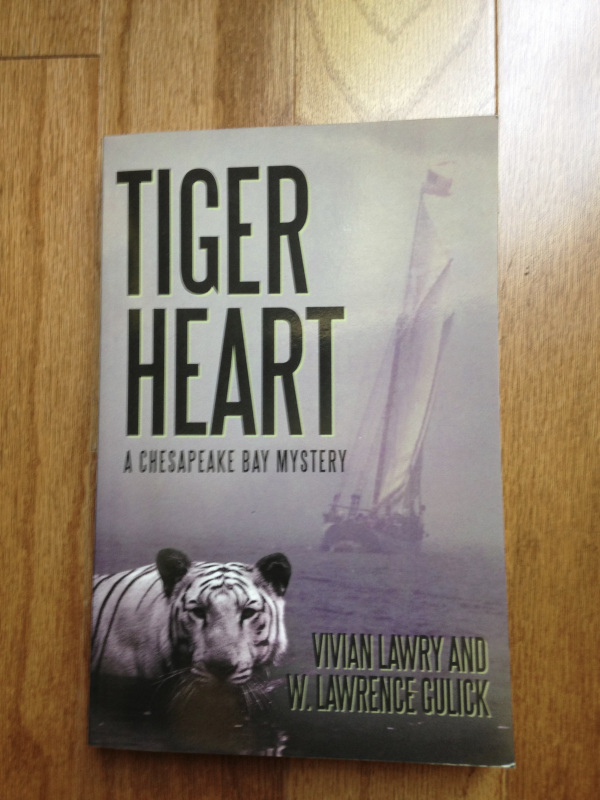
On Saturday, October 2, 1:00 p.m., my coauthor and I will be reading from our recently published book DARK HARBOR: A Chesapeake Bay Mystery. The event is sponsored by the Friends of the Atlee Library in Atlee, Virginia, but it is open to the public, and free.

Writing Tip: Unnecessary details

Identifying unnecessary details is especially difficult for new writers. How do you separate the telling details that add realism and depth from those that distract the reader and slow the narrative?

There is no easy call. All you can do is examine descriptive phrases and ask yourself, “Does it matter?” For example, if a woman is reluctantly delving into a box of memorabilia, does it matter whether she sits down on the edge of a queen size bed? Whether she is sitting down on the beige carpet as she opens the box? Both instances are wordy and weak. They should be tightened up and included only if they contribute to the narrative.

Sometimes it’s a matter of placement: e.g., telling us a character is dressed in baggy jeans and a long-sleeved T-shirt with the logo “Too God to be True,” and had hot chocolate made with whole milk and a slice of cold cheese pizza for breakfast could be great character notes. But if these details are tagged on to sentences about resenting a change in routine,  or a parent’s death, they feel distracting and irrelevant.

Bottom line: put in details that matter.

Story Starter: Rules of Thumb

Most people have Rules of Thumb that they live by–consciously or not. A rule might be something personal like, “If the chance of rain is 30% or greater, I’ll carry an umbrella.” Or, “More than 5 years age difference, don’t date there.”  Or, “If I limit myself to one drink an hour, I can drink all night.”

Some Rules of Thumb have entered the popular vernacular. For example, “If you want something done, ask the busiest person you know.” Or, “Assume every gun is a loaded gun, and behave accordingly.”

For this exercise, identify three to five Rules of Thumb you live by. Choose one or more and make it/them central to your character’s functioning. What happens when the rules of thumb don’t hold up? Write the story–and have fun!

Writing Tip: Road Trip Notes

When you travel by car, note the names of roads, churches, businesses, schools–whatever–that strike you as especially colorful.These often add vivid specificity to a story or scene. You are more likely to find compelling names along state or county roads than along interstates, in small towns rather than in cities.

Sometimes just the name is sufficient to start a story. Consider Bone Yard Road or Fresh Fire Church of God as possible settings.