

They say that waking up
Is hard to do.
And I know,
I know that it’s true!
I love being in bed—even if all I’m doing there is sleeping! I love snuggling down, feeling comfy. I can sleep soundly for ten hours or more, given the opportunity. I get up when I have to.
In high school, that meant 5:30 a.m., to be picked up at 6:00 by the parents of three elementary school children, to get them up, dressed and fed, walk them to and from school, and babysit them till the parents got home from work about 5:00 p.m.
And so it went from then through every subsequent job: roll out in time to get to work. During my seven years in college (B.S., M.S., Ph.D.), replace “work” with “class.”
Today, I sleep later, and stay up later. I still get up when I have a specific time-critical commitment. And I still struggle with waking up.
Waking Up with Help
Apparently, I’m not alone here. Sleep specialists say that some level of sleep inertia is normal. It’s just that for some of us, that level is very high! And for them, there are options—some of them pretty harsh. A March 6 article in The Wall Street Journal described several that I (for one) consider extreme.
Modern Assistance
Pavlok Shock Clock is a wrist-watch-like device that delivers an electric shock to the wearer. The wearer sets the intensity to hurt but not cause damage: for example, a setting of 75% is 300 volts. It sells for about $160.
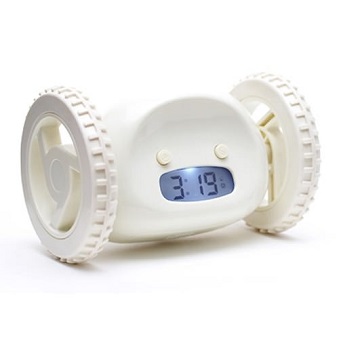
Clocky, created about twenty years ago, is a wheeled alarm that hops off a table and beeps as it zooms around the room.
Nuj, an app on which the user sets a task to prove s/he is up. If the task isn’t performed within minutes, a financial penalty, also set by the user, is levied. All the money collected goes to charity.
Alarmy, another app for which the user chooses a “mission” that must be accomplished before the alarm will shut off. At this writing, it costs $7.49 per month.
Sonic Bomb, sounds off at 113 decibels (think rock concert loud) and flashes red lights. It comes with a vibrating puck for under the pillow or mattress to shake the sleeper awake.
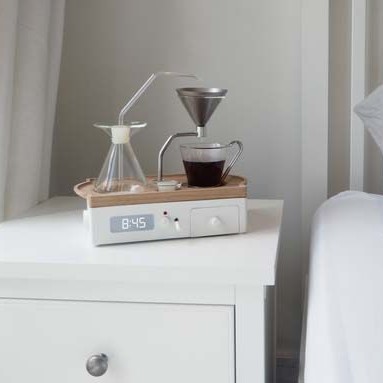
A gentler alternative might be an alarm clock that slowly turns up bedroom lights, mimicking a sunrise. Or one that brews a cup of coffee at your bedside!
Historical Help
Once upon a time, people lived without mechanical alarm clocks or phone apps. To wake up earlier than circadian rhythms dictated, people relied on the noise of animals, deliberately drinking lots of water before bed, or time-keeping bells at nearby religious buildings.

People used a variety of mechanical methods to try waking up on time when their bodies just wanted to sleep. Some lit a candle that dropped metal pieces with a clatter when they’d been burning for a certain amount of time. Others set a slow trickle of water to trip a pressure alarm and ring a gong. A stick of slowly burning incense, held between the toes, would wake even the soundest sleeper when the burning embers hit skin.
But according to the Wall Street Journal article, the demand for alarm clocks took off in the late 1800s, with names like “the Rattler, the Slumber Stopper, and the Tornado.” With the shift to urban settings and factory work, more people needed to be up earlier and at more precise times. Many factories hired a “knocker-upper” to walk through the streets and rouse employees for their shifts.
In the 1930s, the Westclox Factory introduced the Siesta, with an early version of a snooze option: it alarmed and ten minutes later alarmed again louder. My cellphone alarm offers a snooze option that, when chosen, will sound again eight and a half minutes later—which is soooo easy to repeat, making it increasingly difficult to meet whatever commitment made me set an alarm in the first place!
Waking Up Without Help

According to sleep experts, we really shouldn’t need to resort to extreme measures. Mariana Figueiro, PhD, at Mount Sinai, offers advice beginning with why you should consider avoiding the snooze button on your alarm and why raising the shades is critical.
According to Figueiro, the key is to keep a regular schedule. Getting up and going to bed at the same time every day, including weekends, trains your body to know when it’s time to wake up. (This makes the shifts to and from Daylight Savings Time particularly difficult!) And get up right away—without hitting the snooze button. You never sleep as well after your alarm goes off. It’s better to set the alarm for the time you really need to get up.
Habits for Waking Up Easily

Experts seem to agree on the importance of regular sleep habits. The quality of sleep is also important. Activities I’ve come across for getting good sleep include the following:
- Meditate
- Eat lots of protein
- Take breaks from screen time
- Exercise
- Let natural light in
- Get lots of natural light first thing in the morning (or bright, indoor lights)
- Relax before going to bed with music or a physical book (not an e-book)
- Avoid caffeine (coffee, chocolate) later in the day
- Late night alcohol does not contribute to good sleep
Sleeping as Long as Possible
As a sleep lover who gets up at the last possible minute when I absolutely have to, here are some things that help me sleep as long as possible before I have to meet some commitment:
- Organize what I’m going to wear the next day the night before, including jewelry. (I’m a jewelry junkie!)
- Learn to enjoy cold coffee.
- Have power bars on hand so breakfast prep is optional—or marry a spouse who will make breakfast for you on your schedule!
- Minimize grooming time by omitting whatever won’t be noticed and schedule more time-consuming bits (like shampooing) for days without scheduled commitments.
- Minimize travel time by doing classes/meetings via Zoom or something similar.

Bottom Line: Find the path to wakefulness that works best for you.