GIVING THANKS AROUND THE WORLD (Part 2: Europe)

Giving thanks is everywhere, even though others call their thanksgiving by other names, and celebrate on different dates. This blog will focus on our European cousins.

(Check out last week’s blog on how people in Asia celebrate giving thanks!)

United Kingdom: Harvest Home

Baking, canning, and flower contests at a Harvest Home celebration in Chew Stoke

The UK celebrates a harvest festival, also known as Harvest Home. People, particularly in rural villages, celebrate on the Sunday closest to the Harvest Moon – usually in late September or early October. The tradition dates back centuries, with origins in pagan rituals, when communities gathered to celebrate the successful bringing in of crops. In the past, the timing of the festival varied depending on when the harvest was ready, with the whole community, including children, helping until the last load of crops arrived.

“In 1957, there was 120lb cheddar cheese to be consumed and a 6’ x 2’ harvest loaf, which was borne aloft on the shoulders of six men” in the Somerset village of East Brent.

Modern Harvest Home festivals feature a feast of autumn crops and vegetables, as well as food donations and church services, keeping alive the spirit of gratitude for the season’s bounty.

Some say both US and Canadian Thanksgiving have roots in the United Kingdom’s annual Harvest Home. At the least, this tradition has to have influenced the origins of Thanksgiving in both the US and Canada, brought over by British immigrants.

Netherlands: Dankdag

Before leaving for the New World, English immigrants lived and worked for several years in the Netherlands, in the town of Leiden. About 40% of the Mayflower passengers spent over a decade (1609 to 1620) living in this Dutch city before heading to Massachusetts. Some even believe the Pilgrims’ first Thanksgiving was inspired by Leiden’s annual celebration of breaking the Spanish siege in 1574.
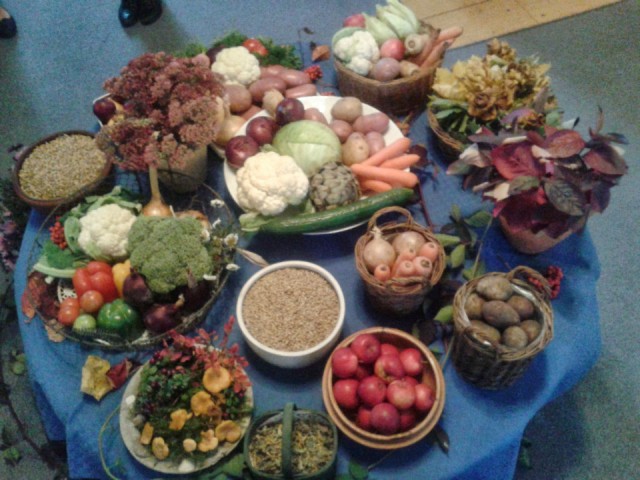
Harvest table at a church in Van Halland

They brought many of their customs to their new (temporary) home, including the practice of expressing gratitude for a successful fall harvest.

While Thanksgiving isn’t an official holiday, many restaurants offer special meals. Dankdag is still celebrated in Leiden. Citizens enjoy an American-style Thanksgiving dinner after a church service at Pieterskerk. The city of Leiden also honors its historic ties by holding non-denominational church services at Pieterskerk every fourth Thursday of November!

And if they live near Beschuitsteeg, they can explore the Leiden American Pilgrim Museum as a tribute to their long friendship with the pilgrims.

Germany: Erntedankfest

Like Britain and many other European countries, Germany celebrates the first major harvest of the season with a big festival. Erntedankfest (“thanks for the harvest fest”) doesn’t have an official date. This religious holiday often takes place on the first Sunday in October, which is often also the first Sunday following Michaelistag (Michaelmas) on September 29. Different places celebrate the occasion on various dates in September and October, but it typically takes place between early October and late November depending on the region, sometimes coinciding with Martinstag (St. Martin’s Day).
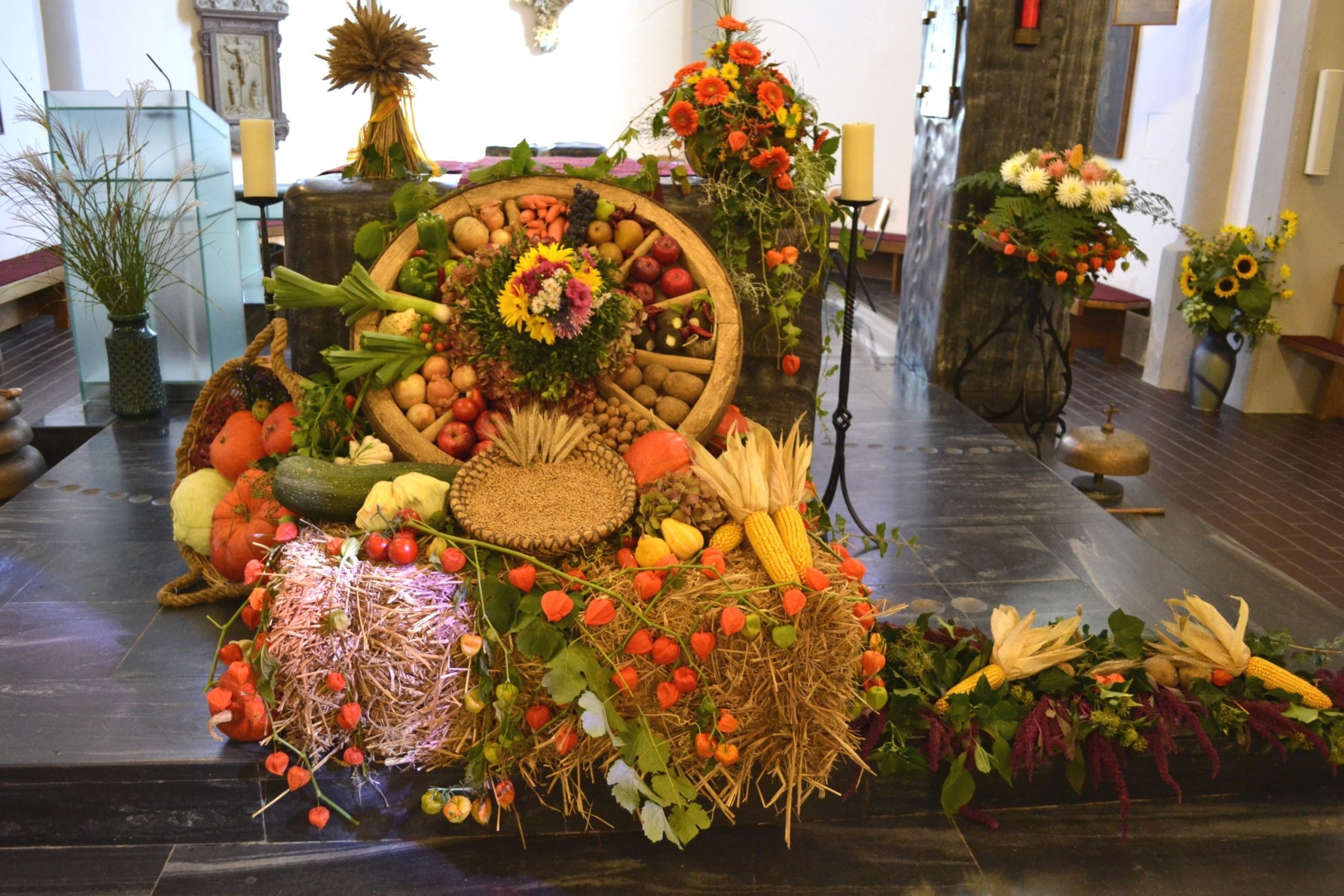
Erntedankfest decorations at a church in Oberösterreich

Erntedankfest is a community affair, often held outdoors or in churches rather than homes. It’s a lively gathering filled with parades, music, and tables laden with such hearty fare as die Masthühnchen (fattened-up chickens) or der Kapaun (castrated roosters), geese, hearty stews, fresh-baked bread, and local brews. There are plenty of traditional foods and seasonal produce. Colorful decorations like cornucopias are typical. There are also church services to begin the celebration, with lantern parades planned for the evening.

Though rural areas tend to take the harvest festival more literally, many churches in German cities also join in on the celebration, giving thanks for the good fortune their congregations experienced that year. During a typical Erntedankfest, celebrants carry an Erntekrone (“harvest crown”) of grains, fruit and flowers to the church in a solemn procession.

Though it’s more common in rural areas, many Germans observe Erntedankfest through televised events, connecting to their agricultural roots from afar.

Other German-speaking countries, such as Austria and Switzerland, also celebrate Erntedankfest to observe the autumn harvest. Erntedankfest traditions include parades, church services, concerts, fireworks, and a harvest feast, where turkey (Truthahn) is a holiday dinner favorite.

Poland: Dożynki

Harvest wreath parade in Milówka

The Polish harvest festival, Dożynki, dates back to the 16th century when landowners shared the bounty of the harvest with the land’s workers. The historical celebration included dancing, feasting, and crafting harvest wreaths to ensure fertility for the next harvest.

The word Dożynki literally means “last sheaves.”

Today, the festival still includes feasts and harvest wreaths. Modern Dożynki celebrations incorporate religious elements, including a pilgrimage to Jasna Góra in Częstochowa. Many Polish celebrants dress in traditional outfits as they share in the harvest.

Thanksgiving in Rome

Italians do not have a national holiday that celebrates American Thanksgiving.  However, plenty of Italians toast the holiday with their expat friends and family at a home or restaurant. 
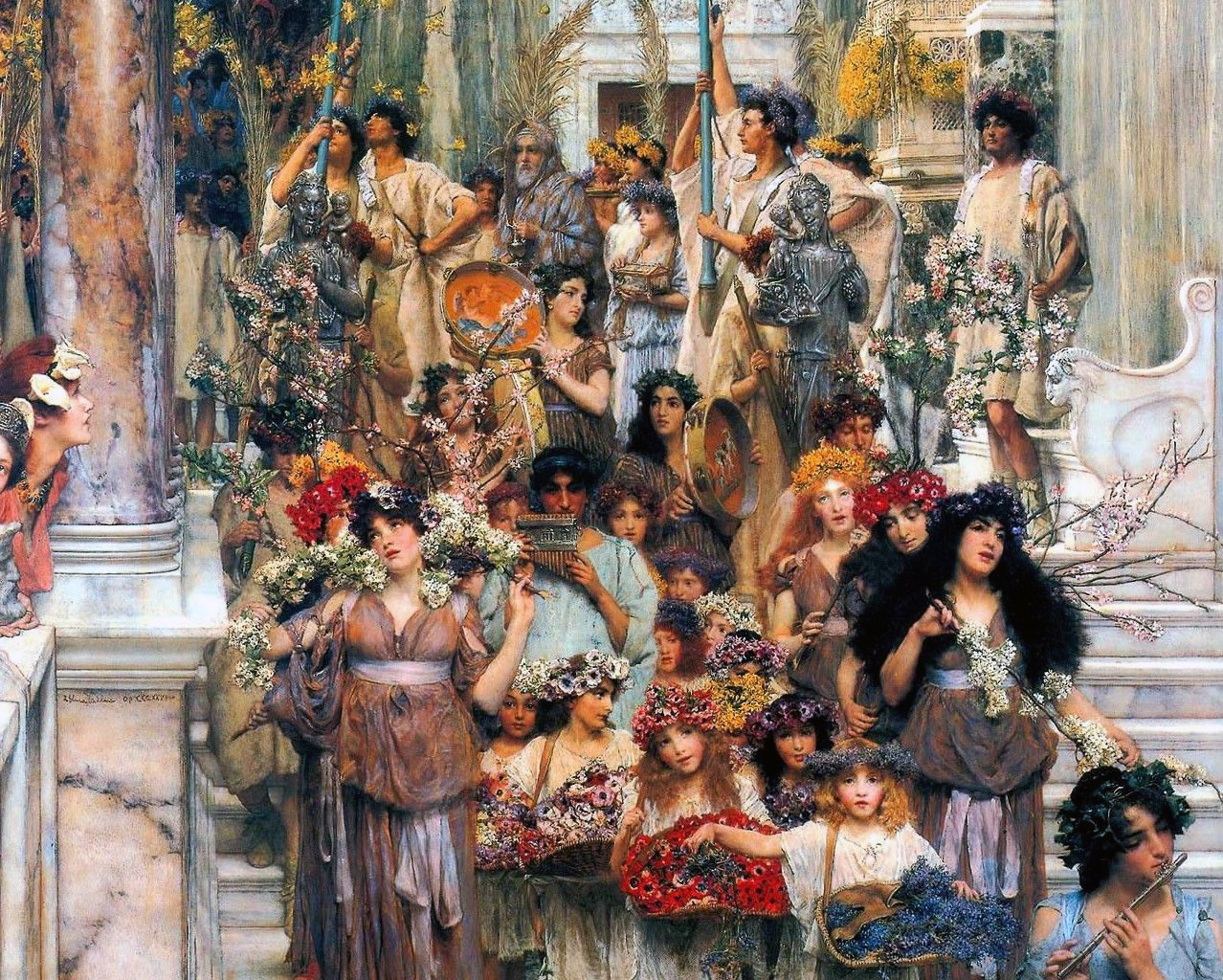
Not a modern depiction of Cerealia, but the sentiment is the same!

In addition, Rome celebrates a harvest festival known as Cerealia. This honors Ceres, the goddess of agriculture, grain, and the love a mother bears for her child.  (FYI: In ancient Greek religion Demeter is the goddess of the harvest and agriculture, presiding over crops, grains, food, and the fertility of the earth. She also appeared as a goddess of health, birth, and marriage.) Cerealia occurs every year on October 4th. Roman custom is to present fruits, grains, and animals to the goddess in appreciation. Parades and music are also part of the celebration.

Bottom Line: Celebrations of giving thanks in Europe share roots of giving thanks for food, much like our Thanksgiving.

THANKFUL, GRATEFUL, BLESSED

Pretty much everyone appreciates what’s good in their lives during Thanksgiving. But if you know what’s good for you, you’ll make it a daily activity!

Benefits of Gratitude

Practicing gratitude can have many benefits. From sources across the web, these benefits include:

Mentally Grateful

—Improved mood: Gratitude can make people feel happier and more content. Writing a gratitude letter and counting blessings “were associated with substantial improvements in optimism” (Huffman, Dubois, Healy, Boehm, Kashdan, Celano, Denninger, & Lyubomirsky, 2014).

—Improved relationships: Expressing gratitude can help build and maintain social bonds.

—Reduced anxiety and depression: Gratitude buffers people from stress and depression (Wood, Maltby, Gillett, Linley, & Joseph, 2008). Writing gratitude letters leads to better mental health in adult populations seeking psychotherapy (Wong, Owen, Brown, Mcinnis, Toth, & Gilman, 2016).

—Gratitude may enhance peace of mind, reduce rumination, and have a negative effect on depressive symptoms (Liang, Chen, Li, Wu, Wang, Zheng, & Zeng, 2018).

—Increased productivity: Gratitude can increase productivity by activating the prefrontal cortex, which is responsible for critical thinking and rational thought processes.

—Strengthened self-worth.

Optimism: Positive reframing underlies the relationship between trait gratitude and a sense of coherence. A sense of coherence is how confident a person feels about potential life outcomes. It is the degree to which a person feels optimistic and in control of future events (Lambert, Graham, Fincham, & Stillman, 2009).

—Reduced stress: Gratitude can help calm the nervous system and reduce stress. (UCLA HealthMar 22, 2023)

Physically Grateful

from The Greater Good Science Center

— Every time a person expresses or receives gratitude, dopamine releases in the brain, thus making a connection between the behavior and feeling good. The more a person practices gratitude, the more often dopamine releases.

—Better sleep: People who practice gratitude tend to sleep better and longer.

—Better physical health: People who practice gratitude report better physical health and are more likely to seek help for physical concerns. Patients who expressed optimism/gratitude two weeks after an acute coronary event had healthier hearts (Huffman, Beale, Beach, Celano, Belcher, Moore, Suarez, Gandhi, Motiwala, Gaggin, & Januzzi 2015).

—Reduced risk of disease by reducing inflammation at the cellular level.

—Reduced difficulties with chronic pain.

—Increased blood flow to the hypothalamus, which controls stress and sleep.

— Gratitude and spiritual wellbeing are related to positive affect, sleep quality, energy, self-efficacy, and lower cellular inflammation (Mills, Redwine, Wilson, Pung, Chinh, Greenberg, Lunde, Maisel, & Raisinghani, 2015).

The Science of Being Grateful

The Greater Good Science Center offers a plethora of information on this subject. In a paper titled, “The Science of Gratitude” (2018), they outline several benefits to gratitude practice.

Individual Gratitude

  • More satisfaction with life
  • Increased happiness and positive mood
  • Less materialistic
  • Less likely to experience burnout
  • Better physical health
  • Better sleep
  • Less fatigue
  • Lower levels of cellular inflammation
  • Greater resiliency
  • Encourages the development of patience, humility, and wisdom

Group Gratitude

  • Strengthens relationships
  • Increases prosocial behaviors
  • May help employees’ effectiveness
  • May increase job satisfaction

Research Into Gratitude

Emmons & Mishra (2011) concluded that there is “considerable evidence that gratitude builds social resources by strengthening relationships and promoting prosocial actions.”

Wong and Brown (2017) determined that gratitude does four things:

  • Gratitude disconnects us from toxic, negative emotions and the ruminating that often accompanies them. Writing a letter “shifts our attention” so that our focus is on positive emotions.
  • Expressing gratitude helps us even if we don’t explicitly share it with someone. We’re happier and more satisfied with life because we “said it to ourselves.”
  • The positive effects of gratitude writing compound like interest. You might not notice the benefit of a daily or weekly practice, but after several weeks and months, you will.
  • A gratitude practice trains the brain to be more in tune with experiencing gratitude — a positive plus a positive, equaling more positives.

“In the past, I always thought of gratitude as a spontaneous response to the awareness of gifts received, but now I realize that gratitude can also be lived as a discipline. The discipline of gratitude is the explicit effort to acknowledge that all I am and have is given to me as a gift of love, a gift to be celebrated with joy.”

Henri J. M. Nouwen (1932-1996)
from Return of the Prodigal Son

Bartlett & DeSteno (2006) published research about gratefulness and helping behavior:

  • Gratitude facilitates helping behavior,
  • Grateful people help the people who helped them (benefactors) and strangers similarly, and
  • Reminding people who helped them (a benefactor) still increased helping behavior exhibited toward strangers. The reciprocity norm wasn’t a factor.

Dickens and DeSteno (2018) found an association between self-control (patience) and gratitude. Grateful people delay future rewards to a higher degree than ungrateful people, positively affecting one’s finances. Increasing levels of gratitude could also help people positively affect health-related behaviors.

Robert Emmons (2010), a preeminent scholar in this field, makes the argument that gratitude allows a person to do several things:

  • Celebrate the present
  • Block toxic emotions (envy, resentment, regret, depression)
  • Be more stress-resilient
  • Strengthen social ties and self-worth

Practice Being Grateful

These suggestions at Positive Psychology were adapted from Sansone & Sansone (2010) and Emmons (2010) and are easy to do daily or weekly.

  1. Journal about things, people, or situations for which you are grateful. Consider including negative situations like avoiding an accident, for instance.
  2. Think about someone for whom you are grateful.
  3. Write a gratitude letter to someone for whom you are thankful. Consider sending it or giving it to them in person.
  4. Meditate on gratitude (present moment awareness).
  5. Do the “Count Your Blessings” exercise (at the end of the day, write down three things for which you were grateful).
  6. Practice saying “thank you” in a real and meaningful way. Be specific. For example, “Thank you for taking the time to read this article and leave a comment. I enjoy reading your contributions because they broaden my understanding of this subject.
  7. Write thank you notes. Some might say this is a lost art. Challenge yourself to write one hand-written note every week for one month.
  8. If religious, pray about your gratitude or use specific prayers of gratitude. Interfaith Worker Justice offers Muslim, Jewish, and Christian examples. Secular Seasons has several graces and invocations. You also can find a collection of secular gratitude approaches on BE. Orlando Humanist Fellowship.
  9. Recall a negative event. Doing this helps you appreciate your current situation.
  10. Be mindful of your five senses. How does each enhance your life?
  11. Create visual reminders to practice gratitude. Sticky notes, notifications, and people are great for this.
  12. Focus on the good that others have done on your behalf.
  13. Actions lead to gratitude. Smile, say thank you, and write gratitude letters.
  14. Be a grateful gazer. Be on the lookout for opportunities to feel grateful.
  15. Give something up. We tend to adapt to newness; sometimes it’s a good idea to give something up so that we can increase our appreciation of it.
  16. Think about what your life would be like if a specific positive event [hadn’t] happened. Write all the decisions and events that would have been different in your life. For instance, what if you didn’t meet your spouse? What if you didn’t get the dream job you have now? What if you hadn’t stopped a particular bad habit?
There’s always something to be grateful for!

Lack of Gratitude

Unfortunately, not everyone eagerly jumps onto the gratitude bandwagon. Emmons (2013) offers the following characteristics of ingratitude:

  • Excessive sense of self-importance
  • Arrogance
  • Vanity
  • Unquenchable need for admiration and approval
  • Sense of entitlement

Thomas Gilovich (2017) describes ingratitude as the result of “adaptation, dwelling on negatives, and skewed perceptions of hardships.” In Enemies of Gratitude, Gilovich explains how and why these three experiences interfere with one’s ability to express gratitude.

Appreciating the positives in one’s life making life better seems a little woo-woo, not to mention circular. But there’s a ton of research indicating that it works. And it’s a small, no-cost investment with potentially great rewards.

Bottom Line: Go for grateful!

Thankful for Books—

—AND THE ABILITY AND TIME TO READ THEM!  Although the book mentioned here are Thanksgiving themed, they are good reads any time.


Thankful for books thanksgiving turkey
Murder and mayhem. Janet Evanovich has three Thanksgiving themed mysteries: Thanksgiving, Foul Play, and The Grand Finale. Apparently Evanovich knows the potential of holidays for drama!


Also, Thanksgiving Angels: A Mercy Allcutt Mystery by Alice Duncan.


For more options, click here!
thankful for books thanksgiving
Otherwise, here are some suggestions from Goodreads readers.
  • Thanksgiving Night by Richard Bausch
  • The Ghost at the Table: A Novel by Susanne Berne
  • The Lay of the Land by Richard Ford
  • A Patchwork Planet by Anne Tyler
  • Thanksgiving by Michael Dibdin
  • A Thanksgiving Miracle by Wells Earl Draughon
  • The Thanksgiving Virgin by Charles Haas


thankful for books turkey
 Classics
  • An Old Fashioned Thanksgiving by Louisa May Alcott
  • Oliver Twist by Charles Dickens
thankful for books silver turkey
BOTTOM LINE: Be thankful for online searches, for you can find Thanksgiving books for all ages and genres!
 
thankful for books happy thanksgiving