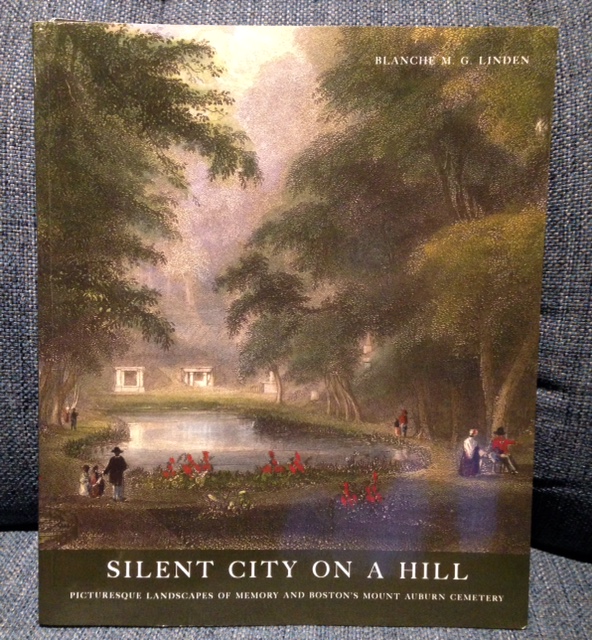
Sometimes things just come together. I’ve had a long-standing interest in graveyards and cemeteries. My all-time favorite is Mount Auburn Cemetery in Cambridge, Massachusetts. The primary picture on my website was taken there! It is the first garden cemetery in the United States, established in 1834.
Silent City on a Hill by Blanche M.G. Linden
So, of course, when I moved to the area, I visited Hollywood Cemetery, the third garden cemetery in the United States.
“Hollywood Cemetery-With Skyline and River” by Andrew Bain – Own work. Licensed under Public Domain via Commons.
At that time, I lived in the McMurdo house in Ashland, built in 1858. Apparently Stonewall Jackson headquartered there briefly during the battles around Richmond—briefly meaning only a few hours. But it piqued my interest in the Civil War.
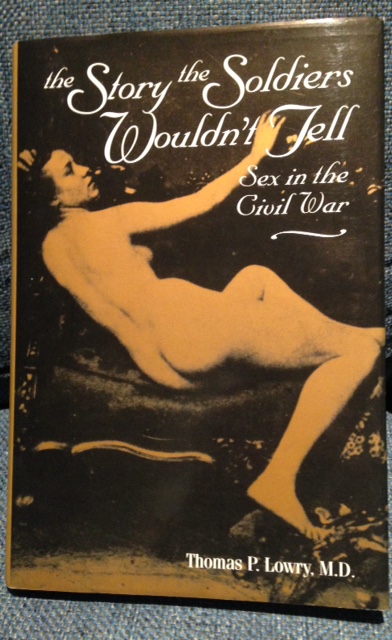
After touring the White House of the Confederacy, I visited the gift shop there. After visiting historic sites or museums, I always check the gift shop for off-beat books. In this instance, I found The Story the Soldiers Wouldn’t Tell: Sex in the Civil War.
The Story the Soldiers Wouldn’t Tell: Sex in the Civil War by Thomas P. Lowry, M.D.
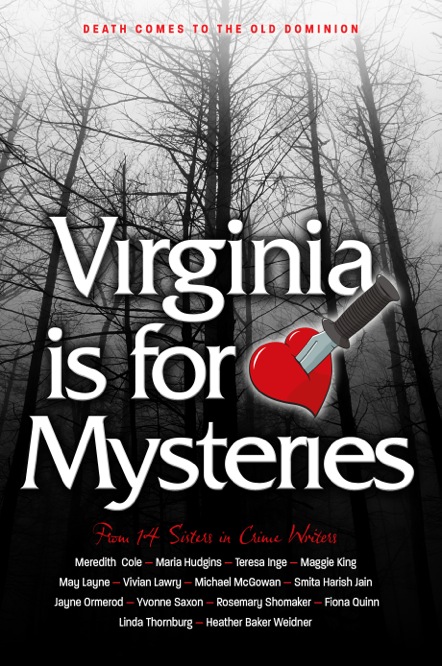
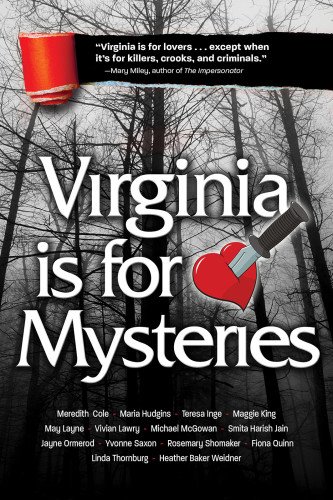
So when the call went out for stories for Virginia Is For Mysteries, it all came together. I wrote “Death Comes to Hollywood Cemetery.” My amateur detective is Clara, a good natured prostitute who plies her trade with fetishists in Richmond and the surrounding area during the Civil War.
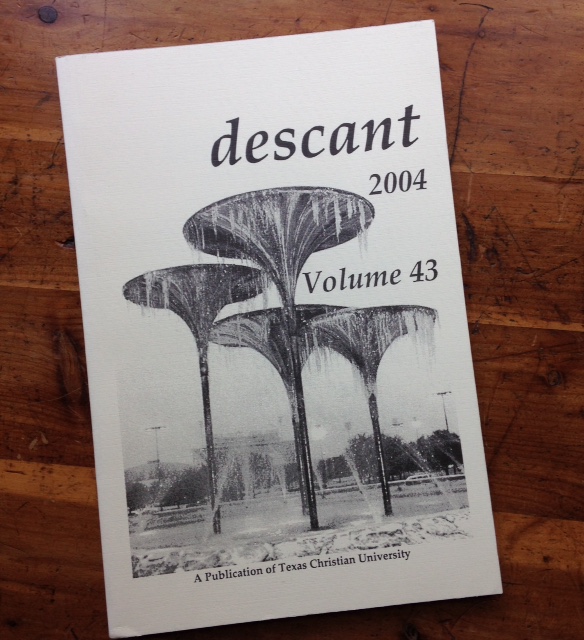
I don’t enter contests. The Sandra Brown Prize for Short Fiction was awarded for “Good Works” based on manuscripts accepted for publication that year in descant.
But this spring, when the James River Writers Best Unpublished Novel Contest call for submissions came, the timing was right. I was wrapping up a manuscript I started years ago, and the deadlines were exactly what I needed to finish it off.
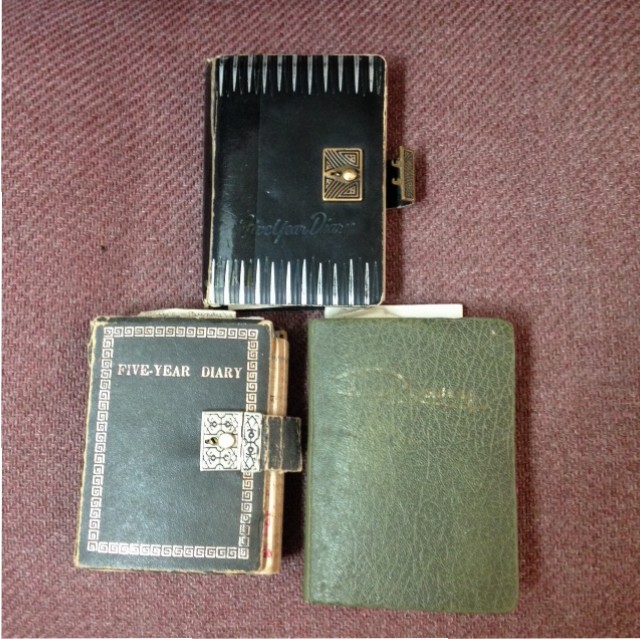
One year during my Nimrod writing week, I took an afternoon off to go to Clifton Forge. There was a store there (now gone) that claimed to sell antiques, but it was the sort of place where everything was jumbled together and thick with dust. I found 3 diaries written by a middle-aged local woman, which I snapped up immediately for no reason except that I am enamored of diaries.
Diaries that inspired Nettie’s Books
If you have diaries, journals, or family letters you would be willing to part with, let me know! I have a file cabinet labeled “Other People’s Lives” for just such treasures.
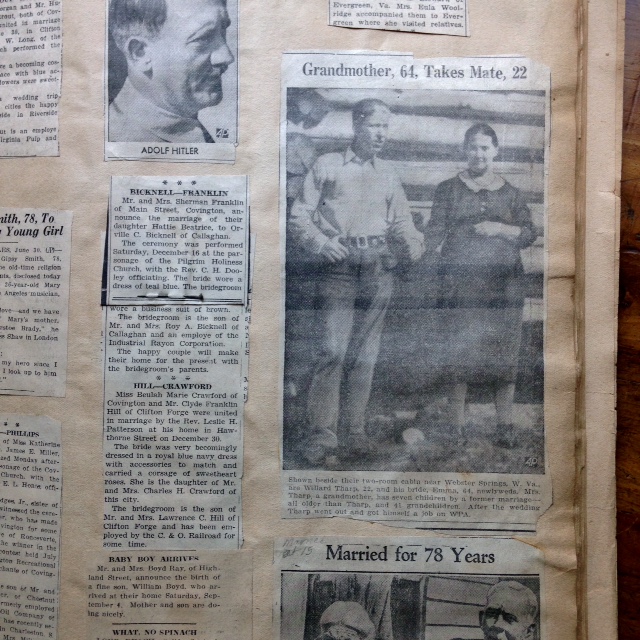
I hesitated before deciding to buy the scrapbook because of its size—15.5 in. x 11 in.—and poor condition, but looking at the sorts of clippings it contained, I couldn’t resist.
Scrapbook that inspired Nettie’s Books
My first thought was to write a short story in which the same woman who wrote a diary about the weather, the garden, cooking, and playing bingo also kept a scrapbook about news of the weird and death. The fact that the earliest diary was 1965-1969 and the clippings were decades older was no impediment.
Click for a closer view of the scrapbook
And then the story grew. The result is Nettie’s Books, set in Bath and Alleghany Counties, 1930-1935. The book begins when Nettie is thirty years old. My next goal is to get it published. I’m hopeful that winning this prize will help with that!
What’s in a name? Perhaps a rose by any other name would not smell as sweet.
Consider your name.
How was it chosen? What does it mean? How does it look? How do you feel about it?
My father John shared the name with a brother of his mother. My mother’s Alta Wavalene came from her father’s youngest sister and her mother’s youngest sister. There are no Vivian’s on either branch of the family tree. Were my parents consciously striking out in a different direction?
One story I heard growing up is that Vivian was the name of my father’s first girlfriend, and he liked it. So, does this reflect my father’s dominance or my mother’s confidence?
Vivian means lively, and likes bright or vivid colors. The latter definitely applies, and I like to think the former does as well. As for appearance, Vivian is all spikes and angles, especially when written in caps: VIVIAN. Hmmmm. No comment. But I do know I felt out-of-place among the Sharons and Shirleys and Barbaras. As a child, I wanted a nickname and it was never forthcoming. As an adult, I like that I have seldom come across another Vivian, and only an Italian chef ever called me Vi.
Consider character names.
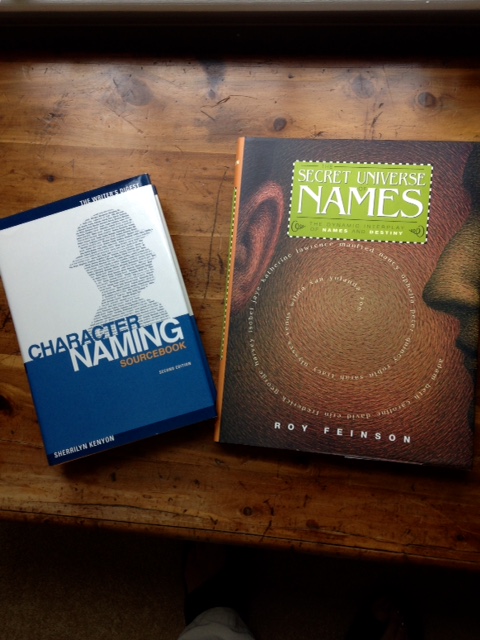
Your characters’ names are as important to them as yours is to you. Give them some thought. As with everything, there are books out there to help. My personal favorite is Character Naming Sourcebook by Sherrilyn Kenyon. For one thing, it starts with an overview of things to consider. In brief, and paraphrased, the ten guidelines are
Capture the persona
Consider heritage, personality, and trade/profession
If you choose a name that breaks the rules, make a point of it
Avoid names that others have made famous
Your character’s name is the usual introduction to the reader. Lydia is harder than Nora. Cynthia is more upscale than Bertha. Bart is stronger than most two-syllable male names.
In deciding on names, avoid not only the beginnings but the endings. Alex, Alice, Amy, and Andrew will confuse readers and turn them off. At the same time, choose nicknames and/or endearments with care. I recently critiqued a manuscript in which William was Billy to the family, Victoria was Vickie,
Margaret was Maggie, Susan was Suzie, and endearments were honey and sweetie. Not a big deal, but if the reader notices, it’s too much.
I like Character Naming because of its breadth, and because it separates names by ethnic roots and meaning. But it isn’t the only book out there. Indeed, you can go to a local telephone directory and mix first and last names.
Character Naming and The Secret Universe of Names
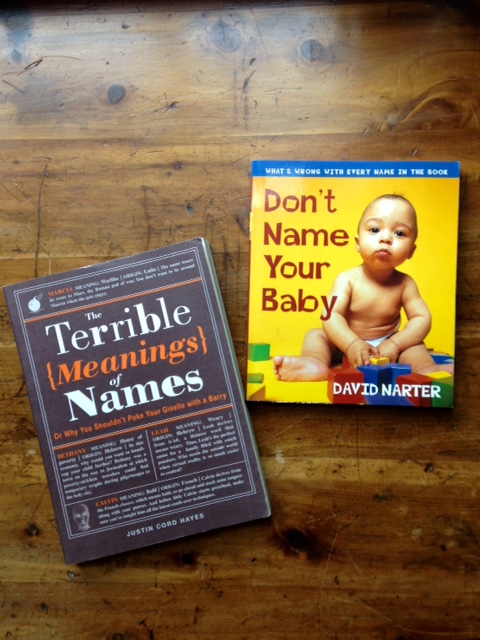
And if you are interested in the humorous side of writing, consider these:
The Terrible Meaning of Names and Don’t Name Your Baby
That way you won’t inadvertently name two friends Barbara Smith and Barbara Morton and end up with BS and BM!
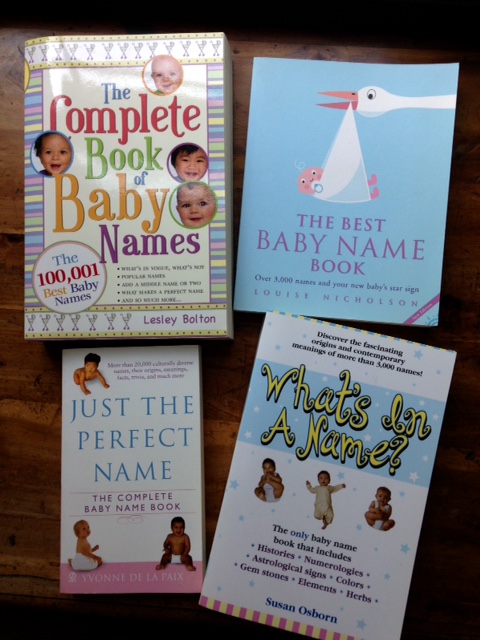
More books on baby names
Consider perception.
Consider the article “13 Surprising Ways Your Name Affects Your Success” by Maggie Zhang and Jenna Goudreau. The main points of their article are highly relevant to writers. If your name is easy to pronounce, people will favor you more. If your name is common, you are more likely to be hired. If your name is uncommon, you are more likely to be a delinquent. If you have a white-sounding name, you’re more likely to get hired. If your name is closer to the beginning of the alphabet, you might get into a better school. If your last name is closer to the end of the alphabet, you’re more likely to be an impulse spender. You are more likely to work in a company that matches your initials. Using your middle initial makes people think you’re smarter and more competent. If your name sounds noble, you are more likely to work in a high-ranking position. If you are a boy with a girl’s name, you are more likely to be suspended from school. If you are a woman with a sexually ambiguous name, you are more likely to succeed. Men with shorter first names are overrepresented in the c-suite. Women at the top are more likely to use their full names (e.g., Deborah, Cynthia).
And one final point for authors: think carefully before giving your main characters long or hyphenated name. You are going to be typing those name a gazillion times!
Sometimes life gets on top of you. You aren’t dead, just buried. And accidents happen. Such was the case for me recently. When two on-line journals went live nearly simultaneously, I realized that I had granted first rights to both of them. My attempt to set things right follows.
I am embarrassed and extremely regretful to have to tell you that I inadvertently granted publication rights to two literary journals. On May 8, 2015, when I granted OxMag rights to my short story “Trust,” I did not recall that I had previously (on March 27) granted publication to Diverse Arts Project Journal. All I can say in my defense is that over the last several months I’ve been distracted by two surgeries, daily hospital care for a persistent non-healing wound, various other health complications, family issues, and a flurry of short story acceptances. Once I discovered my error, notifying you seemed the only honorable thing to do.
As an on-line publication, I suppose that you can—and may wish to—remove my story from this issue. Alternatively, should you choose to allow the double publication to stand, please add an appropriate footnote acknowledging the Diverse Arts Project Journal.
Again, my apologies for the error. Please let me know how you decide to handle this. And thank you for your time and efforts on my behalf.
A little more than three weeks later, I received the following response.
Thank you so much for coming forward with this issue, we appreciate it.
Because it is our policy generally to only publish previously unpublished work, we will remove your story “Trust” from our Spring 2015 issue. We did enjoy your story, and re-reading it gives us time to again appreciate why we chose to publish it initially. We encourage you to continue submitting work to OxMag, but also remind you to in the future keep us informed of the status of any simultaneous submissions. (Submittable actually has an option to withddraw stories from consideration once they’ve been accepted without you having to notify everyone.)
We wish you good health, and also congratulations on the other short story acceptances—that’s very exciting!
Avoid First Rights Blunders
There are several take-aways for writers. One, with e-publishing, this sort of error can be corrected. Unlike a print journal, where making changes of this sort would be prohibitively expensive, it’s a relatively easy fix. Two, if you screw-up—regardless of the medium—admit it. Besides easing your conscience, doing so reflects well on you. In this case, OxMag thanked me and invited future submissions. And, three, take care of the paperwork (either yourself, or through a third party). It’s much better to avoid this sort of situation than to try to repair it!
Corpse flower, By Credits: US Botanic Garden. [Public domain], via Wikimedia CommonsOne question that non-writers often ask is, “Where do you get your ideas for stories?”
My short answer is, “Everywhere.” The somewhat longer answer is newspapers (especially news of the weird), magazines, tidbits on TV, conversations (overheard and otherwise), photos, books, life events (mine and others’), obituaries—i.e., everywhere. I tend toward the dark and the odd.
The recent blooming of a corpse flower at the Denver Botanic Gardens reminds me of my story “Bunga Bangkai” in Different Drummer. All of the stories in that collection are weird, but this one is extremely exotic and esoteric. It started when I came across a news story about a corpse flower blooming in the University of Connecticut greenhouses at about the same time that I somewhere heard or read the phrase “garden of heads.” The result was magical realism, with touches of animism and number symbolism—a story of the search for lost love and reconnection. Here are the opening paragraphs:
I came to The Huntington Botanical Garden to assist at the blooming of the Amorphophallus titanium—the huge shapeless penis. The other botanists here call him Johnson, or sometimes Titan arum, but I prefer to call him Bunga Bangkai, his name in our native Sumatra. Bunga Bangkai is wondrous. In bloom, the spadix—the penis—is fleshy and red, cloaked by a frilly-edged, leafy spathe (or petal) the shape of an upturned fluted bell, pale green on the outside and burgundy velvet on the inside. He resembles his distant cousins the Calla lily, skunk cabbage, and jack-in-the-pulpit, except that the bloom of Bunga Bangkai is three feet across and six feet tall—nearly eight feet if his potato-like corm is included in the measure. This Bunga Bangkai’s corm–his tuber—looks like a water chestnut and is the size of a small curled-up child.
For this blooming, I have tended Bunga Bangkai since his bud tip first pierced the earth, nearly three weeks ago. He has grown six inches a day and his bloom-time is near. Two weeks ago, we carried him from the conservatory to the garden, to share this rare spectacle with the people. More than four thousand come each day. At home in Sumatra, he would bloom every year. But here, it will be at least three years before he blooms again. Since his immigration in 1935, fewer than a dozen bloomings have graced the United States.
Funny, but reading that story now, I realize that there are ever more corpse flowers blooming in the U.S. and abroad—which I find very gratifying!
. . .than the devil you don’t. Perhaps you’ve heard this bit of folk wisdom. It reflects the common understanding that people abhor uncertainty. Predictability is a desired state, even if what is being predicted is negative—to the point of being disastrous, dangerous to the point of being life-threatening. Think prisoners/captives: one powerful way to break down their resistance, to garner compliance, is to increase their uncertainty. This can be done handily by having no natural daylight, and artificial light that cycles on randomly, along with an unpredictable eating schedule, unannounced questioning sessions that sometimes include physical abuse and sometimes don’t—anything that is disorienting. Whole books have been written on uncertainty and its management. (For example, see Psychology of Uncertainty by JD Smith, WE Shields, DP Britzman, D Brothers, and K Gordon; or The Social Psychology of Uncertainty management and System Justification by K VandenBos.)
The takeaway for writers is that to increase tension, increase uncertainty, decrease predictability.
Given the examples above, the application to action/adventure plots is obvious, but this writing rule applies across genres. Will he/won’t he call? Does she love me or not? Will this disease kill my child? Will my boss understand if I miss another staff meeting? Will I miss my plane? Does the murder suspect that I know he did it? If your story unfolds in a predictable pattern, your reader will lose interest. Why bother to read what you know is going to happen? Perhaps truly fabulous prose will keep some readers going, but why depend only on that?
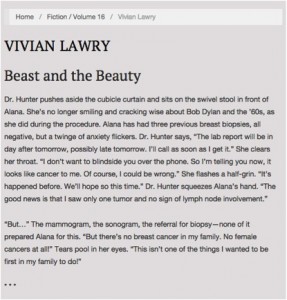
There’s been a lot of great news lately. I’m delighted to share that my short story “Beast and the Beauty” is in the Spring 2015 issue (Volume 16) of Clare Literary Magazine, a publication of Cardinal Stritch University.
You can read “Beast and the Beauty” and the full issue for free by CLICKING HERE.
Thank you to the Editorial Team at Clare Literary Magazine.
Click the text to read the rest of “Beast and the Beauty” in Clare Literary Magazine.
As National Short Story Month comes to a close, I’m reminded short stories come in many dimensions. “For Sale: baby shoes, never worn.” is at one extreme. This story is usually attributed to Ernest Hemingway, though that is unsubstantiated.
I have a story in the upcoming collection Virginia is for More Mysteries (Koehler Books, April 2016)titled “War and Murder at Nimrod Hall.” This is a sequel to “Death Comes to Hollywood Cemetery,” which appears in Virginia Is For Mysteries.It follows Clara as she escapes war-torn Richmond in 1862 only to encounter wounded soldiers and spies in Bath County.
Look for “Death Comes to Hollywood Cemetery” in Virginia is for Mysteries, out now from Koehler Books.