




Surely everyone out there is aware of the (apparent) worldwide toilet paper shortage. Although people who claim to know say there is plenty of TP to go around, what shoppers actually see are miles of empty shelves. And there’s no denying that the TP panic has led to weirdness. Lots of weirdness.
Writers note: if anything in this blog is useful for your writing, it’s purely incidental to what I hope is the smile factor. (I won’t be able to reference every individual incident. They’re all over the internet. You can look it up!)
Ingenuity or Desperation
A thief in Eugene, Oregon smashed the entire back window of an SUV to steal two 30-roll cases of TP, along with any miscellaneous valuables within reach. That turns out to be small potatoes. Police in Guilford County recovered a stolen 18-wheeler loaded with over 18,000 pounds of TP.
In Hong Kong thieves held up a supermarket delivery driver and made off with hundreds of rolls. Authorities estimated that the value of the TP was $218 (HK$1700) but could be sold for much more on the black market.
A man in the UK crammed his van so full of scarce paper products that he was over the legal weight limit for his vehicle and had to pay a fine worth more than $370 (GPB 300).
Hoarders and others with a supply have offered TP and other scarce items online at sites like eBay and Facebook Marketplace for extreme prices to such an extent that efforts to curb price-gouging have been put in place. Several customers have had their accounts suspended.
One man jumped ahead of the curve, going to small towns in his area and buying out the TP and hand sanitizer from the shelves of mom-and-pop stores, Dollar Stores, etc., and then offering them online at such excessive prices that he’s been barred and is stuck with a garage full of supplies he cannot sell.
A similar scalper in Australia had his hoard seized by police and donated to local shelters.
Brick and mortar stores have started imposing limits on how many of each item individual shoppers can buy. Once stores moved to control bulk buying—such as limiting the number of packages customers can buy in one day—desperate people took desperate measures. For example, each member of the family going into the store separately to buy the maximum. When Wegman’s limited people to two packages of TP per day, someone bought the TP and then came back ten minutes later wearing a hat and sunglasses and tried to buy more.
Some people are not happy with the limiting of purchases. Near Richmond, VA, a man arrived at the supermarket check-out with a cart full of paper napkins. When told he could buy only two, he yelled, “F**k you!” then upended the cart and walked out.
The situation has gotten so crazy in some parts of Australia that police are having to guard pallets of toilet paper in stores, handing packages to customers one at a time.
Recently, my endodontist’s receptionist told me that they had locked up their supplies of toilet paper, hand sanitizer, and other items that had begun to disappear. Public restrooms in gas stations, fast food restaurants, and convenience stores have done the same.
Perhaps they should follow the lead of a convenience store worker in Japan. She hung signs with images of eyes and kanji characters in front of the TP to curse the rolls. The symbols imply that anyone pilfering the TP will be hunted down and eaten by a hungry monster. And the pilfering stopped! Never underestimate the power of superstition.
Security cameras were also watching this TP thief at a hotel.
An Internet cafe in Florida posted the following hand-written note in the bathroom: “Stealing toilet paper at this point in time is not funny. I pray that you do not get the virus— But if you do . . . God was watching!” There was no report of the note’s effectiveness.
Once shelves were denuded of TP, people started stocking up on tissues, paper towels, wipes, and napkins. But flushing such things is likely to screw up the plumbing, septic systems, and sewers. City officials in Ankeny, Iowa tweeted the plea to flush only human waste and TP. The city of West Des Moines posted similar pleas not to flush wipes, paper towels, napkins, diapers, feminine hygiene products, socks, dryer sheets, or facial tissue. Johnston, IA, added toothbrushes and toys to the list!
Iowa isn’t the only place where such warnings are needed. A Tacoma, Washington plumbing company reported an instance of people flushing pieces of T-shirts down the toilet. They routinely give a roll of TP to people who have called them in.
An Arkansas florist turned his pre-COVID-19 stash of TP into “floral bathroom tributes” just $75 (for about 9 rolls). And TP is becoming a welcome wedding gift.
TP has become such a valuable commodity that retailers are rewarding customers with rolls of it. A pizza restaurant in Milwaukee, offered a roll of TP for every large pizza bought. Other large restaurants from coast to coast have started similar TP giveaways. And some establishments accept toilet paper in lieu of money!
An Australian newspaper, NT News, included eight blank pages in the middle of the printed pages to be used as TP, complete with cut lines so customers could get the maximum number of squares.
An LA jewelry store decided to use toilet paper as a marketing ploy, as advertised here.
Arcade owners in the UK and Hong Kong have replaced the usual plush toys in claw game machines with rolls of TP. Other similar vending machines offer hand sanitizer and other personal hygiene products to the prize pool.
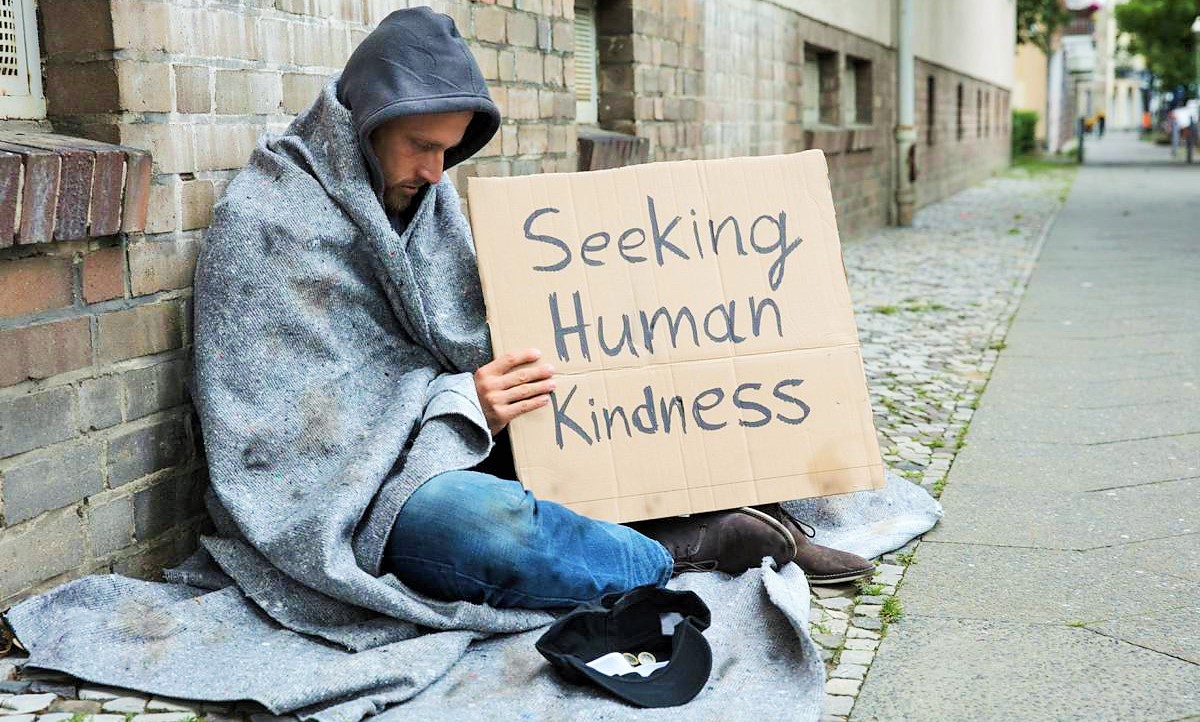
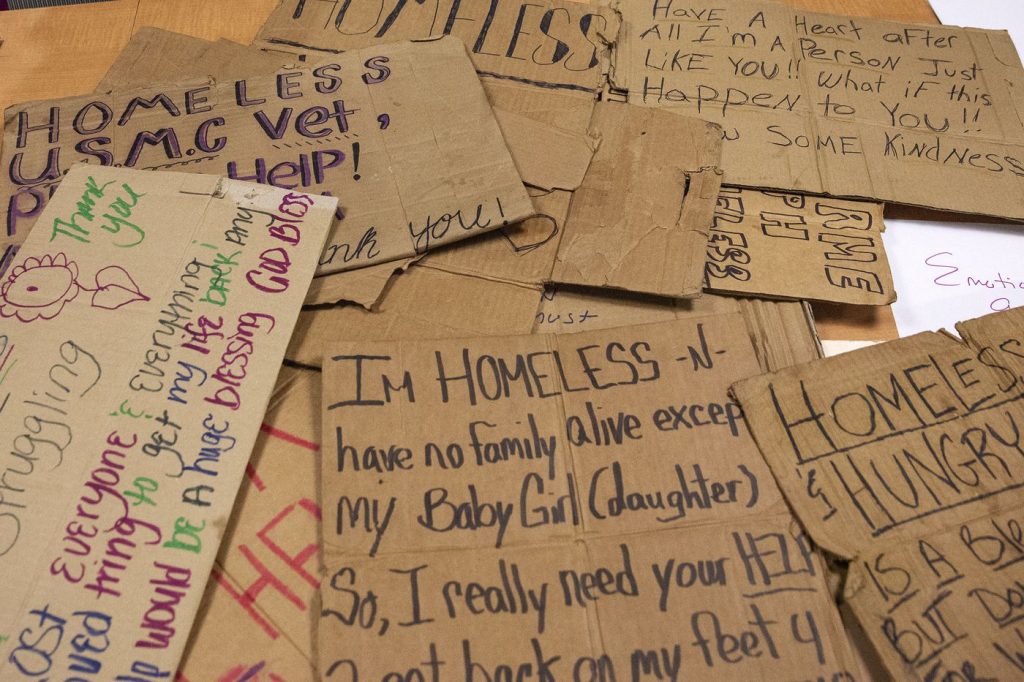
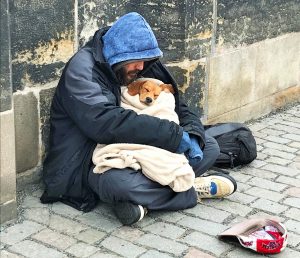
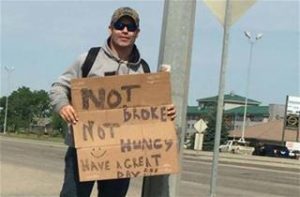
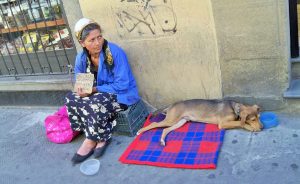
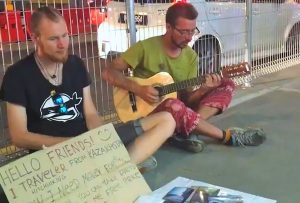
No doubt, somewhere out there, someone is standing in the median of a roadway holding a sign that says, “Will Work for Toilet Paper.”
On the Flip Side: Acts of Generosity
In Coral Gables, FL, Church by the Glades announced a day and time for people to pick up free toilet paper.
In Summerville, SC, police issued rolls of TP to drivers in lieu of tickets.
NT News, an Australian newspaper, has begun including extra sheets of blank paper in the centerfold, specifically for use as toilet paper.
Traveling/Keller (an Atlanta-based marketing firm) is one of many companies that are temporarily closed. Having enough TP on hand for 1,000 employees, they decided to give it away. Employees threw rolls of TP through the open windows of cars driving by in their “Toilet Paper Tosses” initiative.

On a smaller scale, many people have been offering a roll or two to friends or family in need, going to the store for those who can’t make it out, or donating hygiene products to local homeless and women’s shelters.
The New Currency
Venezualans have experience using toilet paper and diapers as currency, after skyrocketing inflation. It seems the rest of the world may be catching on.
Alternative Methods of… You Know
There is a fatberg under London that is the size of a bus!
There are plenty of other materials with which to maintain your personal hygiene when you don’t feel up to facing the hordes at the stores. Be aware, though: many of these alternatives cannot be flushed. Sewage systems around the world are becoming clogged by “fatbergs” of flushable wipes (that aren’t flushable), paper towels, diaper, sanitary napkins, and all the other alternatives people experimented with.
Reusable Sh*tMits
Snow
Bidet
Tortillas
Newspaper
CVS Receipts
Sponges
Leaves
Hemp
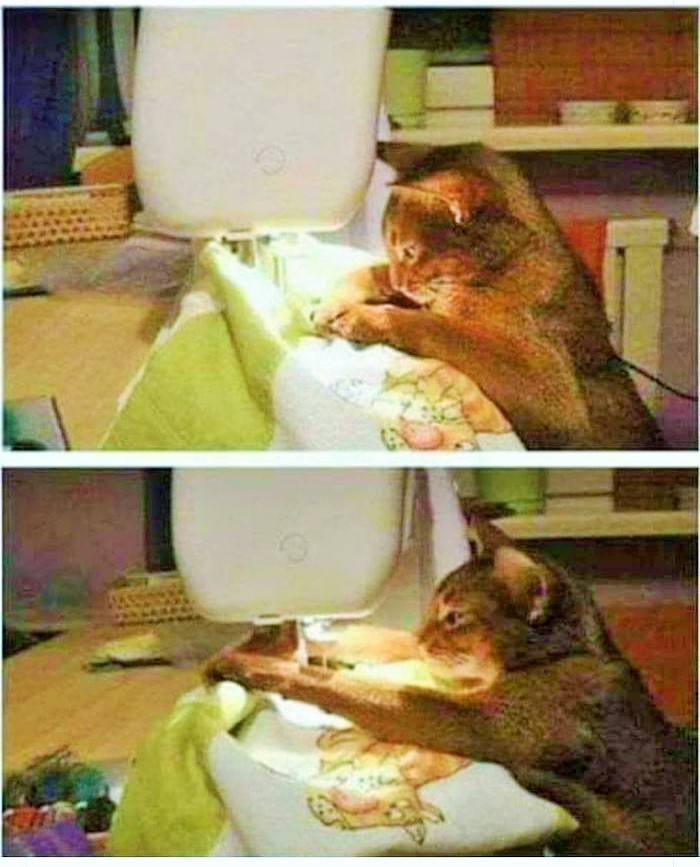
Quilting Squares
Corncobs
Stop. Think.
Do you really need to buy TP right now? Most standard 2-ply, 1000 sheet rolls should last about a week. But for a number tailored to your household, there’s an online calculator for that.
P.S. Police departments around the country are reminding people: Don’t Call 911 If You Run Out Of Toilet Paper. It is not a life-threatening emergency.
What to Do When You Realize You Can’t Return It
Some people have already realized the folly of buying pallets of squished-up trees in preparation for a respiratory illness, but most stores have policies in place refusing returns. Here are some other ideas! (These photos were taken before February 2020.)
They say there is an ideal job for every person, and in an ideal world every worker would find a job that absolutely suited their skills and interests. The world we live in is, alas, not an ideal world. The world you create through your writing can be as ideal as you choose, and the jobs held by characters can be a perfect fit. Or not.
Is being Scottish a career?
A perfect job match for a character can demonstrate their talents and background. An imperfect job match can be a source of conflict, humor, or even plot development. The ways in which characters find a career path can be just as revealing as the job itself: some people join the family business whether they have the aptitude and interest or not; some people slowly work their way up the ladder to the job they actually want; some people have an innate talent, honed by practice. Some careers are dependent on the setting (such as a snowshoe maker or dinosaur wrangler), but most types of work have some equivalent in every genre.
Jobs for people who love working with their hands. Educational requirements, apprenticeships, licenses, etc., vary by job. Some have no requirements beyond on-the-job training. Both introverts and extroverts can find tactile jobs to suit their interests (in theory, at least).
Carpenter
Casino dealer
Chef/baker
Construction worker
Electrician
Hairstylist
Massage therapist
Mechanic
Sign language interpreter
Stagehand
Welder
High-paying, low-stress jobs for introverts. These are jobs for characters who prefer independent tasks and interactions with smaller groups of people/coworkers. They typically require post secondary education. Apart from convenient plot devices, these jobs are unlikely to include terrifying catastrophes and world-ending deadlines. Usually.
Atmospheric scientist
Computer and information research scientist
Electronics engineer
Software developer
Technical writer
Technical translation
High-paying jobs with good work/life balance. Education/training varies, but a common thread is that these jobs typically don’t require on-call or emergency response. (Actually, most writers earn very little from their writing, but the possibility is always there.)
Physical therapist
Dental hygienist
Web developer
Postsecondary teacher
Writer/author
Jobs that require good observational skills. Educational requirements vary, as do salaries. Despite high demands on the personal time and physical strength of people working in these fields, many have salaries significantly below the U.S. median.
Registered nurse
Veterinary technologists and technicians
Sociologists
Police and sheriff’s patrol officers
Private security
Environmental scientists and specialists
Childcare workers
Jobs that offer the possibility of frequent crises. Some people are perfectly suited for staying calm and doing their job in the middle of an adrenaline rush; some people simply love the adrenaline rush. Contrary to what television would have us believe, these professions are not a constant stream of accidents and terror. However, characters working in these jobs could be a very handy source of action to drive a plot.
Firefighter
Paramedic or EMT
ER surgeon
Personal security
Test pilot
Stunt driver
Middle school teacher
Parent of a toddler
Jobs that do not require reading. Approximately 800 million adults worldwide are functionally illiterate; in the US, 36 million adults cannot read or write above a third grade level. The reasons for illiteracy are almost as varied as the people affected by illiteracy: inadequate or inappropriate education, poverty, social prejudice, learning disability, mental disability, physical disability, poverty, gender bias, etc. There are few jobs that require absolutely no reading, but there are several that don’t rely heavily on that skill.
Side Note: Functionally illiterate adults develop a variety of methods to get around in society; consider how you might write such a character.
Animal care and service workers
Crafts artists
Dancers
Fishing and hunting workers
Photographers
Agricultural work
Musicians/singers
Jobs that require little or no prior training. The eternal question “How can you get job experience if no one will hire you without experience?” applies in just about every career you can choose. Being born into a family of royals, subsistence farmer, or reincarnated dragon whisperers kind of limits career choices. For the rest of us, we have to start with anything we can find. That does not mean these jobs are any easier or less vital.
Dishwasher
Waiter or tables busser
Retail customer service
Housekeepers
Home delivery
Window washers
Shelf stockers
There’s always one…
Bottom Line for writers: if you are creating a new character, consider jobs that fit!
Public Service Announcement: The Red Cross is in desperate need of blood donations right now. Please take a trip to your nearest donation center if you possibly can.
In these days of the pandemic, I spend my days going to doctors’ appointments, watching my flowers bloom, and wandering around the internet. I recently browsed several jobs lists, and thought you might be interested in the following.
Writers note: Maybe they could contribute to characters or plots.
Scuba Diving Pizza Delivery
Yes, there is such a job. An underwater hotel in Florida (a bit of an oddity itself) offers pizza which is brought in a watertight case by a scuba diver. (Although food delivery is still allowed, I doubt the hotel has guests just now.)
Yum.
Mr Marmite
Marmite Taster
Why not? After all, there are tea tasters, coffee tasters, wine tasters, etc. Indeed, there is a whole team of Marmite tasters who check for texture, consistency, and flavor. Marmite—6,000 tons a year of yeasty by-product of beer brewing that very strange [British] people like to spread on toast—is made in Staffordshire, England, and has been since 1902. A taster might eat the equivalent of about 100 jars per year. St John Skelton, also known as Mr. Marmite, retired in 2016 after 42 years as the head of Marmite’s tasting team. He estimates he’s eaten the equivalent of 264 jars over the course of his career.
Stunt Taste Tester
Before Viggo Mortensen ate locusts made from sugar and onion skin on the set of Hidalgo… Before the first contestant on Fear Factor ate ground worms and cockroaches… There were brave souls who were paid to eat a bit of everything to make sure sure no one would be poisoned and sue the studios.
I think this pet is confused.
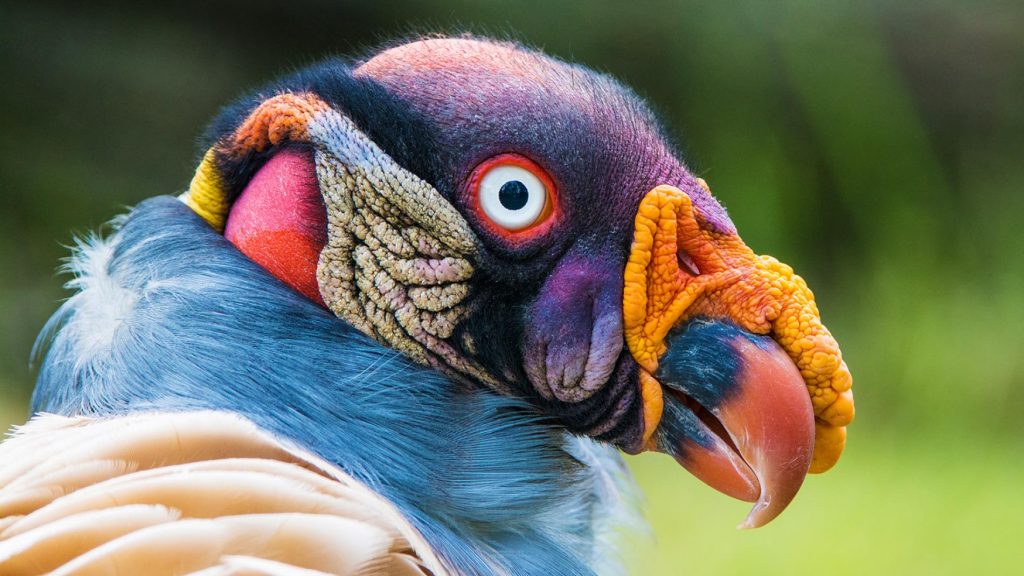
Pet Food Taster
One might expect dog foods–including canned food, dry food, bones, chews, etc.—to be tested by dogs, and maybe they are. But they’re also sampled by humans who rate the flavor and texture compared to rival brands and human food. Indeed, pet food tasting is mostly pet food testing and development. These tasters usually hold doctoral degrees, and do a lot of things besides tasting, but in the end they must smell and taste the products. Smell may be as important as taste, given that pet owners are very picky about smell—and probably don’t taste the product themselves.
Nose
And speaking of smell, being a “Nose” is an actual job in the perfume industry (and in other industries, though not as commonly) . Also known as a perfumer, a Nose must have an extraordinary sense of smell, used to select and combine elements to create designer fragrances. This job requires more talent than training. Although primarily identified with perfume fragrances, Noses in the food industry create synthetic and natural aromas to be added to prepared foods. The salary range is very broad, but the median salary (in 2010) was $68,320.
Dice and Card Inspector
Gambling is a highly regulated industry. Part of the process is having someone measure all the sides of the dice to ensure that they are equal, that the corners are square, and that they haven’t been manipulated to land on a certain number. They are also in charge of periodically destroying cards and dice. They may be employed by state authorities, casinos, or manufacturers. Best estimates of pay range from low 5- to low 6-figures.
Those gloves don’t look thick enough to stop any fangs.
Snake Milker
Technically, only mammals produce milk. So what do snake milkers collect? Venom of poisonous snakes, such as asps, vipers, cobras, corals, mambas, kraits, and rattlesnakes. This is hands on—right behind the head, getting the snake to release venom into a jar, beaker, etc. The venom is used to make anti-venoms and other medicines.
Ancient Egyptian mourners had a well-established pricing structure for their services.
Professional Mourner
In many parts of the world, both Ancient and Modern, a loud funeral is supposed to help the dead travel to the afterlife. (It is also a sign of respect from the surviving family members and a chance to display wealth.) Therefore, the crying and weeping of family and friends is augmented by the weeping and wailing of people paid to do so. Modern mourners, technically known as moirologists, can be found online and often charge per service, such as having hysterics and trying to jump into the grave.
You can also hire yourself out as a wedding guest or bridesmaid, with extra charges for making fantastic toasts or getting the dancing started.
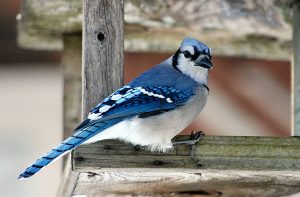
Train Pusher
As far as I know, this job exists only in Japan. These people, “oshiya,” are paid to push passengers into subway cars in order to reach maximum capacity before the doors close.
Pizza and beer not provided. Pizza shirt possibly provided.
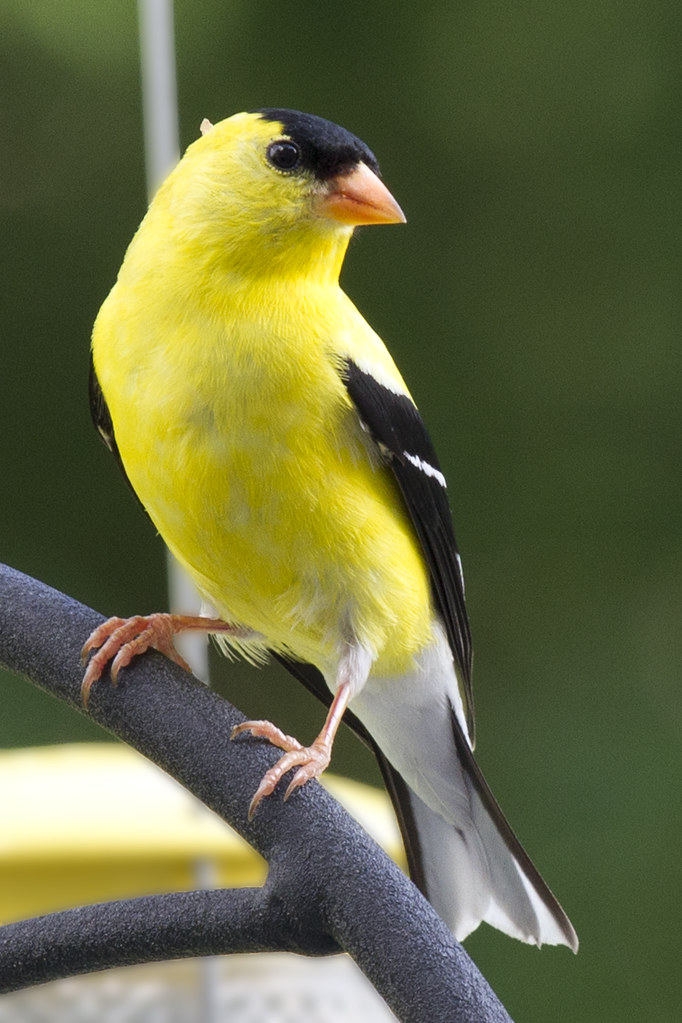
Full-Time Netflix Viewer
Yep, people are actually paid to do that. Before content is released to the public, an employee views it and assigns a tag, which aids viewers in finding exactly the type of program they want.
Drying Paint Watcher
Someone can actually earn a living painting sheets of cardboard to test how long new paint takes to dry, watching for whether it changes color or texture. Hmmm… I wonder whether a colorblind person could do that.
Not creepy at all
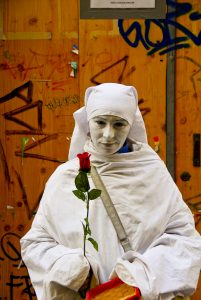
Living Mannequin
For those who have very precisely proportioned bodies and dreams of making everyone’s deepest nightmares come true, working as a living mannequin is the ideal profession. They wear selected clothes and accessories, sometimes with very specific makeup and hairstyles, and pose as part of the store display. Staying very still, staring blankly into the distance, ever-so-subtly shifting as they breathe… And now I’m off to have nightmares!
Human Scarecrows are also available to make sure no one ever runs out of nightmare fuel. They’re technically paid to keep pests out of crop fields, but that’s really just a side gig.
Some agencies offer the service for free, but they tend to shed all over the blankets.
Professional Sleeper
This is my personal favorite, though I don’t know how many hotels actually have such a person on the staff. Basically, the sleeper sleeps in a different bed each night and makes an evaluation of the bed’s comfort and how satisfying the night’s sleep was. But don’t quit your day job. A professional sleeper earns about $15,000 a year. If paid by the hour, it’s about $10.
Professional Bed Warmers perform an essential service for the most discerning hotel customers – huddling under the covers until the patron is ready to go to bed, ensuring there is no shock of cold mattress and chilly sheets. Hot water bottles and electric blankets lack that personal touch.
Professional Cuddler
These people aim to make people feel respected, accepted, and worthy by one-on-one, fully clothed, platonic cuddle sessions. Depending on the level of contact, cuddling may also be an effective treatment for skin hunger, the human need for physical contact with other people. Cuddle sessions may be preferable to professional sleeper, for cuddlers earn about $80 per hour.
Bottom line for writers: novelty and variety are good things!
Disney Princesses with modern careers by Matt Burt
These jobs might be good to consider if your protagonist is an amateur detective who keeps getting pulled into investigating mysteries. Diane Mott Davidson has done it with a caterer. Nancy J. Cohen writes the Bad Hair Day series, set in a beauty salon.
Some of the most narratively convenient jobs only existed within specific time periods
Then, too, they might be useful for a romance series. And of course, with the right framing, they could be historical. Here, in no particular order are jobs that involve meeting new people.
Teaching a Hobby or Recreation Class
Think free offerings at a library, or adult education classes such as those offered by the Shepherd Center in Richmond. These jobs bring together people who are like-minded, and often of similar ages. Teaching a memoir writing class would bring a whole different demographic from coaching a Little League team. I’d put running a summer camp in this category as well.
Private teaching and tutoring provides slightly different opportunities. Students tend to be either extremely interested or extremely disinterested in the subject. Tutoring sessions or private lessons are often held at the home of the student or the teacher, in what can be a very personal setting. Although each teaching session involves only one student at a time, a professional tutor could have a string of pupils coming through the house all day.
Food Service
Chef Jose Andres runs the World Central Kitchen to bring healthy food to people facing disasters, such as Puerto Ricans after Hurricane Maria hit or front-line workers in Queens NY fighting COVID-19.
Coffee shops have been done, but there are lots of jobs in food service, especially in small, local eateries. A broad range of people could be customers, perhaps mostly business executives who work nearby leading to international plot twists. It’s also a place where one’s protagonist can keep abreast of what’s happening in the neighborhood—where anything could be happening.
How does one carry a cocktail like to the table?
Perhaps instead of an amateur detective, your protagonist is a Good Samaritan, who publicly or secretly helps those in need. Think about the cook/chef and what food suppliers, etc., make up that circle. An independent eatery is going to have entirely different customers and employee needs than a sub-department within a larger grocery or department store. And don’t forget bartenders, who hear everything the drunk patrons blurt out.
A Book Store
Bookstore in Chongqing that defies the laws of physics
Yes, book store mysteries are already out there. But consider a specialized book store—e.g., plants and gardening, or comic books—and what that clientele might be. Or reverse it: an avid collector of XYZ books who uncovers nefarious goings on in the business, or who strives to save a struggling indie.
The Gym
And then the dancers show up at the gym…
Here again, there are options for a protagonist who is an employee OR a patron. What about the trials and tribulations, and conflicted feelings, of an employee who isn’t really fit. The local gym is a good place to learn about runs, walks, and other sports events in the area—where anything can happen. Remember the Boston Marathon bombing.
Fancier gyms might also include personal trainers, a pool, a bar, massage therapists, group fitness teachers, even towel valets. All of these services mean extra employees and usually higher membership fees. Because of the high degree of physical contact involved in many of these jobs, a gym employee may develop unusually close relationship with patrons.
Retail Sales
I mean, really, just count the ways depending on what sort of retail. The pay typically isn’t very good, which could add a whole lot of motivation to pick up other work on the side. The majority of people currently working in retail juggle two or even three jobs to be afford basic necessities. Employees working on commission typically make even less but have to behave very differently at work.
Sex Workers
Guan Panpan, famous courtesan during the Tang dynasty
A whole different set of options here. I’ve written a series of stories about a prostitute during the Civil War who unraveled the mysteries of all sorts of deaths. A modern version of that is one option. Then, too, the danger is a big factor. Whether prostitution is legal or not, there is an inherent vulnerability in such a position for any character. Suppose your sex worker is generally a good person, working to support family, and is friends with someone in law enforcement. Consider the threats to life and limb. What if your protagonist is the CEO of a ring of workers and gets involved in all sorts of things to keep the workers safe and healthy.
Marguerite Baretti, featured in The Pretty Women of Paris
Prostitution was legal and regulated in France throughout the nineteenth century. When Napoleon become Emperor in 1804, he ordered the registration and fortnightly health inspection of all sex workers in the country. Brothels had to be owned and operated by women. In 1883, there was even a tourist guide to the best brothels and prostitutes in Paris, discreetly published: The Pretty Women of Paris.
Need I say more? Keys to lots of empty houses which might house virtually anything. Going into residences alone with strangers. Etc., etc., etc.
Home Repair
Plumbers, roofers, electricians, etc. are in the unique position of working in the houses of complete strangers. Both the customer and the worker have to assume some level of trustworthiness on the part of the other. Customers open their homes to strangers who drive recognizable but easily faked vehicles, carry cases of tools (weapons), and usually go into the less-public areas of a home. Repair workers walk into the home of a complete stranger where anything might be seen or overheard, particularly from crawl spaces, attics, cellars, and other perfect spots to hide a body.
Gig Workers
Nearly every job on this list has been moving to gig work in recent years, at least in the US. Employers of large businesses encourage workers to accept part-time positions, which almost never offer benefits. Teachers, professional trainers, bartenders, caterers, home repair workers, real estate agents, and especially sex workers are increasingly self-employed.
Many people working these positions as “gigs” have more than one occupation. Ride-share drivers, delivery drivers, salespeople, musicians, writers, editors, artists, beauticians, pet sitters, interior decorators, fashion designers, childcare providers, cleaners, translators, lawn care, etc., etc., etc., I have a friend who is simultaneously a retail worker, a music teacher, a gig musician, a translator, a language tutor, a florist, and a nanny, depending on what day of the week it is. Imagine the variety of interactions a character working multiple part-time jobs might have.
Imagine the potential plot with these customers!
Bottom line for writers: And job or situation that brings your character into contact with lots of people is ripe with opportunities. Think outside the box!
Why would you want one? Let me count some of the ways.
Humor
Stress
Conflict
Tension
Novelty
There Have Always Been Crap Jobs
Fresco from a wall in Pompeii
In Ancient Rome there were puke collectors. Yep, it’s what it sounds like. Not only did the Coliseum have a vomitorium (the passage leading spectators to seating areas, not a room constructed for the purpose of vomiting between feast courses) that needed attention after major events, but during banquets guests often didn’t even leave their couches to vomit—in which cases, someone crawled around on the floor scraping up the mess. In some households, the same servant was responsible for sticking a feather down the diner’s throat to trigger their gag reflex and produce the mess to be cleaned.
They vomit so that they can eat, and they eat so that they can vomit. They don’t even consider the dishes which they have assembled from across the earth worthy of digestion.
In Tudor England, 70% of the aristocratic diet was meat, much of it roasted on iron spits in kitchen fireplaces. Spit boys turned the spits all day, every day. The work was strenuous, uncomfortable, and dangerously close to open flames and boiling fat drippings.
The Rat Catcher by Pieter de Bloot
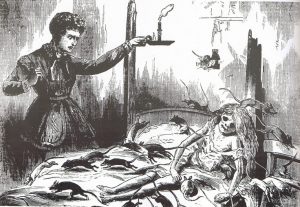
In Victorian England, there were rat catchers. Again, it was exactly as named. The streets and sewers in cities, especially, were infested. His tools of the trade were a big bottle of arsenic-based poison, a cage, and a terrier dog. Local governments paid per tail or per head. Often the rats were captured live for subsequent killing in public and/or for fights between the rats and the terriers, which afforded betting opportunities. Of course, there was always the risk of (probably infected) bites for the rat catcher.
Children made good rat catchers – they were small enough to fit into tight spaces.
Note to writers: If you write historical fiction, take care to find some of the worst jobs of the time. Details about characters working in these jobs can be a very effective way to illustrate general attitudes toward hygiene, class differences, and the overall living conditions of the poorest members of society.
Crap Jobs Still Exist
Deodorant Testers
Crap comes in many forms. Here, in no particular order, are several examples.
Low wages — People working in crap jobs often become stuck in a cycle of poverty, made worse by a lack of job security.
Elder Care is one of the fastest growing and lowest paying job markets.
Retail salesperson — Especially those who work on commission may lose out as on-line shopping booms.
Taxi drivers — Here the major factor is competition from potential clients using ride-share apps such as Lyft or Uber.
Correctional officers — State and federal budget cuts influence hiring and retention, especially as governments switch to private prisons with an emphasis on profit over safety.
Forging weaponry for the Orcish armies of Mordor is no longer a viable career path.
Jobs in steep hiring decline — The common thread among many modern crap jobs is that technological advances have depressed the need for people producing their goods or services.
Logging worker
Newspaper reporter
Disc jockey
Photographer
Buyer for grocers and other wholesalers
Advertising salesperson
Broadcaster
Retail salesperson
Copy editor
Orchestral musician
Machinist
Assembly line worker
Coal miner
Secretary
Telephone operator
Stress factors — Even a well-paying job can be a crap job if it includes tight deadlines, physical demands, and danger.
Writers note: you may already have characters with some of these jobs. Consider more focus on the crap factor.
I don’t think this is standard operating procedure…
Food server
Chef
Broadcaster
Nuclear decontamination technicians
Police officers
Fire fighters
Emergency medical technicians
Enlisted military personnel
Roofer
Welder
Water transportation worker (direct and maintain ships and boats)
Brickmason
Truck driver
Construction worker
Dockworker
Bus driver
Painter
Cruise ship personnel
Boredom — See my earlier blog on sources of boredom. Here are a couple of examples that might not immediately come to mind, as well as a few more obvious ones.
This job looks simultaneously terrifying and terribly boring.
Hair follicle counter— This is a job position in a company developing hair regrowth products. During clinical trials, the counter must establish a baseline and then monitor progress by counting the individual hair follicles in one square inch of scalp.
Research assistant to a scientist studying learning behavior in Eastern box turtles — This person sits on a bar stool and overlooks a T-maze. At the end of one arm of the T is lettuce, blueberries, and other food the turtles like. At the end of the other arm is a drop-off into a box of shredded paper. Research questions: will turtles who look back and forth more often at the choice point before following one arm or the other (VTEs) learn the correct direction faster? The assistant’s job is to record the amount of time from the starting point to the choice point, count the VTEs, record whether the choice was correct or not, and record the total time of the trial. Vigilance is required, even though some individual trials can take over an hour.
Frozen pea tester, checking the temperature of peas on a production line
Bookmark string threader
Milk bottle squeezer, making sure bottles aren’t leaking
Label sticker, who puts labels on packages and envelopes
Tablet picker, picking out broken bits before packaging
Beetroot pickling line cleaner, picking up the rotten bits that have been thrown on the floor from the production line
Sign holder/Human sign, holding or wearing advertising or directions
Note to writers: this list is almost endless. Look online.
Keeping Disneyland clean after all those Princesses ride past in their horse-drawn carriages looks so fancy!
Vomit collector — Although puke scrapers per se are no longer with us, the modern day equivalent is the person who cleans up vomit on and around rollercoasters and other such rides.
Pest control worker — Besides dealing with roaches, rats, termites, snakes, etc., they are exposed to pesticides and often have to crawl into cramped spaces.
Pee collector — Pee is collected from many species (e.g., orangutans) for scientific research. Then, too, deer urine farmers collect pee and sell it to hunters who hope it will attract other deer.
Manure inspector — This involves collecting farm animal poop to test for contaminants harmful to vegetation, other animals, or the consumers of these vegetable and animals.
Barnyard masturbator — These workers spend their days giving hand-jobs to animals to collect the sperm for artificial insemination. Insemination the good old fashioned way is sometimes considered too risky for extremely valuable animals, thoroughbred race horses for example.
Odor judge — Basically, these people use their noses to evaluate and chemistry to adjust smells for commercial products, everything from prepared food to armpits, cat litter, feet, breath fresheners, disposable diapers. . .
Singaporean sewer diver
Hazardous waste disposal worker — These are people who collect the biomedical waste—everything from needles and swabs to amputated limb and extirpated body parts—and incinerate it. It is said to smell like “a combination of burning rubber, bad body odor, and smelly feet.”
Hazmat diver — That’s diver, not driver. Hazmat divers do things like maintain underwater valves and land fill pumping equipment or work in septic tanks. Besides the risk of finding a body, such workers must have an enormous series of vaccinations for various diseases, and must decontaminate after every dive.
Forensic entomologist — This is an insect specialist who helps collect evidence from dead bodies. You might be familiar with this job from watching crime shows on TV.
Crime scene cleaner — This work begins after the bodies and evidence are removed. It may involve blood, body fluids, etc. They also clean up after accidents and unattended deaths.
Sewer cleaner — Making repairs, clearing drainage and sanitation lines, sometime up to their armpits in all the things one would expect in sewers, plus the occasional dog or other animal.
Crap Jobs in the Time of COVID-19
Because of special circumstances associated with the pandemic, jobs that might otherwise be low on the crap index are suddenly topping the list. Despite being told to stay at home and interact with as few people as possible, some jobs still need to be done. In addition to generally low pay, boredom, stress, regular phyisical danger, these employees now face frequent interactions with possibly infected people, extra duties to cover for colleagues out sick or quarantines, and dealing with a particularly irate (often abusive) public.
Employers don’t provide health insurance, paid sick leave, paid family leave, or childcare allowances for the majority of these employees. And no one brings them free lunches or sings their praises from the balconies at night. Dr. Ben McVane posted on twitter, “Many of my patients work jobs classified as essential, be they cab drivers, construction laborers or delivery workers, without receiving any essential protections or job security.”
Amazon walk-out
Now, because of Covid-19, we’re being told that Amazon workers are “the new Red Cross”. But we don’t want to be heroes. We are regular people. I don’t have a medical degree. I wasn’t trained to be a first responder. We shouldn’t be asked to risk our lives to come into work. But we are.
Many restaurants are almost entirely dependent on delivery.
Grocery store workers
The people unloading trucks, stocking shelves, and ringing up customers are working much longer hours at a more frantic pace than normal. Additionally, grocery store employees take the brunt of customers’ anger when the stress of daily life meets a lack of hand sanitizer on the shelves. Many large grocery chains have forbidden employees from wearing gloves or masks at work for fear of spooking the customers.
Warehouse loaders
Online shopping has surged in the past few weeks as retail shops have closed. Workers in online shopping warehouses are being made to work longer hours at a faster pace, often in more crowded conditions as employers hire more people to meet increased demand. Conditions at Amazon warehouses have gotten so bad that employees held a walk-out this week at the New York warehouse.
That’s one way to stay safe while delivering food. I guess.
Food deliverers
Rather than going out to eat or to grocery stores to buy food, people are using networks that employee people to deliver food right to the door. Restaurant delivery drivers have to go in and out of the restaurant and interact with potentially infected customers for their entire shift. Companies like InstaCart allow customers to pay someone else to go into the grocery store to gather their purchases and then deliver them, often forbidden to wear the most basic of protective gear.
Drivers
Cab drivers and ride-share drivers (Uber, Lyft, etc.) are seeing an increase in business as more people are told to avoid public transportation. However, this means the individual drivers have complete and possibly infected climbing in and out of their cars all day, sharing a confined space. The vast majority are still classified as contract workers and so receive no insurance or sick leave from employers.
Truck drivers
Goods still need to travel from the warehouse to the consumer, even if the drivers are exhausted (driving-hour standards have been relaxed) and taking on longer routes farther away from home. Factor in the drivers who have already tested positive or entered quarantine, and those hours behind the wheel get more and more exhausting.
Bottom line for writers: a job can be crappy in more than one way, so consider all the angles when you write crap!
Whatever this guy’s job is, having Kim Jong-un looking over his shoulder has to make it one of the most stressful and dangerous jobs imaginable.
The best thing you can do to help is avoid spreading the virus. This building in South Africa has a subtle hint about how you can do that. (AP Photo/Nardus Engelbrecht)
By this time, I would bet that nearly everyone on Earth has been touched one way or another by COVID-19. Global pandemics are an unfortunate experience that unites all of humanity. Similarly, medical providers around the world have been called upon to step up, just as they would in any similar event whether historical, fantastic, or science fictional.
We’re all in this together. Let’s not be that guy.
Nurse Green treating consumption patients in a New York sanitorium in 1843, Doctor White treating AIDS patients in Zimbabwe in 1997, and Healer Black treating bubonic plague patients in Constantinople in 546 all have the same general goals and similar biological challenges.
Medic Silver treating space plague in patients on the Third Moon of Alpha Centauri is likely to find xirself facing the same situation.
Doctors, nurses, aids, technicians, assistants, medics, and medical workers of every other kind have been making this plea, posting photos from all over the world. (Richmond, Maryland)
For most of us, all but urgent care medical appointments have been postponed or cancelled. Even urgent care has changed drastically. I recently had an appointment for a root canal in a nearly empty clinic. The receptionist told all patients to wait in their cars until called, and only the dentist, his assistant, one office worker, and I were in the building the entire time I was in the chair. Of course, most of us see these changes from the perspective of the patient. What about the providers?
Philadelphia
A chiropractor who has a one-man practice told me that so many patients are canceling (or not making appointments in the first place) that he is worried about what’s happening to his personal income, and whether he can continue to pay his one office worker. My dentist is the head of a small practice (fewer than 50 employees) and he said the same thing: trying to keep the practice open and employees paid when they are seeing only urgent care cases. A dental assistant, recognizing that the practice is vulnerable, worries that she won’t be able to pay the rent.
Malaysia
These people are the tiniest of samples and most would agree they aren’t front-line workers in this pandemic. For that perspective, I am fortunate to have a colleague who lives in a veritable nest of doctors, nurses, medical students, and first responders, and here are things they had to say.
Israel
Is this sort of thing what you had in mind when you applied to med school?
Australia
Absolutely not. When I went to medical school, I thought I wanted to go into surgery, but I realized that I hated rounding and getting dressed up. As far as the current pandemic, I don’t think anyone envisioned something like this. We haven’t had anything close to this since 1918 with the Great Influenza Pandemic. And in probably every humans’ mind, medical care has advanced so much since then. How could anything like that happen again?
Not at all. I had visions of helping patients overcome their physical or medical disabilities so they could live their lives. Now I am at the frontline of protecting about 100 elderly, disabled patients who were recently hospitalized for other reasons and are now at risk for coming down with COVID-19. We have already diagnosed it in quite a few of our patients. It is likely many of the others also have it but only mild or asymptomatic cases. However, they are still contagious, and we must be extremely careful so we don’t spread it around to other patients, ourselves, and our families.
Italy
I always knew working with high-risk patients meant that I would be saying a lot of good-byes, and I thought I was okay with that. I could at least make them feel a little bit better, maybe smile a little. But now I feel like I’m saying that final good-bye every time I leave a patient’s house. Like, will this person even be here the next time I come over?
Pretty much, yeah. I always knew the communities where I wanted to work would be full of infection and contagion, without a lot of medicine or cleaning. But there was always something I could do, yeah? Now there’s no medicine, no vaccine, no ventilators, nothing but me in the same mask I’ve been wearing for a week and trying so hard to convince families that grandmother must stay away from her grandbabies.
Nope. I think a lot of this is media driven. And people fear arguing against safety. But being too safe can have its own trade off and risk other forms of safety.
If we did not want that responsibility, we would not have chosen this career path.
Chile
In general, how do you avoid bringing work stress or infections home?
Not bringing infections home is easy. The scrubs I wear for work stay and get laundered at the hospital. I have separate shoes for the hospital which stay in my office. And I use hand sanitizer before I leave the building. We deal with some pretty nasty resistant bugs at work. I don’t need to bring that home to my wife and daughters. I try not to let work get to me. I try to make sure everyone is having fun at work, so it keeps my stress level down. But even with that, it can build up.
Jordan
It’s been tough, lately. I cry every night. I try not to, but I see so many people sick and nothing I can do. I never let my family see me.
Showers when I get to work and before I leave work. There’s a clean line between my two lives. I don’t bring any of that culture home with me. No stickers or special license plates on my car, just the parking decal.
The key to avoiding bringing infections home is the same as avoiding spreading it at work, always good hygiene and using protective equipment. There really is no difference. And as long as I work as hard as I can and do the best I can, stress is not an issue. Only fatigue, which comes to anybody who works long, hard hours.
Sudan
Do you prioritize symptoms, patients, contagion, contact, etc. differently now?
It used to be mostly elective or scheduled operations, so we had time to make sure patients are prepped and optimized for surgery ahead of time. On the bus [ambulance], we don’t get to pick and choose our patients. They call us when they are in their worst time. There’s a big difference between a sterile operating room, and the side of the road at 2am. But in the end, a patient is a patient. It’s about the ABCs and then go from there.
India
Patients have prioritized themselves differently. Nobody will come to the clinic if they can find something else to do. I had a girl come to my house with a broken arm because her parents did not think she should be risk being exposed.
PPE is at a premium. At work, I’m reusing my N-95 masks between patients because otherwise we’d run out. But if I have to intubate a known or suspected COVID patient, we are in full protective gear to include a respirator. We do have new protocols in place for use of PPE on the ambulances when we suspect a COVID patient.
So far we do not have to prioritize anything other than can they leave their room on a closed ward? Should they be cohorted with someone else who also has the virus? Many of our patients have other contagious diseases or infections; we must be careful.
Actually less people are calling 911. Looking at the county stats the call volume has dropped 10-20% over the past month. Generally you can look at a person and tell if they are in distress or not. There used to be a lot of people who called for help when they just wanted a ride. I typically deal with one patient at a time.
Wales
What behaviors in the general public infuriate you from a health care view (at any time, not just now)?
I used to get really worked up with people smoking. There is so much data about how bad smoking and drugs are for you, yet young people still start using them. But I realized I can’t change everyone, and it would just cause me undue stress. So I just focus on who I can help in front of me. I also realize people are going to make their own choices, good or bad. All I can do is give them the information and hope they listen to it.
India
There are so many people who are just forgotten about and so they have no one to help them. They are stuck at home because they are old or no one will talk to them because they are weird or whatever. And then they are sick and no one knows because no one thinks to go and check.
People get a little bit of information and then suddenly they’re the expert and telling everyone else what to do and then people actually do it! Or they follow what the aunties say to do, even if it makes no sense, just because no one wants to upset the aunties. Like, drinking fever tea is not going to cure COVID-19, even if it makes your fever feel a little better.
The only behavior that infuriates me is when I see people carelessly congregating and likely spreading the virus but acting as if it is a joke. It’s infuriating because they are then passing it on to even more possibly highly vulnerable people who have nothing to do with their irresponsible behavior. Otherwise the public’s behavior does not infuriate me. I feel very bad for family members who are not allowed to visit their family members. Must be terrifying being in such a helpless position. When they get obviously upset or even angry, we know it’s understandable.
When a crowd gathers to watch a hospital ship that has come to help with a quarantine, that kind of defeats the purpose….
Passing the liability on to others. “Oh my insurance or doctor said call 911.” And the fact that life is not sunshine and rainbows. Just because you’re not feeling well doesn’t mean you’re going to die.
Jakarta
Have you changed your routines at home or work in the past few months?
I always believed that the immune system is something that needs frequent practice to be strong, and I still do believe that. But with COVID-19, the game has completely changed. I’m now washing my hands much more frequently, or using hand sanitizer whenever I touch something public in the hospital. I wipe my desk, computer, phone, and ID badge down with a sanitizing wipe before I leave work. And I always wash my hands when I walk into my home first thing before I do anything else.
Patients who used to come to me for stomach virus and insulin checks stay far away from the clinic now, especially the pregnant ladies. Now I see only people who are afraid they have coronovirus or that their aunties have coronovirus.
Malaysia
I share a flat with other medics, but I’ve moved back into my parents’ house, where the cellar has a separate washroom and entrance. It’s easier to stay isolated there, even if it’s a longer commute.
In the past two or three weeks our entire day has changed. We do not focus as much on the primary reason the patients are with us, which is to be evaluated and treated for various disabilities. Instead, we are more focused on signs or symptoms suggesting that they may be coming down with the virus. We don’t want to miss them for their sake, and for the increased risk of them spreading it to other patients and staff.
I definitely pray a lot more. I’ll admit it’s a little strange to see His Holiness over video broadcast in an empty room, but it’s very nice to know that I’m not alone to say the Rosary even when I can’t go to Mass here.
Stepped up the disinfecting. And wearing more healthcare protective equipment. We don’t got in nursing homes unless they can’t be brought outside. And we tell people to meet us outside.
I spend more time at each house because a lot of my patients aren’t having any other visitors. All the community outreach stops at the front door now.
England
Have you seen anything good as a result of the recent insanity?
I try to focus on the good, but it’s so hard when there is so much bad. I guess… traffic is fantastic now. I think everyone is trying to do their part to support local restaurants and businesses. Most people seem to want to do the right thing.
Italy
With so many people made to stay at home, I think a lot of families are spending more time together. And everyone seems to be thinking up some way they can help, kids giving birthday money to shelters and medical students doing childcare for health workers.
Communities are recognizing that shop clerks, drivers, cleaners, they’re all absolutely necessary. It’s not just the politicians and rich folk who matter. Where would we be without rubbish clean-up and food delivery?
Difficult times like this often bring out the best that is already in people. The best has been in them all the time, but now they are expressing it and experiencing it more.
People are learning that hospitals are disgusting places and that there are risks in going to them.
Kenya
Is there anything you wish management, government, media, or whomever would do differently?
All those different entities do so many things wrong, it’s hard to know where to focus. I’ve learned for the most part that there is little that I can affect on a large scale, such as with government or the media. So I tend to not pay attention to either much.
Armenia
Some countries have been able to mobilize testing of millions of people very rapidly. It would help us to determine who has already had the virus and is very low risk for acquiring it and passing it on, and is therefore fairly safe working on the front lines. They can also get back to work in what is currently called nonessential businesses. Without enough testing, we are fighting this battle blindfolded.
Why do travel companies keep offering cheap tickets?!
The media has been distorting the message. We keep hearing how certain drugs have not been approved for this virus, but really nothing has been approved. That doesn’t mean we shouldn’t at least try. About 20% of all medications used have not been approved for the thing doctors are prescribing them for. This is called off label use and we use this approach all the time for many medications. For a governor to ban certain medications because they have not been approved is the same as practicing medicine without a license.
India
The amount of bad information floating around is so dangerous. I understand that people are scared and no one has all the answers, but I wish people would stop telling things that aren’t true. Washing your mouth with bleach, drinking boiling water, filling your room with smoke… No, don’t do these things.
I wish there was more reliable information available in every language. My neighbours like to assume that, because I speak English, I have all of the answers that are being hoarded by British and American doctors.
It’s become a social and status symbol to say that you’ve been tested or have it. No one cares. Just stay home.
Hawaii
What keeps you up at night?
The one thing that has kept me up at times is when I have a patient that has a complication, whether I contributed to it or not. I tend to “Monday Morning Quarterback” every little thing I did and blame myself even when it’s not my fault.
Holland
Nothing currently keeps me up at night. As long as I do my best in my family is okay, I sleep well. It’s been a long time since I’ve been unable to sleep.
I worry about the people no one seems to help – the families who can’t get food, the people stuck behind barricades, the old ones left at home with no neighbors to check on them.
Dead kids tend to make it harder to sleep for a while.
Philippines
The question we all really want to ask: How do you keep your hands from drying out and cracking when you wash them every twenty seconds?
Nantucket
Make sure you rinse really well. Little bits of soap film, especially in the knuckles or between your fingers, can cause irritation.
Soap and water is so much better than hand sanitizer. The alcohol in hand sanitizer is usually what dries out skin. Plus, soap and water is more effective.
I’ll skip defining boredom. It’s so common that it doesn’t need definition, any more than hunger or sunlight. Nearly everyone feels bored at one time or another, more or less often, sometimes daily. Men, in general, are more often bored than women. And people with little education are more likely to report being bored. As with nearly everything, there are two sides to boredom.
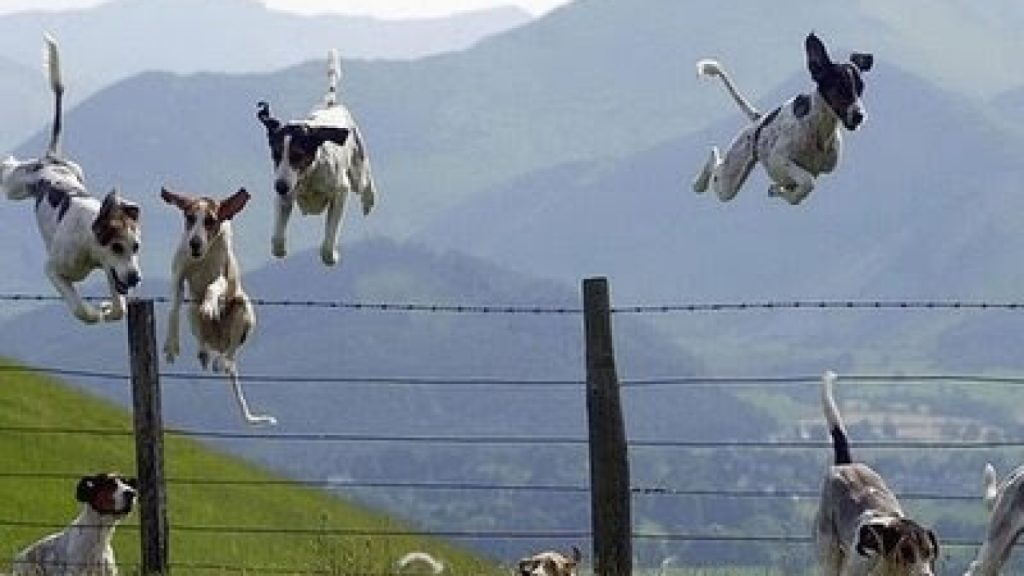
Sometimes it’s hard to tell if they’re bored or if they’re just being dogs.
1. MonotonyintheMind — When people are not interested in the details of the task at hand, or when a task is highly repetitive, they are likely to feel bored. We lose interest in things that are too predictable, too much of the same thing, too little stimulation. This can often lead to feeling trapped.
Piracy is just so dull sometimes.
2. LackofFlow — Flow is total immersion in a task that is challenging but within one’s abilities, a task with clear goals and immediate feedback. Tasks that are too easy are boring. Tasks that seem to be too difficult may lead to anxiety.
3. Need for Novelty — People with a strong need for novelty, excitement, and variety—i.e., sensation seekers—are at risk of boredom. For these people, the world moves too slowly. The need for external stimulation may be why extroverts are particularly prone to boredom, which they try to cure by novelty seeking and risk-taking.
4. PayingAttention —What bores us never fully engages our attention. After all, it is hard to be interested in something when you cannot concentrate on it. People with chronic attention problems, such as attention-deficit hyperactivity disorder, are more likely to suffer boredom.
5. Emotional Awareness — People who lack self-awareness are more prone to boredom, unable to articulate what it is that they desire or want to do. They have trouble describing their feelings. Not knowing what we are searching for means that we lack the capacity to choose appropriate goals.
6. InnerAmusementSkills — People who don’t have the inner resources to deal with boredom constructively rely on external stimulation. In the absence of inner amusement skills, the external world will always fail to provide enough excitement and novelty.
7. LackofAutonomy — People often feel boredom when they feel trapped. And feeling trapped—stuck or constrained so that one’s will cannot be executed—is a big part of boredom. Adolescents are often bored, largely because children and teenagers don’t have a lot of control over their schedules and activities.
8. The RoleofCulture — Boredom is a modern luxury. As the Enlightenment was giving way to the Industrial Revolution in the late 18th Century, boredom came into being. When people have to spend most hours of the days securing food and shelter, boredom isn’t an option.
The Upside of Boredom
Boredom does have its benefits. It is a “call to action.” Nietzsche suggested that men (sic) of rare sensibility value boredom as an impetus to achievement. So…
1. Boredom can be a catalyst for action.
2. It can provide an opportunity for thought and reflection, a search for life’s meaning.
3. It can also be a sign that a task is a waste of time—and thus not worth continuing.
4. Boredom can spur creativity.
Challenges for writers:
Writing boredom in an engaging way
Choosing ways for characters to handle boredom that forward the plot
Milking boredom for tension and/or emotional acting out
One of the side effects of COVID-19 is that many people have more unstructured time than usual—much more. By unstructured time, I mean periods of time with no plan in place for what one must/wants to get done
Poking everything with a stick does not count as a plan.
(Note:getting into mischief is not a healthy goal.)
Stretches of unstructured time often bring pressure and anxiety, sometimes existential panic.
Worrisome thoughts are more easily set aside when busy. But with unstructured time, it’s easy for self-doubts to come to the fore.
Am I too fat?
Have I done a good job as a parent?
Will anyone remember me when I’m dead?
When we have lots of time available, it’s easy to procrastinate. One can fritter away the time, flitting from one indulgence to another, from reading a novel to online shopping. Come the end of the day, one then feels guilty for not having been productive—or not productive enough. The feeling that one has “wasted time” is uncomfortable.
Lithuanian Military photographed by adasvasiliauskas
Being constantly on the go is often linked to self-worth—in which case not being productive leads to low self-esteem, as in “I’m a failure” or “I’m lazy.”
Making the most of every minute of every day isn’t recognized as an impossible, not to say unhealthy, goal.
Don’t let fear drive you to hide away in a box.
When deprived of the activities that usually fill our days, we often drift into unhealthy activities.
Being physically inactive
Drinking and/or smoking more
Snacking and/or eating too much
Online gambling
Binge shopping
Structure can keep you from climbing the walls… or windows.
Being suddenly confronted with unstructured time can be disorienting. This is often true of the newly retired. Regularly scheduled activities—which could be anything from work to volunteering, golf or poker to orchestra rehearsals—make people aware of the time of day as well as days of the week or month.
For me, COVID-19 cancellations make every day feel like Monday, my formerly “free” day. I have to pause and think what day of the week it is.
Make sure to change out of your pajamas every day. I recommend formal gowns for coloring time.
Also, the “natural” day for humans isn’t exactly 24 hours: it’s somewhere between 24 and 26 hours. We reset to 24 hours based on outside constraints. My personal day is longer than most, and it’s easy to stay up and wake progressively later and later—say 3:00 to noon. For those on lock-down due to COVID-19, with no scheduled activities, the time of day might feel “off.”
The short solution to all these negatives is simple: make plans. Keep the list of plans brief — say three — and doable. The plans could be relaxing activities such cutting flowers, taking a walk, etc. The idea is that making plans decreases the likelihood that you’ll pass days in haphazard activities or listlessness.
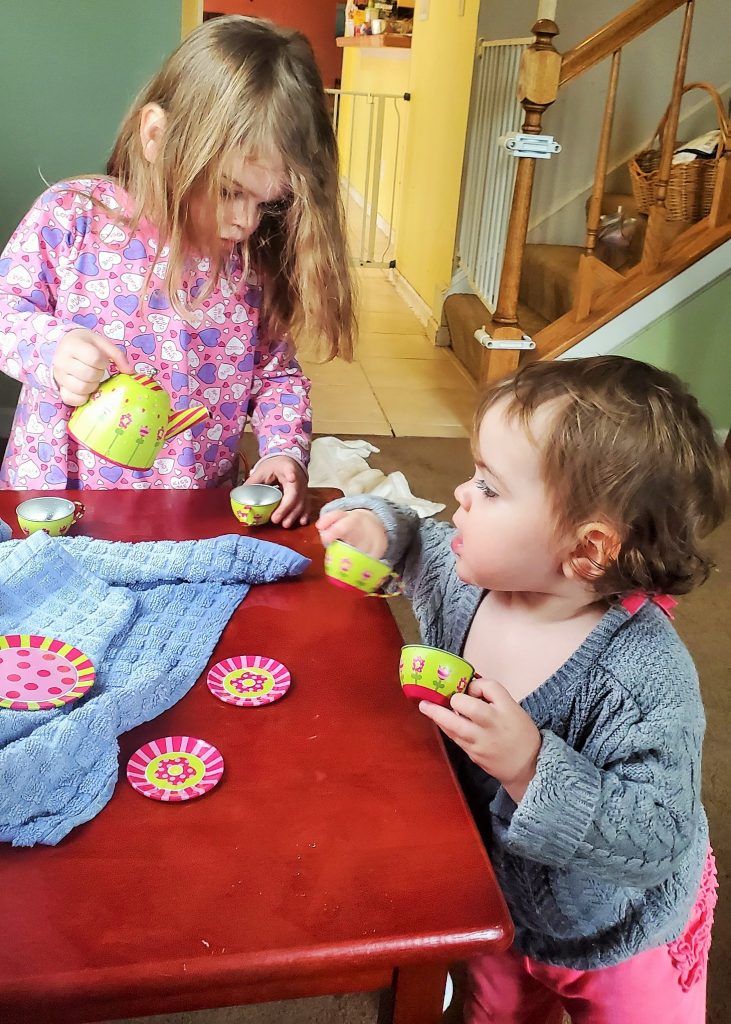
Enjoy an elegant tea party with inanimate friends!
Astronauts, being experts in the field of isolation, have offered some advice to those of us down here on the planet.
Keep a consistent sleeping schedule
Go outside and get some sun, so long as you do it by yourself
Separate work and leisure time, if you still work from home, so that one does not overtake the other
Stay in touch with people online or over the phone
These astronauts seem to have missed the rule about staying 6 feet apart.
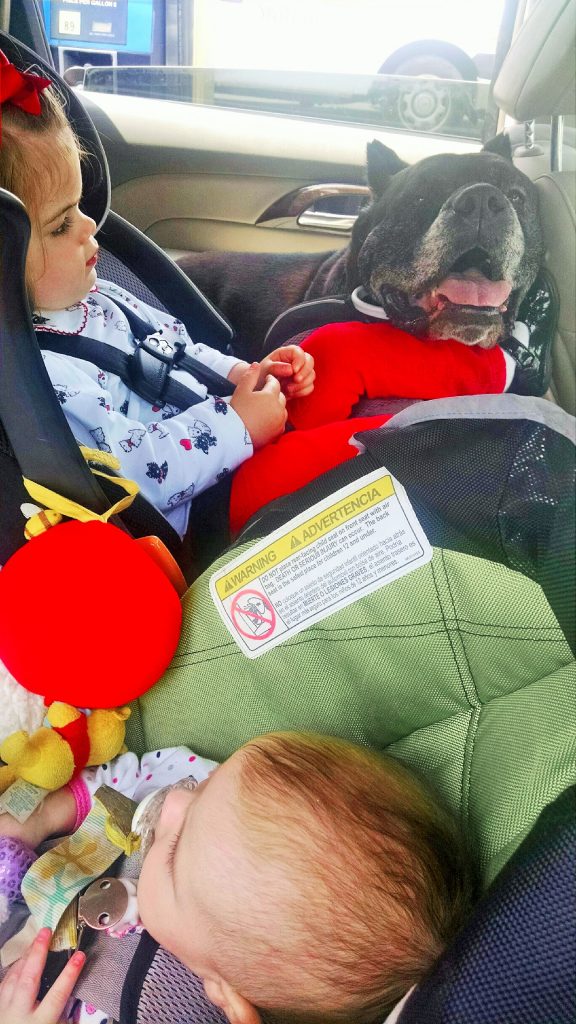
(Don’t worry; the baby isn’t sitting on the dog while reading to him… not that he’d notice if she was.)
As more people are staying at home, many organizations are creating virtual activities to keep your mind active. You can take a virtual tour of a museum or national park,audit classes in a variety of subjects, join exercise or meditation groups, watch ballets or operas or Broadway shows, even have a cocktail or movie party with your friends! If all else fails, there are ways to help your community from the comfort of your living room.
OpenCulture has gathered many of these links to allow people to browse their options.
To fix the growing shortage of protective gear among healthcare workers, many people have started making face masks for local hospitals and fire stations.
Coursera is currently working with many universities to allow students to earn college credit
Many independent, foreign, classic, and documentary films are available to watch online for free
One of my favorite guest bloggers has agreed to provide her always unique perspective on current events. With all that’s been written on the current pandemic, we sometimes need to take a step back and look from a (very) different angle. Kathleen Corcoran is a local harpist, teacher, writer, editor, favorite auntie, and tenuous believer in the goodness of humanity.
Whenever society collapses (or maybe wobbles a bit), we seem to see the extremes in people come out. The very best of heroes stand up, and the very worst villains take advantage. As the late, great Sir Terry Pratchett wrote in Good Omens, “Where you found the real McCoy, the real grace and the real heart-stopping evil, was right inside the human mind.” Of course, disaster also sometimes brings out the very weirdest elements…
Note: The examples provided below are by no means a comprehensive list of incidents. They represent my own personal opinions and are not endorsed or promoted by any other entity.
Volunteers at the Sunnyvale Community Services food distribution site (Karl Mondon/Bay Area News Group)
The Best Side of Humanity
During the Plague of Justinian, the official Court Historian Procopius kept notes on how the plague affected the Roman Empire. In addition to some rather bizarre medical theories, he saw the way the plague brought out the very best of humanity. “[T]hen all, so to speak, being thoroughly terrified by the things which were happening, and supposing that they would die immediately, did, as was natural, learn respectability for a season by sheer necessity.” From History of the Wars, II.xxii–xxxiiitranslated by H.B. Dewing.
One constant in every disaster is the appearance of some form of healthcare worker, whether professional or volunteer, providing care for patients despite personal danger, overwhelming circumstances, inadequate supplies, exhaustion, and every other possible obstacle.
As far back as the Plague of Justinian, the court historian Procopious wrote about the exhausting and selfless labors of those who cared for plague patients, though it seems the main job of a nursing aid at the time was stopping their patients from committing suicide before they died from the plague: “When they were struggling to rush headlong out of their houses, they would force them back by shoving and pulling against them.”
Elsie Maud Inglis started a women’s medical corps during WWI and established two hospitals on front lines. When the German army advanced, she was taken prisoner with her patients rather than be evacuated. During a later prisoner exchange, Elsie Inglis refused to be released unless her captors also released her patients, saving 13,000 injured Serbian POWs.
During the 1918 Influenza Pandemic (sometimes called Spanish Flu), the ease of infection and limited hospital space resulted in incredibly high mortality rates among everyone who worked near the sick. Stories emerged after of nurses working straight through their shifts only to die at the end, of medical students taken out of classes to run entire hospital wards, of doctors continuing to direct care rotas despite being confined to bed themselves.
Corporal Desmond Doss repeatedly ran into enemy fire to recover wounded soldiers as a medic in WWII. Despite refusing to carry any weapon as a conscientious objector, he saved nearly 100 wounded soldiers under fire and was awarded the Medal of Honor.
After running 26.2 miles, many Boston marathoners who crossed the finish line after the 2013 bombing continued running several more miles to Massachusetts General Hospital to donate blood.
Despite having been hit earlier by Hurricane Katrina, Cuba was one of the first countries to offer aid to the US victims of the hurricane, offering to send 1,586 doctors and 26 tons of medicine.
Kellan Squire, an ER nurse who ran for Lieutenant Governor of Virginia (in part to fix the healthcare system) has this to say about healthcare workers in the current pandemic: “We’re going to get infected, we’re going to die and get ICUed at a rate a few times above other subgroups, we’re going to charge in without the resources or support we need to do our jobs. It’s just what we do. It’s not like we’re going to stop… especially now.”
Despite facing serious threats to themselves or their families, there are always people who are willing to face that danger in order to aid or shelter others.
Ninety percent of the Jewish population of Denmark survived the Holocaust because nearly the entire Danish population worked together to hide or evacuate their friends and neighbors when the Nazis invaded.
In 1943, hundreds of non-Jewish women married to Jewish men who had been deported gathered every day at the Rosenstrass e 2-4 Welfare Office to demand the release of their relatives, risking harassement, arrest, and execution while completely unarmed themselves. The “Rosenstrasse Protest” was successful; all of the arrested men were released, and the protesters faced no repercussions.
In Kenya in 2015, al-Shabab terrorists started a pattern of entering an area, separating Muslims and non-Muslims at gunpoint, and then massacring all of the non-Muslims. A bus leaving Nairobi in December was boarded by terrorists who demanded that the passengers separate by religion, but Kenyan Muslims on board refused to move, sheltering their fellow riders in their ranks. The al-Shabab terrorists eventually left without firing a shot.
The families of Sarajevo business partners Yosef Kavilio and Mustafa Hardaga wound up saving each other, decades apart. In the 1940s, Mustafa Hardaga and his wife Zejneba hid the Jewish Yosef Kavilio and his family in their cellar. Decades later, in 1992, Kavilio’s descendants in Israel saw on television the danger Zejneba Hardaga faced from Bosnian troops. The petitioned the Israeli government to locate Zejneba and her daughter, who were safely evacuated to Israel.
Sometimes doing the right thing means deliberately disobeying laws or going against direct orders from a superior.
Dominican Friar Najeeb Michael, who was in charge of digitizing thousands of ancient volumes of Iraqi history, refused to leave his abbey in Mosul when ISIL invaded. Instead of evacuating immediately as his superiors orders, he kept boxing up and moving cases of books to prevent them from being destroyed. Even when he finally started to leave the city, he kept stopping his car to children and disabled passengers on his way to safety.
Hugh Thompson was a helicopter pilot in Vietnam who landed his helicopter between American soldiers and the fleeing residents of My Lai, threatening to open fire on the soldiers if they did not stop killing civilians and destroying homes. He then flew dozens of survivors to receive medical care. Despite direct orders to cover up the My Lai Massacre, Major Thompson cooperated fully with the investigation into the incident. He was later ostracized by fellow military members, receiving anonymous death threats and mutilated animal bodies left on his front porch.
Tibor Rubin repeatedly broke out of North Korean POW camps to smuggle food back in to fellow prisoners. He also provided medical aid to other POWs, using skills he picked up while surviving Mauthausen concentration camp during the Holocaust
In 1944, Nazi ships tried to round up all of the Jews in the Ionian Islands of Greece. When the SS demanded that Mayor Loukas Karrer of Zakynthos provide a list of all Jews on the island, Bishop Chrysostomos handed them a list with two names on it: Mayor Loukass Karrer and Bishop Chrysostomos. Meanwhile, the 275 Jews on the Zakynthos were hidden by residents of nearly inaccessible mountainous villages; every person on the island collaborated in saving their Jewish neighbors.
The Edelweiss Pirates was a loosely connected network of ex-Hitler Youth, mostly between the ages of 14 and 18, who did everything they could disrupt the Nazi war effort in Germany, including blowing up railways and helping Jews escape execution.
Sergeant Dakota Meyer was ordered to ignore a distress call at Ganjigal and to fall back instead. He drove into the battle zone five times, transporting wounded soldiers in his Humvee and providing cover fire for other military personnel to escape.
Dr. Albert Battel was a lieutenant in the German army who stopped the SS from entering Przemysl ghetto in 1942. While the SS was stalled trying to get through the blocked bridge, Lieutenant Battel and his unit moved families out of the ghetto and hid them at his own Army headquarters, preventing the SS from deporting them to the Belzec Extermination Camp.
With the stock market practicing pogo moves, kids needing extra childcare, people missing shifts, and every possible industry seeing some kind of disruption, it’s still amazing to see businesses putting the good of the community over profit.
Zahid Iqbal has donated and delivered thousands of “coronavirus kits” from his convenience store in Edinburgh, Scotland. He and his employees have made the kits from toilet paper, antibacterial handwash, tissues, and anti-inflammatories and then brought them to retirement homes and the homes of at-risk neighbors.
Healthcare workers in America are facing a serious shortage of Personal Protective Equipment (PPE), putting them at additional risk of infection while they work. Several medical tv shows are donating PPE used on sets (still sterile boxes of gloves, face masks, surgical gowns, hairnets, etc.) to EMTs, fire stations, and hospitals.
There are some very creative methods of giving back to the community and helping society that take a specific blend of available talent and courage to perform.creative methods of giving
Chef José Andrés closed all of his restaurants in DC to comply with restrictions on social gatherings. With empty kitchens and refrigerators full of food, he decided to go back to work making packaged meals to distribute to people in quarantine, healthcare workers, and anyone else in the area who needs help feeding their families.
Other restaurants that have to close for social distancing are donating massive amounts of food (as well as cooking and packaging supplies) to local food banks, shelters, Meals on Wheels, and community kitchens.
Chiari Hospital in northern Italy needed ventilator valves to help COVID-19 patients breathe. Engineers from Isinnova collaborated with the 3-D printing company FabLab to produce replicas of the valve quickly, allowing the ventilators to stay in use.3-D printing ventilator valves.
Musicologist Ahmad Sarmast graduated from school and then returned to his native Afghanistan to record oral musical traditions he feared would be lost in chaos and uncertainty. Along the way, he started teaching girls to play orchestral instruments in defiance of religious restrictions. He has already survived one bombing assassination attempt and continues to record, notate, and teach despite now being nearly deaf and riddled with shrapnel.
Dr. Ahmad Sarmast with some of his students
The Worst Side of Humanity
Unfortunately, there will always be people waiting to take advantage of any situation. Some betray their neighbors to save themselves. Some see any opportunity for profit or personal gain. Some seem to hurt people for no other reason than the pleasure they feel when hurting people. Again, Sir Terry Pratchett said it best: “Evil begins when you begin to treat people as things.” (from I Shall Wear Midnight)
The phrase “adding insult to injury” comes to mind when reading these next examples. People who are kicked when they are down, sometimes in the most petty of ways.
After the students protesting in Tiananmen Square were gunned down in 1989, the Chinese government reportedly charged families of victims a “bullet fee” for the cost of the bullets used to execute their dead family members.
During Irish Potato Famine, Sultan Abdul Medjid Khan of the Ottoman Empire tried to donate £10,000 and ships full of food to send to Ireland. British ambassadors told him it was forbidden for anyone to donate more than Queen Victoria, who had only donated £1,000.
People running from Hurricane Katrina were turned back at gunpoint when they tried to cross the bridge into neighboring town of Gretna.
White Star Line billed the families of Titanic victims for freight shipping cost of having bodies returned, used a weird contract clause to fire every employee the moment the ship started to sink, and billed the families of the band members for the cost of uniforms that weren’t returned (because they were too busy playing to keep people calm as the ship sank to worry about taking off their clothes and stowing them safely on a lifeboat for return to the company).
The Mongol army was busy beseiging the city of Kaffa (present-day Feodosiya) on the Crimean Peninsula when they were forced to retreat because their ranks were so depleted by the Black Death. Stories from the time claim that the Mongols catapaulted the bodies of soldiers who died from the plague over the city walls into Kaffa on their way out.
At the end of WWII, Soviet soldiers held in German POW forced labor camps were returned to Russia. Trains carrying these soldiers home were diverted to Russian forced labor camps, gulags, where most of the soldiers were sentenced to 10-20 years for the “crimes” of assisting the enemy and having possibly been exposed to Capitalist Western POWs.
A scapegoat can always be found for any disaster or atrocity. Xenophobia and bigotry are easier than understanding the facts.
Armenians were blamed for the Ottoman Empire’s defeat in WWI, providing a convenient justification for the Armenian Genocide.
Jews, Romani, witches, and sailors were all blamed for Black Death at one point or another. Terrified plague mobs expelled, burned alive, deported, stoned, and performed every other imaginable atrocity on whichever group was most convenient at the time.
Mentally and physically handicapped Robert Hubert was not in London during the Great Fire of 1666; his ship didn’t even arrive until two days after the fire was extinguished. Nevertheless, he was tried and hanged for firebombing London and starting the Great Fire.
Jerry Falwell and Pat Robertson went on TV and announced that the 9-11 terrorist attacks were the fault of “liberal civil liberties groups, feminists, pagans, homosexuals, and abortion rights supporters.”
The current novel coronavirus COVID-19 pandemic has been blamed on China (especially Wuhan province), Chinese people, people of Chinese descent, people of partial Chinese descent, and people who might look a bit Asian if you tilt your head at just the right angle. Government officials (including those in very high office) have blamed the Chinese government, and it trickles all the way down to children being bullied for “spreading the virus.”
It seems there will always be someone willing to take advantage of others’ fear, selling the Brooklyn Bridge and a guarantee to Heaven all in one convenient package.
“Spiritual leaders” whose primary goal is to raise funds have started asking for donations in return for prayers, going so far as to ask for donations to build a hospital for patients with coronavirus (conveniently leaving out the bit about the hospital being a spiritual place rather than an actual building where medical care is provided.)
The prices of everything from face masks to canned food have skyrocketed around the world.
Price-gouging of food and fuel became so severe during WWII that enabling price controls was one of the primary reasons the government enforced a rationing system.
“Doctors” during the Black Plague in Europe charged extreme prices for very expensive treatments, such as eating a paste of ground emeralds or bathing in the urine of uninfected mothers.
People hoard anything they think might become scarce, even if they don’t immediately need it, even if others need it more.
While people starved by the millions in 1845-1847, the worst years of Ireland’s Great Hunger, millions of bushels of grain were shipped to England, along with livestock, dairy, and beer. Landlords only allowed the peasants to eat potatoes, which had all been destroyed by blight.
People panic buying medical supplies, especially in the US, have caused a shortage in hospitals, clinics, fire stations, nursing homes, etc. Doctors and nurses are re-using face masks, making surgical gowns at home, and not doubling gloves in an attempt to make their increasingly limited supplies last.
Soviet POWs got the short straw everywhere.
Um… What?
Fear makes people do all sorts of strange things, like buying loads of toilet paper in preparation for an illness that doesn’t cause any increase in toilet use.
City officials seeking to cure the “Dancing Plague” in Strasbourg in 1518 asked medical officials how to help people who were literally dancing themselves to death, flailing and jerking around for days on end until they dropped dead from exhaustion. The doctors decided that these people had a sickness that needed to be shaken off… by forcing them to keep dancing!
A strip club in Las Vegas is advertising that the lap dances on offer are guaranteed to be free from coronavirus.
People have begun sharing very odd photos and videos of the ways they are passing time while in quarantine or isolation. Pets wearing ties or being unhelpful coworkers are a popular photo subject, as are twitter competitions for things like jumping on the bed or holding one’s breath.
The Justinian Plague often began with very high fevers, causing hallucinations. These visions were often interpreted as signs from God of punishment to come or evidence of demonic possession. Exorcism was a common prescription, usually carried out by a tonsured monk. There were also people who believed that the monks were demons and the cause of the plague and fled from the sight of any man who was getting a bit bald on top.
According to some reports, the Dutch are hoarding cannabis in preparation for whatever COVID-19 brings, while the French are building stockpiles of red wine.
Something the Justinian Plague and the 1918 Influenza Pandemic had in common – people often wore name tags, armbands, toe tags, or some other external form of ID because the illness could kill so quickly that it was often the only way of ensuring your body would be identified if you dropped dead on the street.
With the aquariums in Chicago closed to visitors, the penguins have taken over!
Who put these guys in charge?
Be the Best!
You can be one of the good guys. Here are some ways you can show the best of humanity during this pandemic (and at any other time!)
Donate blood! The Red Cross really needs blood donations from healthy people to meet the needs of virus patients on top of all their regular needs.
Buy vouchers or gift certificates online for local restaurants, bars, shops, etc. Redeem them when things are back to normal. Think of it like a microscopic micro-loan.
If you are crafty, make reusable face masks for medical professionals. Here are some instructions.
Donate to organizations working to help the most vulnerable people in our societies.
Call, text, email, video chat with your friends, family members, work acquaintances, that guy down the street you wave to while walking your dog. Social distancing, while necessary for physical health, is not great for mental health. Make an extra effort to reach out to isolated people and stay connected.
Beware the Carnosaur Virus! from the movie Carnosaur
We are currently enduring a coronavirus pandemic (COVID-19). But perhaps I can tell you some things about pandemics in general that you don’t know!
Writers note: you will find below several bits of information you absolutely must have if you are going to write a story involving a pandemic—or even an epidemic.
ALZ-113 (Simian Flu) from Planet of the Apes
First you need to know the different levels of the disease’s severity within a community.
Sporadic: a disease that occurs infrequently and irregularly (rabies, polio)
Endemic: the constant presence and/or usual prevalence of a disease or infectious agent in a population within a geographic area (chicken pox in American schoolchildren, malaria in certain areas of Africa)
Hyperendemic: persistent, high levels of an endemic disease occurrence, above the expected “normal” levels
Disinfection of workers at an Ebola clinic, 2016
Epidemic: an increase, often sudden, in the number of cases of a disease above what is normally expected in that population in that area (Ebola in 2014, Zika in 2018)
Outbreak: carries the same definition of epidemic, but is often used for a more limited geographic area
Holoendemic: essentially every individual in a population is infected, though not all show symptoms (modern occurrences are not common, but one example is hepatitis B in some areas of the Marquesas Islands)
Cluster: aggregation of cases grouped in place and time that are suspected to be greater than the number expected, even though the expected number may not be known
Pandemic: is an epidemic so big it crosses international boundaries and affects large numbers of people.
Bubonic Plague
Squirrel Army!
Pandemics can occur in crops, livestock, fish, trees, or other living things, but I’ll be sticking with people here. You may want a plot line that has people battling a pandemic in another species. What happens to the food supply if all the wheat or corn or soybeans die off? How would people protect themselves from an entire population of aggressively rabid squirrels?
A wide-spread disease or condition that kills many people is a pandemic only if it is infectious. E.g., cancer and diabetes are not pandemics.
Until recently, I thought—in a vague sort of way—that pandemics were a thing of the past, mostly centuries ago. Wrong. Currently, besides COVID-19, HIV/AIDS is an active pandemic world-wide. For example, several African countries have infection rates as high as 25%, or even 29% among pregnant South African women.
Distribution of AIDS cases worldwide
Any given pandemic is seldom one-and-done. Maybe none of them are.
Black Death, Venetian miniature. Middle Ages, Italy, 14th century. (Photo by DeAgostini/Getty Images)
Seattle PD wearing newly distributed face masks to prevent the spread of respiratory disease
Plague: contagious bacterial diseases that cause fever and delirium, usually along with the formation of buboes, sometimes infecting the lungs. In past centuries, plagues killed 20%, 40%, even 50% of a country’s population. The first U.S. plague outbreak was the San Francisco plague of 1900-1904.
Writers note: isolated cases of plague still turn up in the western U.S.
Influenza (a.k.a. Flu): the first flu pandemic recorded was in 1580, and since then influenza pandemics have occurred every 10 to 30 years
Cholera: seems (to me) to be nearly perennial, with pandemics recorded 1871-1824, 1826-1837, 1846-1860, 1863-1875 (in 1866 it killed some 50,000 Americans), 1881-1896, 1899-1923, 1961-1975.
Typhus (a.k.a., camp fever, gaol fever, and ship fever): caused by bacterial Rickettsia prowazekii and characterized by a purple rash, headaches, fever, and usually delirium. It spreads rapidly in cramped quarters, often carried by fleas, lice, and ticks. It’s common in times of war and famine.
Smallpox: caused by the variola virus, it raged from the 18th century through the 1950s. Vaccination campaigns beginning in the 19th century led the World Health Organization to declare smallpox eradicated in 1979.
Writers note: it is the only human infectious disease to have been completely eradicated. But for your purposes, maybe not!
Measles: historically, before the vaccine was introduced in 1963, 90% of people had the measles by age 15. Measles is an endemic disease, so groups of people can develop resistance. But it is often deadly for those who get measles, and it has killed over 200 million people over the last 150 years. Worldwide, in 2000, measles killed 777,000 out of 40 million cases.
Tuberculosis(a.k.a, TB): a very present danger, as new infections occur at a rate of one per second. A quarter of the world’s current population has been infected, and although most of those are latent, 5-10% will progress to active disease. Left untreated, TB kills more than half of its victims.
Leprosy (Hansen’s disease): caused by a bacillus, it is a chronic disease. It has an incubation period up to five years, but it can now be cured. It’s been estimated that in the early 13th century, there were 19,000 leper hospitals (leprosariums) across Europe.
Malaria: widespread in tropical and subtropical regions around the world.
Writers note: consider the implications of climate change. Once common, malaria deaths became all but non-existent due to drug treatment. However, growing drug resistance is a major concern. Malaria is resistant to all classes of antimalarial drugs except artemisinins.
Yellow fever was vaguely understood to be carried by sailors on long voyages
Yellow fever: a viral infection carried by mosquitoes. In 1793, it killed approximately 10% of the population of Philadelphia.
Ebola virus: one of several viral hemorrhagic fevers (along with Lassa fever, Rift Valley fever, Marburg virus, and Bolivian hemorrhagic fever) that seem to be pandemics in waiting because they are highly contagious and deadly. On the other hand, transmission requires close contact and moves fast from onset to symptoms, so effective quarantines are possible.
And on the third hand, writers note: it could always mutate and adapt.
Coronaviruses: a large family of viruses that cause illnesses ranging from the common cold to MERS-CoV, SARS-CoV, and the current Coronavirus-19, which is a new strain of SARS-CoV-2. Common effects of all of these are fever, cough, shortness of breath, and breathing difficulties.
Historians have identified five (sometimes six) “major pandemics” that have affected enough of the population to cause a significant change in the social order. They are often referred to as plagues, despite not being caused by the bacterium Yersinia pestis.
The Plague of Justinian (541-543) continued to cause famine and death after the primary infection had been contained because the sudden lack of a labor force meant that crops weren’t planted and harvested.
The horrific conditions during and after the plague are believed to have created an ideal atmosphere for the rapid spread of Christianity.
Though he survived his infection, Emperor Justinian had to shelve plans to consolidate power and expand the Roman Empire.
Plague victim demonstrating a bubos
The Black Death of 1347 to 1351 is believed to have killed as much as half the world’s population.
Historians have estimated that resulting labor shortage allowed for the end of the feudal system and the beginning of the Renaissance in Europe.
The population of Greenland was so diminished that the Vikings didn’t have the manpower to continue their raids in North America.
The Colombian Exchange is a general term used to cover all of the species of plants, animals, people, and diseases moved from one continent to another during the European invasion of North and South America.
There is evidence that the extreme loss of life may even have caused a shift in global climates, because so much farmland and pasture land was abandoned and returned to forest.
Polio, hepatitis, encephalitis, and syphilis were transmitted to Europe from North and South America, sometimes introducing a more virulent strain than had previously been present.
The worst-hit areas of the Third Plague
Hong Kong
The Third Bubonic Plague began in 1855 and reached every part of the world before it died down in the 1960s.
Researchers confirmed that the disease was spread by bacteria in flea bites, allowing for major breakthroughs in quarantine methods.
Some of those early quarantines involved such draconian measures in colonized areas that they contributed to rebellions in Panthay, Taiping, and several regions of India.
Public information campaigns helped to reduce transmission
The 1918 Influenza outbreak, commonly known as the Spanish Flu, infected 500 million people around the world and killed more people than World War I. In 25 weeks, it killed more people than AIDS did in its first 25 years.
The close quarters of soldiers involved in World War I contributed to the rapid spread, but the contagion raised public awareness of how disease is transmitted and how to prevent it.
Note: The “Spanish” flu was present around the world, but it gained its name because the Spanish government did not censor information on the pandemic. Because most other countries worked to suppress information so as not to disrupt the war, people got the impression that the disease was coming from Spain, the source of their information.
Keith Haring, AIDS activist and artist
Though it was first reported in 1981, HIV/AIDS is believed to have originated in a mutated genetic strand of the virus from a monkey in the 1920s.
Sex education in schools and sexual practices among some portions of the population (notably among sex workers) changed drastically to focus on safety.
Because it was first prevalent among the gay community, many religious leaders claimed the virus was a divine sign that homosexuals were evil.
Leprosy hospitals still exist in India
“Alien” diseases are more deadly than local ones. Writers note: what are the implications of colonizing Mars?
Medieval dead cart
In 1529, a measles outbreak in Cuba killed 2/3 of the natives who had previously survived smallpox.
Malaria was a major threat to colonists and Native Americans when introduced to the Americas along with the slave trade.
In Colonial times, West Africa was called “the white man’s grave” because of malaria and yellow fever.
European explorers often had devastating effects on indigenous people—and vice versa. For example, some believe that the death of up to 95% of the Native American population of the new world was caused by old world diseases such as smallpox, measles, and influenza.
On the other hand, syphilis was carried from the new world to Europe after Columbus’ voyages.
Attempts to combat typhus after the liberation of Bergen-Belsen
Many notable epidemics and pandemics involve transmission from animals to humans, zoonoses.
Influenza/wild aquatic birds
SARS-CoV/civet cats
MERS-CoV/deomedary camels
COVID-19/bats’
Avian influenza (bird flu)/birds in Vietnam (a pandemic in waiting)
During the Third Plague, researchers definitively proved that flea bites spread Bubonic plague
Writing about pandemics—or any disease, actually, you need to decide on:
Disease type/ who’s most susceptible (childhood/ common/ rare)
Cause (bacteria, virus, parasite, fungus, imbalance of bodily humors, witchcraft, divine intervention, etc.)
Transmission (airborne, body fluids, food or water, touch, telepathy, miasma, etc.)
Virulence (how likely a person is to catch the disease after coming into contact with it)
Length of the incubation period: a person could be showing symptoms and become infectious almost instantly or it could take years
Symptoms of this disease
Whether it’s treatable and/or curable
How people react when they encounter someone with this disease
For a first-hand idea of what people thought during the Black Death, check out this Eyewitness to History!
Houses with sick inhabitants were marked for quarantine in London
BOTTOM LINE FOR WRITERS: pandemic are tried and true for creative fiction, whether historical or current, sci-fi or known world, mystery/action adventure or romance. Go for it!
Let’s end this on a more cheerful note: Happy Saint Patricks Day!